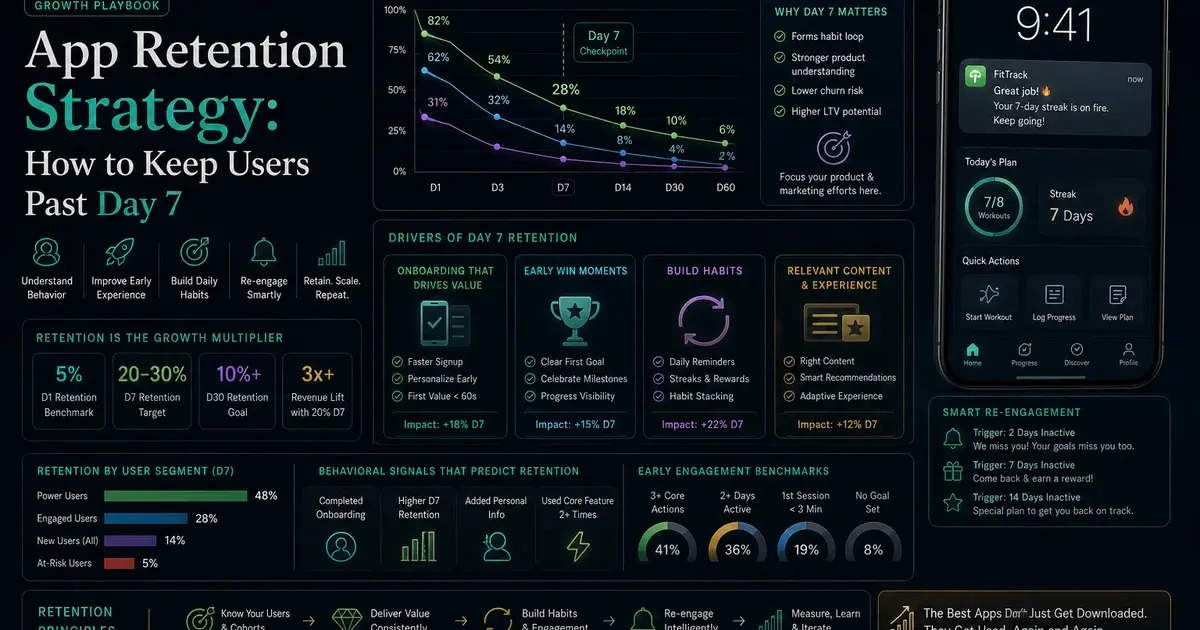
Social Media App Marketing: Cracking the Cold-Start Problem
Social apps die from empty feeds, not from low installs. The playbook for niching down, seeding content, and crossing the cold-start chasm.

On this page
- What is the cold-start problem for social apps?
- Why must social apps niche down at launch?
- How do you seed content before you have users?
- Why is creator-first acquisition the highest-leverage move?
- Which engagement loops actually compound?
- When is paid right (and wrong) for a social app?
- Frequently Asked Questions
What is the cold-start problem for social apps?
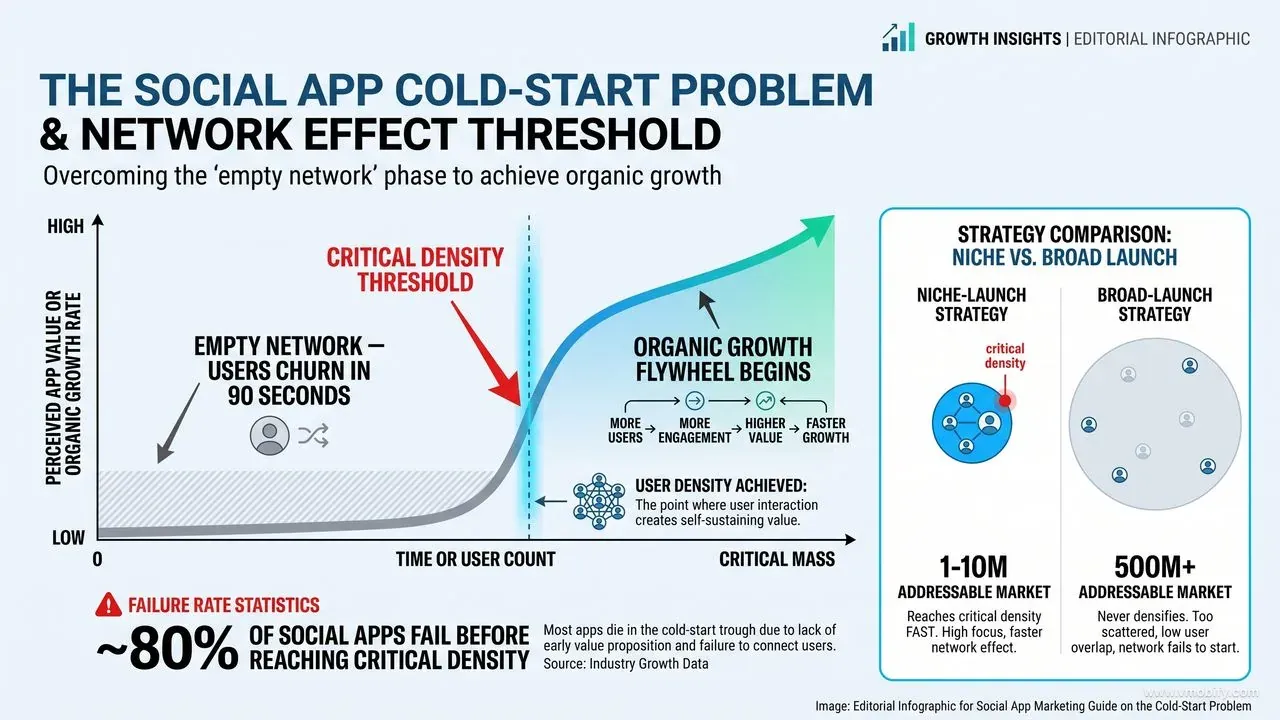
A social app's value is its other users — which means the 1,000th user has roughly 100x the value of the 1st, and the 1st user has effectively no value at all. This is the cold-start problem in its purest form: nobody wants to use an empty app, but the app cannot stop being empty without users. Every social founder has to solve this paradox before any other growth question matters.
Most failed social apps died because they reversed the order. They raised a round, hired a performance marketer, and spent on UA before solving density. Users landed in an empty experience, swiped through a dead feed, and churned inside 90 seconds. The funnel looked like a UA problem — "our CPI is too high, our retention is broken" — but the actual problem was upstream: there was nothing in the app worth retaining for. No amount of creative testing or bidding optimisation fixes an empty network.
Across the 300+ apps we have run growth for since 2013, social and community apps fail more often than any other category — and almost always for the same reason. They treat marketing as a volume problem when it is a sequencing problem. Density first, distribution second. Apple's own launch best-practice guidance and the retention benchmarks in the AppsFlyer Performance Index both make the same point in different language: social apps with sub-baseline D1 retention never recover their ranking position, regardless of how much they subsequently spend.
The 5-second test is the only metric that matters in the cold-start phase. Open the app fresh, on a new account, in your target geography. Within five seconds, does the feed feel inhabited? If the answer is no — and it almost always is, on first build — every dollar of paid UA is being poured into a leaky bucket. The work to do is not acquisition. It is density. For a related decomposition of how retention compounds, see our app retention strategy guide.
Why must social apps niche down at launch?
Every successful social network in history launched into a tight niche before generalising — Facebook started at Harvard, Instagram started as a photo-filter app, TikTok started as lip-sync videos for teens, Discord started as a voice tool for gamers. Niching down is not a tactic founders adopt because they lack ambition; it is the only mathematically sound way to manufacture density in a finite addressable market.
The arithmetic is simple. 500 active users inside a niche of 50,000 addressable people creates a 1% penetration rate — enough that members start running into each other, recognising names, building local reputation. The same 500 users distributed across a generic "social app for everyone" addressable market of 500 million is a 0.0001% penetration rate. The first feels alive. The second feels haunted. Density is perceptual, not absolute, and it is always relative to the size of the world the user thinks they are in.
The three criteria a launch niche has to satisfy:
- A coordinated meeting-place tradition. The audience already gathers somewhere — gamers on Discord, designers on Dribbble, knitters on Ravelry, climbers on Mountain Project. If your audience does not already congregate, you are not building a social app; you are building a behaviour-change campaign, which is an order of magnitude harder.
- Content and identity behaviours unmet by existing networks. There must be something the existing options refuse to host or do badly — too generic, too hostile, too algorithmically punishing. TikTok worked partly because Instagram had become a polished-lifestyle network with no room for goofy lip-sync content; the unmet behaviour was permission to be cringe.
- Addressable size of 1-10 million. Below ~1M, the ceiling is too low to justify the engineering; above ~10M, density appears too slowly and you burn your runway waiting. The sweet spot is large enough to monetise eventually but small enough to dominate quickly.
The mistake we see most often in our portfolio of community-app clients is founders who pick a niche and then immediately try to expand it in the deck. "We are launching for indie game developers — and eventually all creative professionals — and ultimately the entire global gig economy." Investors may want to hear the TAM story, but the product strategy has to ruthlessly defend the niche for the first 18-24 months. Expansion is a privilege earned after density, not a milestone scheduled into a roadmap.
One useful heuristic: if you cannot name 50 specific people in your launch niche, the niche is not narrow enough. If you can name 50 but not 500, you have probably found it. The IAMAI reports on Indian internet behaviour are a useful resource for sizing Indian-context niches at this granularity.
How do you seed content before you have users?
Social apps need feed content the moment a new user opens the app — which means the founding team has to manufacture content density before launch rather than waiting for the network to produce it organically. There are three reliable seeding strategies, and the best-executed launches use all three simultaneously.
- Founding-cohort seeding. Hand-pick and manually onboard 200-500 highly-engaged "founding users" weeks before public launch. These are not friends-and-family — they are people identified specifically because they will post within the first 24 hours of getting access, and post repeatedly thereafter. Reddit's original launch playbook (the founders posting under hundreds of fake accounts to seed the conversation themselves) is the canonical extreme version of this. Modern equivalents use real humans, but the principle is the same: a feed has to look inhabited before anyone outside the founders' circle ever sees it.
- Cross-posted scrape (where legal and ethical). For some categories, seeding feeds with content imported from public sources users will already recognise is legitimate — recipe apps importing from public recipe sites, climbing apps importing public route data, knitting apps pulling open-licence patterns. The user opens the app and sees recognisable content, which lowers the cognitive load of joining. Important caveat: every store has tightened policies here, and Apple's App Store Review Guidelines reject apps that simply scrape and republish without adding value. The scrape has to be a baseline you build on, not the entire product.
- Team-generated baseline content. The internal team posts daily, by name, with their real faces, for the first 90 days. This sets the tone, models the desired content behaviour, and gives new users people to interact with on arrival. The cost is engineering time the founders would rather spend on the product; the return is a feed that feels alive without any external user behaviour at all.
Across the community-app launches we have worked on, the apps that combined all three seeding mechanics passed the 5-second test on first open about 80% of the time. The apps that relied on team-generated content alone passed it about 30% of the time. The apps that planned to "let users seed it organically" passed it essentially never — and most of those apps were dead within nine months. For a tactical example of how this plays out in a vertical-specific cold-start, see our dating app marketing case study, where the same density-first sequencing applies.
Why is creator-first acquisition the highest-leverage move?
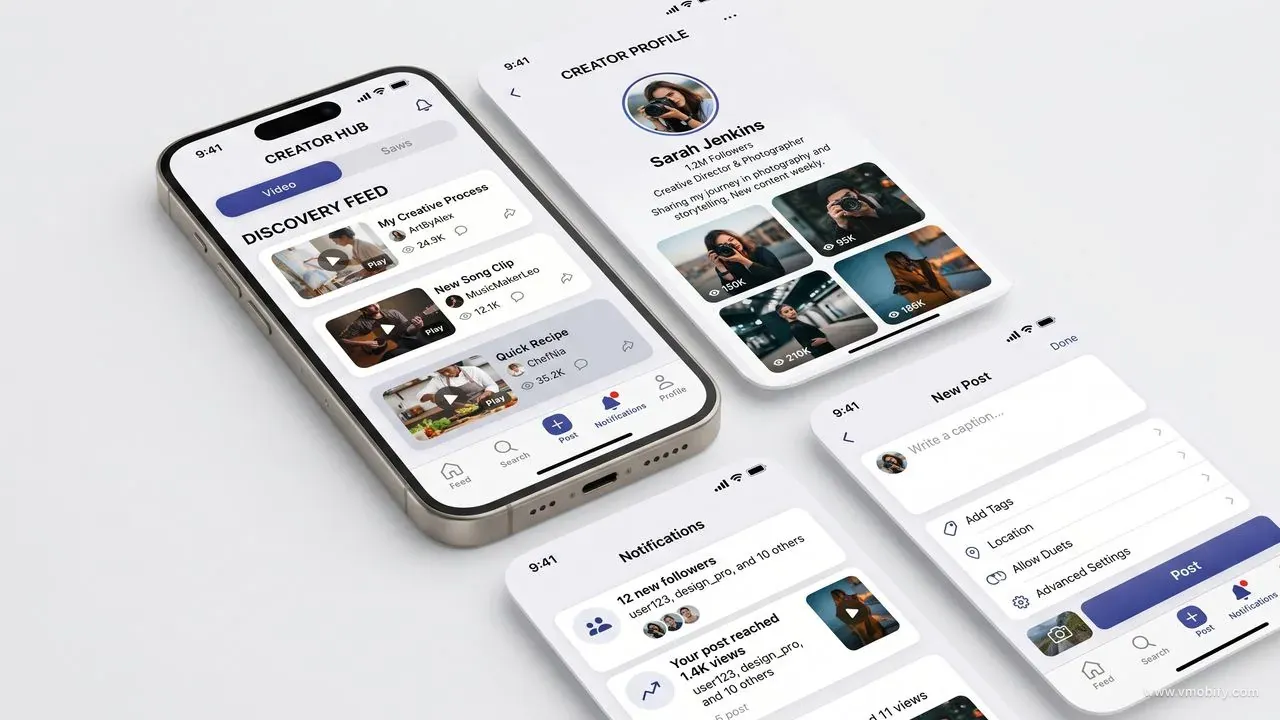
The highest-leverage user a social app can acquire is a creator — because every creator brings their existing audience, generates the content other users consume, and creates the network density everyone else depends on. One mid-tier creator with an engaged audience of 50K is often worth more to a launching social app than 50,000 cold installs from a paid campaign.
The structural reason: a typical social app has a 1-9-90 contribution ratio (1% post, 9% comment, 90% lurk). Acquire 1,000 random users and you net roughly 10 posters. Acquire 10 creators and you net 10 posters who each bring an audience of consumers. The ratio of effort-to-density is at least an order of magnitude better for creators. This is why TikTok, Substack, and Twitch all built their growth machines around creator acquisition rather than user acquisition — and why our highest-performing community-app clients across the 300+ apps in our portfolio do the same.
The four mechanics that actually work:
- Creator incentive programmes. Direct payment, equity grants, or revenue share for the first 100-500 creators. Substack guaranteed publisher advances. YouTube paid Shorts bonuses. TikTok ran the Creator Fund. The economics look painful in isolation; in context they are buying density, not content — and density is what every subsequent user is paying for.
- White-glove onboarding. Dedicated humans helping each early creator set up their profile, choose their first posts, learn the platform conventions, troubleshoot their first week. Famously unscalable, deliberately so. The point is not to scale; the point is to make the first 100 creators successful, because their public success is what convinces the next 1,000 to join.
- Audience-import tools. Make it trivial for creators to bring their existing audience from other platforms — pre-filled invite lists, cross-posting tools, "I just joined X" share cards for Instagram Stories and Twitter. Friction here is the silent killer of creator acquisition. Every additional click between "creator commits" and "creator's audience is on your app" cuts conversion meaningfully.
- Featured-creator placement. Algorithmically boost early creators to give them visibility they would never get on saturated platforms. The implicit deal: "we will make you a bigger fish in a smaller pond." For mid-tier creators throttled by Instagram's reach algorithm or YouTube's monetisation rules, this is genuinely valuable — and it costs the app nothing except a few percentage points of feed real estate.
The Indian creator market is particularly favourable for this play right now. Statista's India influencer market data shows the segment growing 25%+ year over year, with creator inventory expanding faster than brand demand — which keeps acquisition costs low and creator availability high. Regional-language creators on Instagram Reels and YouTube Shorts are dramatically underpriced relative to their audience engagement. We routinely build creator-first acquisition programmes for Indian social apps where effective cost per engaged installed user comes in under ₹50 — roughly an order of magnitude better than equivalent paid UA. For full programme structure, see our user acquisition services.
Which engagement loops actually compound?
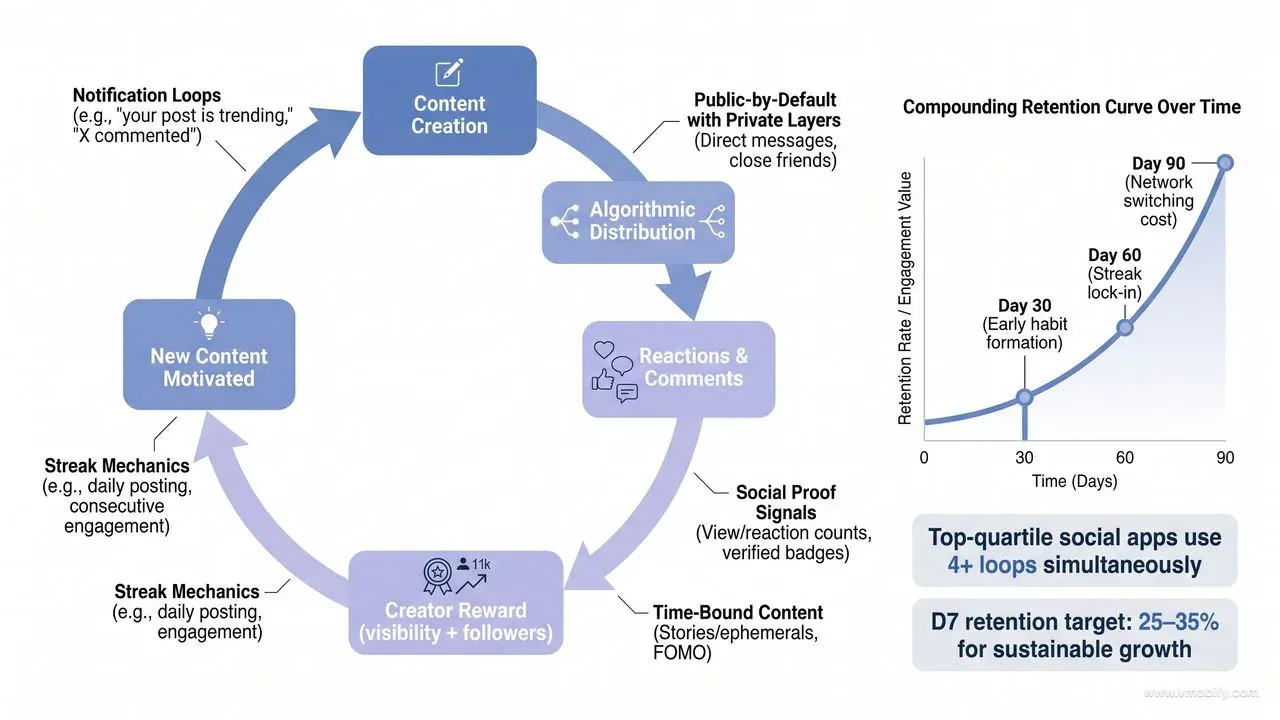
Social apps live or die by the daily engagement loops they build into the product — because retention compounds, and retention is the substrate every other growth metric grows out of. The five loops below are the ones we see consistently working across high-performing social and community apps.
- Notification loops. Comments, mentions, friend activity, "X is also here" alerts. These are the bread-and-butter return mechanic of every social product. Easy to over-do — aggressive notification spamming generates short-term DAU at the cost of long-term retention and triggers iOS's Focus filtering, which collapses the loop entirely. The discipline is to send notifications that earn the open, not just trigger it.
- Streak mechanics. Snapchat invented the modern social streak, and every social app since has borrowed some version of it. Daily-use rewards that compound over time drive habit formation in the literal neurological sense — users start checking the app reflexively to protect the streak. The risk is that streaks create brittleness; one missed day after a 200-day streak can churn the user permanently. Mature implementations include grace periods and streak-freeze items.
- Time-bound content. Stories (24-hour expiry), live audio rooms, ephemeral broadcasts. Scarcity creates FOMO; FOMO drives return visits. The mechanic also reduces the social cost of posting — content that disappears in 24 hours feels lower-stakes than permanent posts, which raises posting frequency and feeds the content side of the loop.
- Public-by-default with private layers. Public posts drive discovery and growth; DMs, group chats, and close-friends layers drive depth and switching cost. The apps that ladder users from public consumption to public posting to private group participation build the strongest retention curves, because each layer adds switching cost the user would have to rebuild elsewhere.
- Social proof signals. View counts, reaction counts, share counts, "1.2K people watched this." Visible proof that participation is rewarded is the single most reliable mechanic for converting lurkers into commenters and commenters into posters. Hide the counts (as some apps experimented with) and posting volume drops measurably within weeks.
The mistake we see most often is treating these as independent features rather than a stacked system. Streaks alone are a gimmick; notifications alone are a nuisance; social proof alone is vanity. Stacked together, with each loop reinforcing the others, they produce the compounding daily-use behaviour that defines a working social network. Adjust's mobile app trends research consistently shows that apps in the top retention quartile of the social category use four or more of these mechanics in combination; apps in the bottom quartile typically rely on one or two.
When is paid right (and wrong) for a social app?
Social apps must be primarily organic in the cold-start phase — paid scaling without proven density burns money and accelerates churn — but paid becomes a powerful accelerant at specific later moments once the network is alive. The trick is knowing which moment you are in.
Paid is wrong for:
- Initial launch. Spending into an empty network produces 90-second churn and trains the store algorithms to suppress your discoverability. Both Apple's Search Ads and Google's App Campaigns optimise on post-install events, and an empty network produces no post-install events worth optimising on. The algorithm cannot find good users for an experience that does not work yet.
- Attempts to substitute for missing density. No paid budget large enough to compensate for an empty feed exists. We have watched founders burn ₹2 crore trying to outspend a cold-start problem; the only thing that has ever solved it is solving it.
- Broad-targeting brand campaigns. Brand awareness for a social app the audience cannot yet usefully join is wasted impressions. Brand spend works when the product has reached a point where curious users converting to engaged users is the dominant funnel constraint — usually 12-24 months in, not at launch.
Paid is right for:
- Reaching a new niche or geography after density is proven in the first one. Once you have density in Niche A, paid is how you efficiently acquire the seed cohort for Niche B. The playbook from niche one tells you exactly what creator-first, founding-cohort acquisition looks like in niche two.
- Defending against competitor launches. When a well-funded rival enters your category, defensive paid spend buys time for your organic loops to compound past their early growth curve. Discord vs Guilded is the canonical example; Discord's paid spend at the right moment protected the network from being fragmented.
- Scaling once organic loops are working. When D7 retention clears category baseline and your existing users' invite rate is steady, paid pours fuel on a working fire. Before those two conditions, paid is fuel on wet wood.
The channel mix when paid becomes right — roughly:
For deeper channel-by-channel structure see our Meta App Install Campaigns playbook and fastest way to get app installs guide.
Optimise on retention events, never installs. "First post," "first DM," "10 connections," "second-week return" — these are the events that signal a user has actually entered the network rather than just downloaded the app. Optimising paid bids on installs alone produces cheap installs that never engage; optimising on retention events produces fewer installs at higher upfront CPI but materially better cohort economics. This is the single highest-leverage configuration choice in social-app paid UA, and the one most teams skip because it requires a working event taxonomy and 30+ conversions per event before the algorithms can learn.
Talk to our team if you are launching or scaling a social or community app — we run cold-start density programmes and creator-first acquisition pods across the Indian and global markets, and most of our highest-performing community-app clients reached scale on this exact sequencing. For broader category benchmarks, see our case studies.
Frequently Asked Questions
Why do most new social apps fail?+
They acquire users before solving content density. Empty feeds churn first-time users in seconds, no matter how much was spent on the install. The order has to be density first, distribution second — reversing it is the single most common reason social apps die.
Should I launch closed beta or open?+
Almost always closed or invite-only for a social app launch. Closed launches let you control density, identify your founding cohort, build a scarcity narrative, and prevent the catastrophic first impression of an empty app reaching public review at scale.
How small a niche is too small?+
Below ~500K addressable users is typically too small to ever reach meaningful scale or monetisation. Above ~10M, density appears too slowly and you burn runway waiting. The sweet spot for a launch niche is 1-10M addressable, with a coordinated meeting-place tradition you can credibly serve better than existing options.
Do influencers work for social app marketing?+
Creator partnerships work dramatically better than transactional influencer marketing. The goal is to bring creators onto the platform as creators — with payment, white-glove onboarding, and featured placement — not to pay them to read a script in an ad. The first model compounds; the second does not.
How long does it take to cross the cold start?+
Usually 6-18 months of focused niche execution to reach the density where retention compounds without external intervention. Trying to grow faster typically causes churn that resets the curve and burns runway on traffic that does not stick.
When should a social app start spending on paid UA?+
When D7 retention clears category baseline in the AppsFlyer or Adjust benchmarks for your category, and when organic invite rate per user has been stable or rising for 60+ days. Before both conditions are met, paid is almost always net-negative. After both are met, paid scales the working machine you have already built.
What conversion event should social-app paid campaigns optimise on?+
Retention events, never installs. "First post," "first DM," "second-week return," or "10 connections" are the right targets. Optimising on installs alone produces cheap downloads that never engage. The trade-off is higher upfront CPI in exchange for materially better long-run cohort economics.
Sources
- AppsFlyer Performance Index — Retention benchmarks by vertical — used to size whether social-app D1/D7 retention clears category baseline before scaling paid
- Apple App Store Review Guidelines — Policy reference for scraped-content seeding and minimum-viable-value requirements
- Google Play — Launch Best Practices — Install velocity and retention as ranking signals for social-category apps
- Statista — India Influencer Marketing Market Size — 25%+ YoY growth in Indian creator economy — favourable for creator-first acquisition
- Adjust — Mobile App Trends — Engagement-loop research across social-category apps in top vs bottom retention quartiles
- Apple Search Ads — Post-install event optimisation requirements for social-app paid campaigns
- Google Ads — App Campaigns Help — UAC retention-event optimisation configuration for social apps
- IAMAI Reports — Indian internet behaviour and audience sizing data for niche addressable-market estimation
About the author
Amol Pomane — Founder, Vmobify
Amol leads Vmobify, a mobile app growth agency that has driven 30M+ downloads and ranked 54K+ keywords across 300+ apps since 2013. He writes about ASO, paid user acquisition, retention, and the operational reality of scaling mobile apps in India and global markets.
Model an install budget
Turn CPI and activation assumptions into acquisition scenarios.
Open free tool