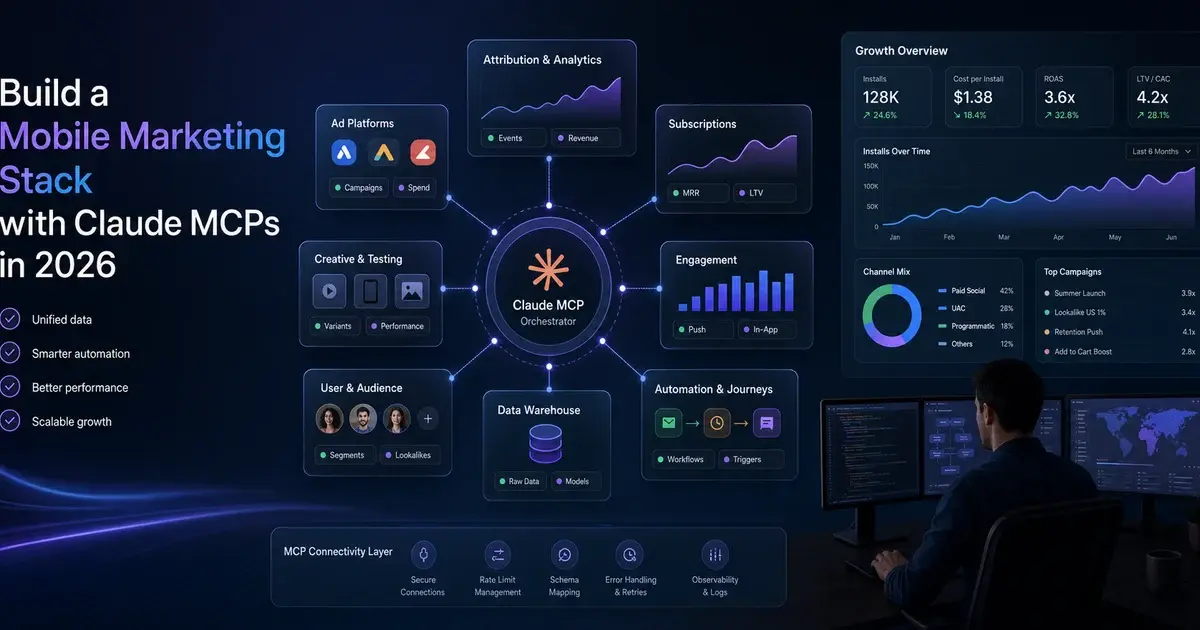
Build a Mobile Marketing Stack with Claude MCPs in 2026
The fragmentation tax that defined mobile marketing for a decade is finally getting refunded. This guide walks through every layer of the MCP-connected stack — attribution, analytics, subscriptions, engagement, and ads — with real install commands, real prompts, and honest limits every operator must know.
On this page
- Why did the MCP moment hit mobile marketing first?
- How do you set up the MMP layer?
- How do product analytics MCPs work?
- What does the RevenueCat subscription MCP unlock?
- How do you wire up the engagement layer?
- Which ad platform MCPs matter most?
- What does a real growth team week look like?
- What are the limits every operator must own?
- Frequently Asked Questions
Why did the MCP moment hit mobile marketing first?
Mobile marketing hit the MCP moment first because it has always had the most fragmented data problem of any digital discipline — and fragmentation is exactly the problem MCP was designed to solve. For a decade, every "AI for marketing" pitch died on the same rock: integration. You could build the most capable model in the world, but if it could not talk to AppsFlyer, Mixpanel, Braze, Meta, and TikTok simultaneously — without a six-month custom API project — you were just another dashboard. A dashboard is not a teammate.
The Model Context Protocol changes the unit economics of that integration problem. AdExchanger calls it "the universal adapter for AI in advertising" — a standardisation of how AI agents discover and consume tool capabilities, the same way REST APIs standardised how developers consumed SaaS in the 2010s. The key difference: the consumer of the API is now an LLM, not a developer. An LLM needs the tool to announce itself well — to surface capability, expected inputs, and semantic meaning. The MCPs that do this well are the ones growth teams actually adopt.
Eric Seufert, writing in Mobile Dev Memo, argues we are hitting the boundary where consumer commerce stops being mediated by app-store funnels and starts being mediated by agents talking to other agents. MCP is the lingua franca that makes that conversation legible. For mobile marketers specifically, the payoff is the compression of context-switching: the hours that used to disappear opening AppsFlyer, choosing a date range, exporting a CSV, reconciling against Mixpanel, pasting into a slide, and double-checking the ROAS definition someone in finance once disagreed about. Square's Sara San Antonio put it plainly in AppsFlyer's launch post: "What used to take hours to pull manually now takes under 2 minutes." That is not compression of compute. It is compression of context-switching.
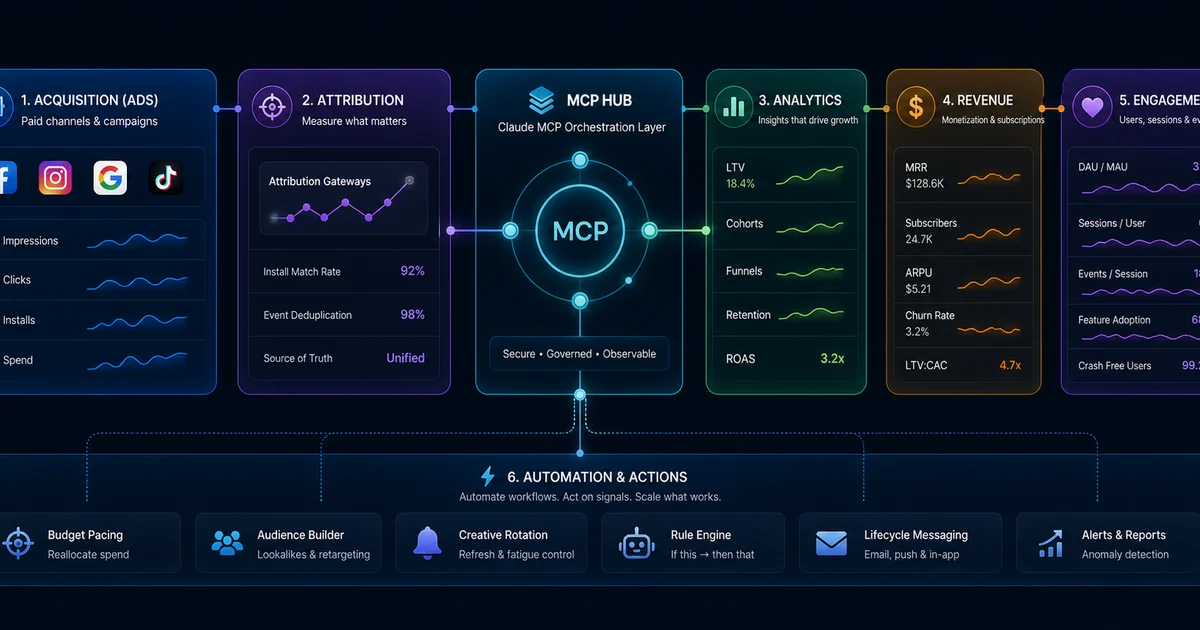
In our portfolio across 300+ apps managed since 2013, we have seen the same dynamic play out across every layer of the stack in the last twelve months. The sections below are a tour through the mobile marketing stack — layer by layer — with real install commands, real prompts, and honest gaps.
How do you set up the MMP layer?
The MMP layer is where every retro and every QBR starts, because attribution is the prerequisite for every downstream decision — if you cannot agree on whether a campaign worked, nothing else matters. Three vendors have meaningful MCP surface in 2026: AppsFlyer, Singular, and Kochava. Pick one, wire it deeply, and resist the temptation to A/B test attribution tools in the agent layer.
AppsFlyer MCP (Beta)
The official AppsFlyer MCP is in beta and supports Claude Pro, Max, Team, and Enterprise tiers via OAuth. Install is straightforward:
# AppsFlyer MCP (beta, OAuth)
claude mcp add appsflyer --transport sse https://mcp.appsflyer.com/sse
# then complete auth in browser
There is also a community wrapper — ysntony/appsflyer-mcp is the most-starred alternative — and the official @appsflyer/sdk-mcp-server npm package for teams that prefer self-hosting. The hosted beta is sufficient for most growth teams; the npm version is worth running on a dev box if your security team requires data residency control.
The highest-leverage configuration step is not the install — it is the CLAUDE.md file you place in the project root before your first query. This file teaches Claude the business definition of your core metrics. Without it, Claude uses its general-internet understanding of ROAS, and you will eventually paste a confident, wrong number into a CFO slide. We have seen this happen. Twice. The definition block looks like this:
# ROAS definition for [App]

- Numerator: net revenue (gross minus refunds and store fees, 30-day window)
- Denominator: paid media spend in the same UTC week
- D7 cohort, not D1
- Include subscription renewals only if the original install is in-cohort
- Exclude organic uplift even if attributed via probabilisticFive sentences of opinionated definition turns Claude from "smart intern with internet access" into "team member who knows what we mean." This applies to every MCP in the stack — not just AppsFlyer.
Singular MCP
Singular's MCP launched explicitly as a Claude integration, and the connector ships through Improvado — an ETL vendor with deep marketing-data schema knowledge. If you are cross-funded across SKAdNetwork and CAPI deterministic measurement, Singular's cost-aggregation and creative-level reporting are best-in-class. The MCP simply lets Claude reason over them in natural language rather than requiring a custom GAQL script for every question.
Kochava StationOne
Kochava's StationOne positions itself as an AI hub more than a single MCP, with custom connectors that sit alongside the measurement stack. If you are already a Kochava shop, it is the right starting point — the product direction is clearly toward agentic workflows, and their API surface is comprehensive for teams already in the ecosystem. Our production experience here is thinner than with AppsFlyer or Singular, so we cannot give you the same depth of hands-on guidance.
How do product analytics MCPs work?
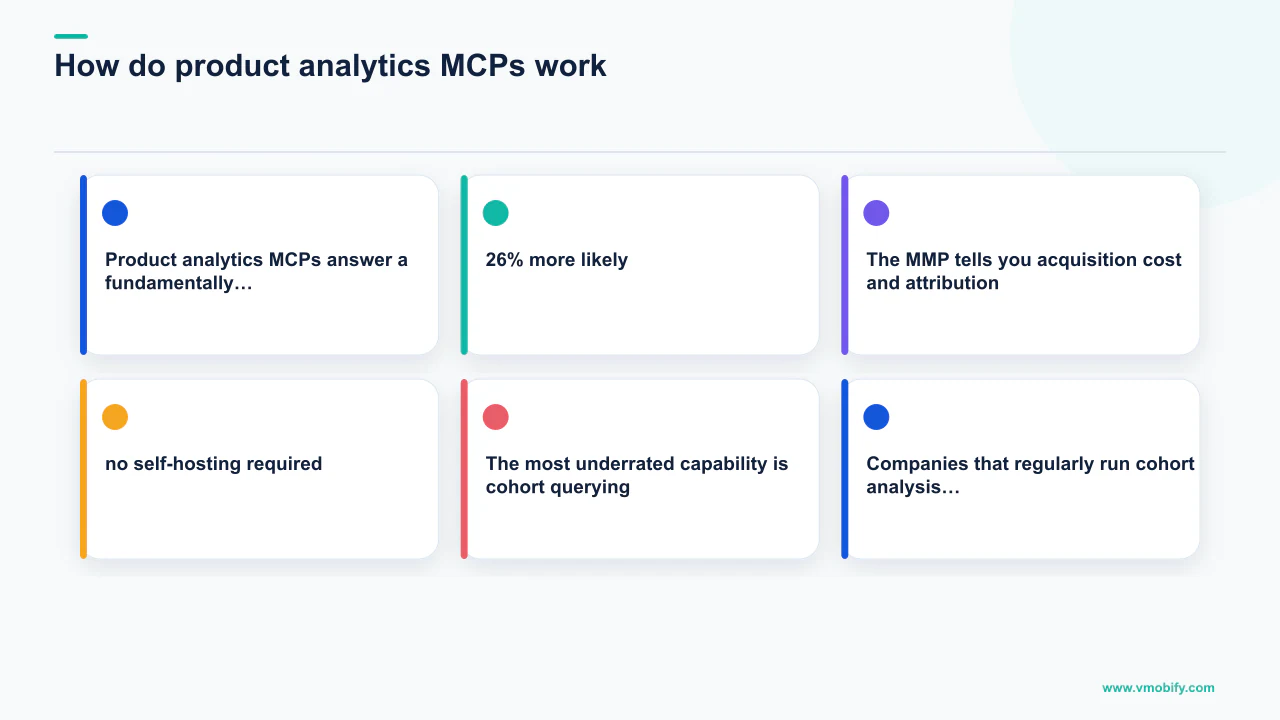
Product analytics MCPs answer a fundamentally different question than MMPs: not whether the campaign worked, but whether the app worked — and whether the users a campaign delivered actually engaged with the product. The MMP tells you acquisition cost and attribution; product analytics tells you what happened next.
Mixpanel MCP
The official Mixpanel MCP is hosted at mcp.mixpanel.com/mcp — no self-hosting required:
claude mcp add mixpanel --transport sse https://mcp.mixpanel.com/mcpThe most underrated capability is cohort querying. Companies that regularly run cohort analysis are 26% more likely to see activation-metric improvement — and cohort questions that previously required a half-day analyst project now resolve in a single prompt. A prompt like "Pull the D7 retention curve for users who installed during the Hour of Code week and compare to school-programme installs from the same month. Flag any significance differences greater than 5 percentage points" returns a side-by-side with confidence intervals — and Claude will surface unprompted observations about the shape of the retention tail, not just the headline numbers. In our portfolio we have seen this kind of unsolicited secondary finding unlock product hypotheses the team would not have generated on their own.
Amplitude MCP
The official Amplitude MCP covers more surface than Mixpanel's: core analytics, product insights, session replay, AI agent analytics, instrumentation status, and weekly briefings. The instrumentation-status tool alone justifies the install for apps with a sprawling event taxonomy — asking Claude "which events haven't fired in the last 14 days and are referenced in my retention dashboards?" catches silent regressions before they become quarterly fire drills. We reach for Amplitude for cross-platform questions (web + mobile) and Mixpanel for pure mobile depth.
GA4 and Firebase MCPs
The official googleanalytics/google-analytics-mcp is solid for basic GA4 reporting, though community forks have done sharper work — including anomaly detection via leave-one-out Z-score and traffic-drop classification. The Firebase Crashlytics MCP is the one most worth calling out specifically: triaging crashes used to mean opening Crashlytics, sorting by user impact, copying stack traces into Slack, and pinging platform leads. Now a single prompt — "Show me the top 5 net-new crashes in the iOS build released Tuesday, correlated with retention drop in Amplitude, grouped by device model" — crosses two MCPs in one query. The correlation across Crashlytics and Amplitude quietly stops being magical and starts being expected once you run it a few times.
What does the RevenueCat subscription MCP unlock?
If you sell a subscription app, the RevenueCat MCP is non-negotiable — it closes the loop between "what did this campaign cost" and "what did the cohort actually pay over 90 days," using the only revenue data source that is actually correct. App Store and Play Store revenue dashboards lag, aggregate, and occasionally lie. RevenueCat's webhook-driven events are the real subscription state of your business.
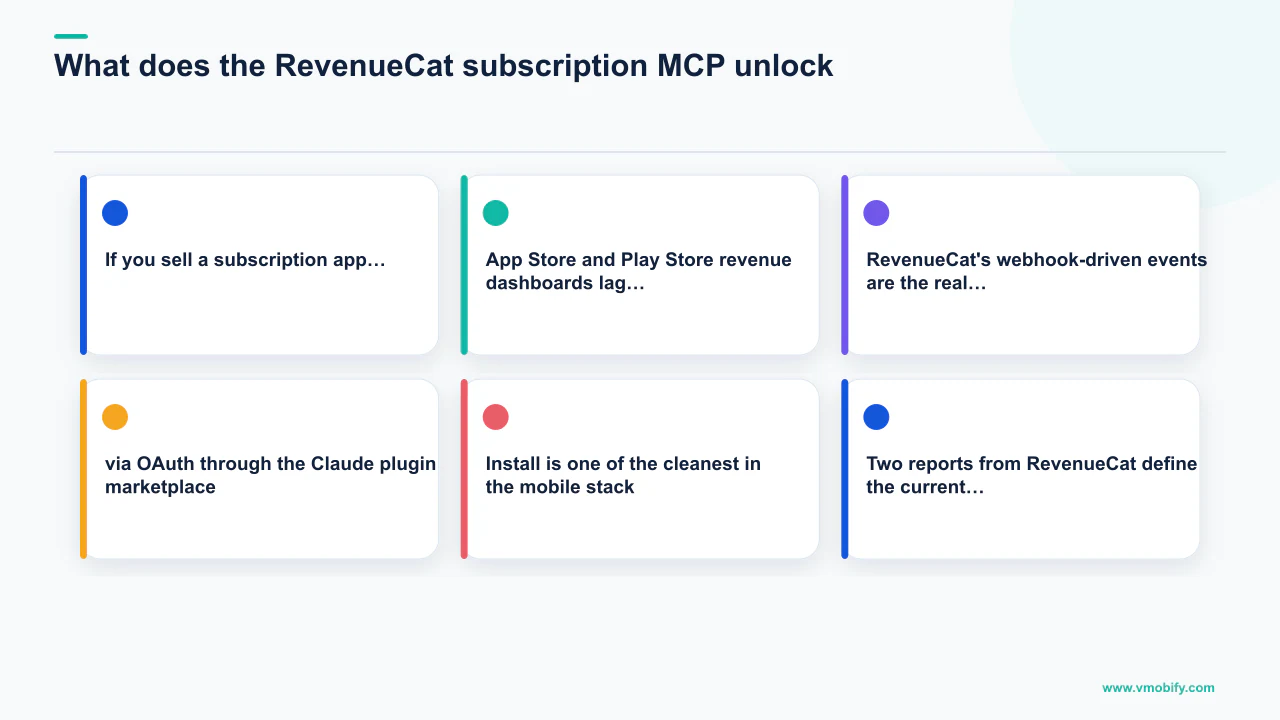
The official RevenueCat MCP ships 26 tools and 21 chart types — MRR, ARR, churn, trial conversions, retention cohorts — via OAuth through the Claude plugin marketplace. Install is one of the cleanest in the mobile stack:
# RevenueCat — install via the Claude plugin marketplace
# or:
claude mcp add revenuecat --oauth
Two reports from RevenueCat define the current context for subscription marketers. The first is the State of Subscription Apps 2026 — the annual benchmark every monetisation team references at planning time. The second is RevenueCat's research on what they call the AI app revenue paradox:
AI apps generate 41% more revenue per user — but churn ~36% faster — than non-AI apps.
This is not primarily a model problem. It is a marketing problem. AI apps get users to try harder in the first session (because the demo is compelling) and give up harder when the initial experience wears off. The RevenueCat MCP wired into your weekly retro lets you monitor this dynamic in real time: segmenting trial conversion by acquisition channel, cohort week, and feature-adoption events to identify whether the churn gap is a creative problem, an onboarding problem, or a product-market-fit problem. Without the MCP, that analysis is a quarterly exercise. With it, it is a Monday morning prompt.
For subscription analytics specifically, the combination of RevenueCat MCP + AppsFlyer MCP in a single Claude session is the most important stack pairing in mobile marketing right now. You can ask "which acquisition channels from last month have the highest 60-day LTV cohort, net of refunds and store fees, on a D7 cohort basis" and get a ranked answer in under two minutes. That question used to take two engineers, a spreadsheet, and a Thursday afternoon.
How do you wire up the engagement layer?
The engagement layer is the most operationally dense part of the mobile stack and, ironically, the one with the most uneven MCP coverage in 2026 — which means operator choices here require more careful evaluation than in the attribution or analytics layers. The MMP tells you who showed up; analytics tells you what they did; subscriptions tell you what they paid; engagement is how you bring them back.
Braze MCP
The official Braze MCP exposes 38 API functions across 15 categories, read-only by default. That read-only default is exactly right — not a limitation, but a considered security posture. You do not want a Claude session "helpfully" launching a 4-million-user push notification because it misinterpreted "test the campaign." The install command:
claude mcp add braze --transport sse https://rest.<your-instance>.braze.com/mcpThe first workflow worth running: ask Claude to pull the open-rate distribution of the last 12 lifecycle campaigns, segment by user tenure, and write a paragraph summary suitable for a lifecycle retro deck. In our experience, that workflow goes from 90 minutes (pulling, exporting, charting, writing) to 14 seconds. You have to run it once to really believe the delta.
Klaviyo
For commerce email and SMS, Klaviyo went directly to Anthropic: a published post on agentic marketing workflows with Klaviyo and Anthropic Claude documents the joint workflows. The integration is more workflow-template-heavy than pure MCP-server-heavy, but the practical effect for an operator is the same: natural-language access to your audience, your flows, and your analytics without leaving the Claude session.
OneSignal MCP
For push, a community-built OneSignal MCP server covers push, email, SMS, devices, segments, and templates. The coverage is functional, though less polished than the native vendor MCPs. OneSignal's own published thinking on AI-powered mobile messaging is a useful read for thinking about where the push category is heading.
The honest gaps
CleverTap, Iterable, and Customer.io do not have native Claude MCPs as of writing. If you are on one of those platforms, your options are: build a community MCP yourself against their published API (not hard, takes a focused weekend), wait for an official one (timeline unknown), or use a generic API wrapper and accept rough edges. In our portfolio we have seen teams on CleverTap and Iterable bridge the gap with well-structured CLAUDE.md files that document their engagement platform's API endpoints as tool descriptions — an imperfect solution, but a workable one while the ecosystem catches up. The MCP coverage in mobile engagement is uneven. Pretending otherwise is how you get burned.
Which ad platform MCPs matter most?
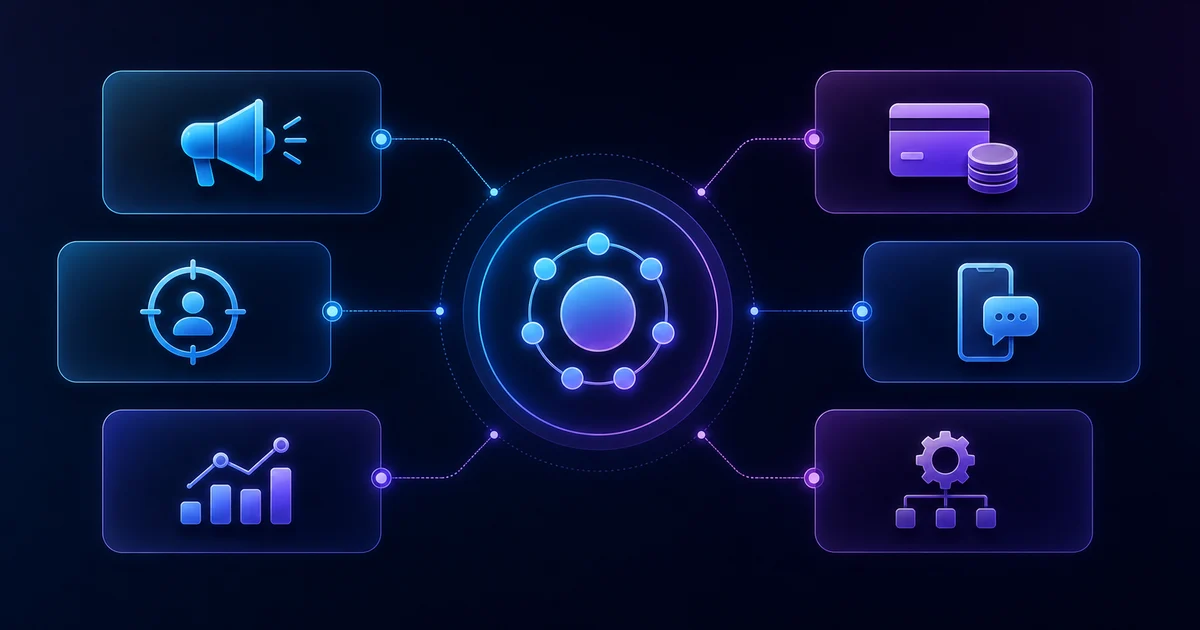
Ad platform MCPs are where the productivity dividend is most aggressive — and where the safety considerations are sharpest, because mistakes cost real money in real time. The four platforms that matter for mobile user acquisition in 2026 are Meta, Google, TikTok, and Apple Search Ads.
Meta Ads MCP
The official Meta Ads MCP at mcp.facebook.com/ads ships with 29 tools: campaigns, ad sets, audiences, creatives, catalogues, diagnostics. Critically, new campaigns, ad sets, and ads default to paused — they must be activated manually. This is the correct default. Install:
claude mcp add meta-ads --transport sse https://mcp.facebook.com/adsThe numbers operators are publishing are significant. One case study documents 90% operational time reduction and a +15% ROAS improvement after wiring the Meta Ads MCP into a weekly creative rotation workflow. Another describes generating 50+ systematic creative variants in 4 hours versus 8–12 a week manually. Adjust for survivorship bias — these are the case studies vendors want you to see — but the directional truth holds in our experience. The most important pairing is Meta Ads MCP + Adobe MCP for a closed-loop creative iteration workflow: pull the top 3 ad sets where CPI rose more than 20% versus last week, generate 4 creative variants in Photoshop using the existing hero asset, push as draft (paused) creatives to the corresponding ad sets. Twelve new creatives, paused, ready for human approval. That used to be a designer's week.
Google Ads MCP
The official Google Ads MCP wraps the deepest API surface of any ad platform, which means it has the most to gain from natural-language querying. Asking "which keywords in the branded campaign saw CTR drop greater than 20% week-over-week and have impression share above 80%?" used to require a custom GAQL script. It is now a prompt. For Google UAC versus Meta versus CPI network comparisons, the ability to pull both platform views in the same Claude session — with the same metric definitions applied — is the end of the reconciliation spreadsheet.
TikTok Ads MCP
TikTok's official MCP server, announced at TikTok World, is the most aggressive vendor positioning in the space — the framing is literally "let AI agents run campaigns." There is also a managed alternative at adsmcp.com and a community TikTok Ads MCP server for teams that want full query control. For mobile UA teams that are TikTok-heavy, this is the most important new integration of the last six months: creative fatigue on TikTok is faster than any other platform, and an agent that can surface fatiguing ad sets and draft replacement briefs in the same session dramatically changes the cadence of creative operations.
Apple Search Ads
Apple Search Ads is the channel we most want Claude on, because it is the channel where SKAdNetwork limitations bite hardest and the cognitively expensive part of the job — synthesising fragmented signal into a decision — is exactly where LLMs are strong. Several managed and open-source MCP options exist; we currently use the open-source ppcprophet/apple-ads-mcp for keyword-level deep analysis where full query control matters. For a full comparison of attribution platforms across these channels, see our AppsFlyer vs Adjust vs Singular guide.
What does a real growth team week look like?
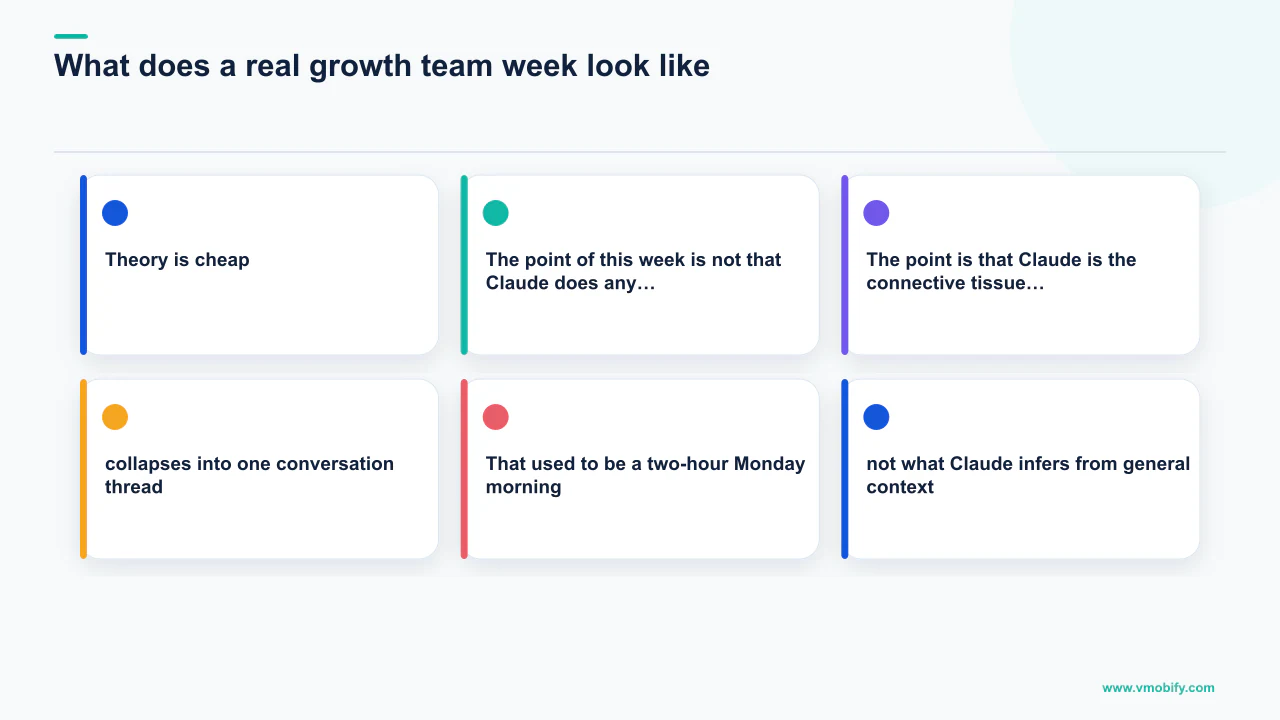
Theory is cheap — here is what an actual week looks like when AppsFlyer, Mixpanel, RevenueCat, Braze, Meta Ads, TikTok Ads, and the reporting layer are all alive in one Claude session. The point of this week is not that Claude does any single job especially well. The point is that Claude is the connective tissue across all of them. The fragmentation that defined mobile marketing for a decade — different tools, different exports, different reconciliation overhead — collapses into one conversation thread.
Monday: weekly read
Pull last week's spend, installs, CPI, D7 retention, and net revenue
by paid channel from AppsFlyer. Compare to the prior 4-week trailing
average. Flag any deltas >15% in either direction. Summarise in 5 bullets.
That used to be a two-hour Monday morning. It is now a coffee. The discipline is in the CLAUDE.md definition file that ensures "net revenue" and "D7 retention" mean exactly what the business agreed they mean — not what Claude infers from general context.
Tuesday: cohort deep-dive on Friday's release
In Mixpanel, build a D7 retention cohort for users who installed
between Friday 5pm and Sunday 11pm last weekend, and compare against
the same cohort window the prior 4 weekends. Surface any feature
adoption differences in the new home screen redesign events.
By lunch, the team knows whether the redesign worked. Not "the LTV looks promising." Whether it worked. In our portfolio we have seen this kind of same-week cohort discipline catch onboarding regressions that would otherwise have gone unnoticed until a monthly review.
Wednesday: creative rotation
For the top 3 Meta ad sets where CPI rose >20% vs last week,
generate 4 creative variants each using the existing hero asset,
varying colour and CTA placement. Push as draft (paused) creatives
to the corresponding ad sets.
This is the prompt that turns the Adobe + Meta MCPs into a closed loop. Twelve new creatives, paused, ready for human approval before any spend is activated. The pause-by-default is load-bearing: Wednesday creative rotation should never auto-activate without a human review step.
Thursday: lapsed-user reactivation
In Braze, find the segment of users who installed 8-14 days ago,
completed onboarding, but have not opened the app in the last 5 days.
Cross-reference with RevenueCat to exclude active subscribers.
Draft push notification copy for review.
Read-only by default means the push does not go out. The operator reads the copy, approves it or revises it, and then activates through the normal Braze workflow. The agent's value here is the segmentation and copy drafting — not the send decision.
Friday: weekly growth report
Generate the weekly growth report as a PPTX. Use the standard template.
Include: spend by channel, CPI trend, D7 retention cohort, top 3 creative
winners and losers, lifecycle campaign performance, RevenueCat MRR delta.
Save to the shared drive.
Done by 4pm Friday. The deck is populated from AppsFlyer + Mixpanel + RevenueCat queries in the same session. It is not a beautiful deck. It is the deck that would have been made on Sunday night, except it is made on Friday afternoon — and the person who used to make it is now free to do something the stack cannot do: make a judgement call. See our results portfolio for what this operational cadence produces at scale, and reach out if you want to run this stack for your app.
What are the limits every operator must own?
An MCP-connected mobile marketing stack is a genuine productivity multiplier, but there are four constraints that do not disappear because the agent is smarter — and operators who ignore them will eventually publish a confident, wrong number to someone who matters. These are the limits we put in front of every leadership conversation about this stack.
SKAdNetwork has not gone away
The 24-hour-plus postback lag, the 64-bucket cap, the 6-bit conversion-value encoding, the absence of granular user-level attribution for non-consenters — none of these constraints are solved by connecting AppsFlyer to Claude. ATT opt-in is still hovering somewhere in the 15–20% range industry-wide per Adjust's Mobile App Trends data. That means for 80–85% of your iOS install base, Claude is working from probabilistic and aggregate signals, not deterministic event-level attribution. Pretending otherwise is how you publish a confident, wrong ROAS number. The MMP comparison guide covers how each vendor handles SKAN signal differently — that nuance matters when Claude is reasoning over the data.
Hallucinated metrics are a real failure mode
This is the failure mode we are most aggressive about gating against. Improvado's documentation on Claude marketing skills is direct: "Relying on them for revenue reporting often led to hallucinations where AI might confidently report a 4x ROAS that simply didn't exist." The three causes we see in the field are fabricated metrics, bad inputs, and — most insidious — wrong metric definitions. The wrong-definition failure is where most incidents originate. The model is not lying. It is using its general-internet understanding of "ROAS" when your company means something specific. The CLAUDE.md ROAS definition block in the MMP layer section is the primary defence against this failure mode. A semantic layer between the raw API and the agent — whether that is a CLAUDE.md file, a stored prompt template, or a Funnel-style ETL with business-logic baked in — is not optional. Skip it and you will eventually paste a hallucinated LTV number into a board slide.
Read-only defaults are features, not limitations
Braze defaults to read-only. Mixpanel defaults to read-only. RevenueCat defaults to read-only. Meta defaults new campaigns to paused. Every serious vendor in this space has made the same call, and they are right. Do not elevate to write scope until the workflow is mature enough that you trust the prompts completely. Even then, gate the high-blast-radius actions — pushing notifications to more than 100,000 users, activating ad sets above a daily spend threshold, publishing store listing changes — behind explicit human approval steps. In our portfolio across the apps we manage, the teams that have had the worst MCP-related incidents are the ones that elevated write scope too early and found out that "draft and review" was more important than it looked during the setup phase.
Regulatory changes will shift what the stack can see
The EU's Digital Markets Act proceedings are live, with decisions expected in mid-2026. Sensor Tower's State of Mobile tracks the macro picture, but the regulatory layer is moving faster than any annual report can capture. The data your Claude sessions can reason over may be materially different in three months, depending on jurisdiction. Build your CLAUDE.md definitions and metric grounding to be portable — so that when the signal landscape shifts, you are updating definitions rather than rebuilding workflows from scratch. See our Meta app install campaigns guide for how privacy-safe measurement affects campaign optimisation specifically.
Frequently Asked Questions
Do I need a paid Claude plan to use mobile marketing MCPs?+
Most official MCPs — AppsFlyer, RevenueCat, Braze, and Meta Ads — require Claude Pro, Max, Team, or Enterprise. The free plan does not support MCP connections. For growth teams, Team or Enterprise tier is the practical entry point because it includes the shared context and memory features that make week-over-week workflows viable.
Is it safe to connect my live ad accounts to Claude via MCP?+
Yes, provided you respect the read-only defaults every serious vendor has shipped. Meta Ads defaults new campaigns to paused; Braze defaults to read-only; Mixpanel defaults to read-only. Do not elevate to write scope until the workflow is mature and tested. For high-blast-radius actions — sending notifications to large segments or activating ad sets above a daily spend threshold — always retain a human approval step.
What is the CLAUDE.md file and why does it matter?+
A CLAUDE.md file is a plain-text document in your project root that teaches Claude the business definitions specific to your app — how your team defines ROAS, which revenue figures are net of store fees, what your D7 cohort window covers. Without it, Claude uses general-internet definitions of marketing metrics and will eventually produce confident, wrong numbers. It is the single highest-leverage configuration step in the entire stack, and it takes about 15 minutes to write properly.
Which MCP should I set up first?+
Start with your MMP — whichever of AppsFlyer, Singular, or Kochava you already use for attribution. Attribution is the prerequisite for every downstream decision. Once you have the MMP wired and your CLAUDE.md metric definitions in place, add your product analytics MCP (Mixpanel or Amplitude) as the second layer. RevenueCat is the third priority for subscription apps.
Does MCP solve the SKAdNetwork attribution problem?+
No. SKAdNetwork's postback lag, 64-bucket cap, and absence of user-level attribution for non-consenting iOS users are platform constraints that no agent layer can circumvent. Claude reasons over the probabilistic and aggregate signals your MMP exposes — which is still genuinely useful — but for 80–85% of your iOS install base, deterministic event-level attribution is not available regardless of which tools you connect.
How does Vmobify use MCP-connected stacks for client apps?+
Across our 300+ apps managed since 2013, we wire MCP-connected Claude sessions into weekly growth reporting, creative rotation workflows, cohort deep-dives, and lapsed-user segmentation. The stack lets us operate across more apps with tighter analytical discipline than was possible with purely manual workflows. Our analytics and UA services both incorporate MCP-connected reporting as standard — see /services/analytics and /services/user-acquisition for details, or contact us at /contact to discuss your specific stack.
What is the biggest mistake teams make when setting up a mobile MCP stack?+
Skipping the semantic grounding layer. Teams that install five MCPs, fire off prompts, and start pasting results into decks without establishing shared metric definitions in a CLAUDE.md file will eventually generate a hallucinated ROAS or LTV that goes undetected until it lands in a board slide. The order of operations matters: define your metrics first, wire the tools second, run the workflows third.
Sources
- AppsFlyer MCP — AI-Powered Workflows — AppsFlyer's official MCP launch with Square case study
- AppsFlyer Performance Index — CPI benchmarks by channel and category for mobile UA planning
- Adjust Mobile App Trends — Annual attribution and retention benchmarks
- Singular Cost Aggregation — Singular MCP integration with Claude for unified mobile attribution
- RevenueCat State of Subscription Apps 2026 — Annual benchmarks on subscription app revenue, churn, and trial conversion
- Meta Advantage+ App Campaigns — Meta's AI-driven app install campaign format
- TikTok for Business App Installs — TikTok's app install campaign documentation
- Sensor Tower — State of Mobile — Annual mobile app market benchmarks and category data
About the author
Amol Pomane — Founder, Vmobify
Amol leads Vmobify, a mobile app growth agency that has driven 30M+ downloads and ranked 54K+ keywords across 300+ apps since 2013. He writes about ASO, paid user acquisition, retention, and the operational reality of scaling mobile apps in India and global markets.
Model an install budget
Turn CPI and activation assumptions into acquisition scenarios.
Open free tool