How to Increase In-App Purchases: 11 Tactics With Benchmarks
Most IAP revenue comes from a tiny share of users, and most teams chase that revenue with generic offers shown at the wrong moment. Here are eleven tactics — starter packs, contextual triggers, spender-tier segmentation, friction cuts and India-specific microtransactions — that actually move in-app purchase revenue, with the benchmarks to aim for.
On this page
- Why does most IAP revenue come from a small share of users?
- How do you solve the first-purchase problem?
- Why do contextual, need-based offers convert so much better?
- When does in-app purchase conversion actually peak?
- How should you segment minnows, dolphins and whales?
- How do pricing and anchoring increase IAP revenue?
- How should you merchandise the store and your offers?
- How do you reduce purchase friction on mobile?
- How do you build repeat-purchase loops?
- What is the right India microtransaction strategy?
- How do you measure IAP conversion and avoid the pitfalls?
- Frequently Asked Questions
Why does most IAP revenue come from a small share of users?
In-app purchase revenue is one of the most concentrated metrics in mobile: across most freemium apps and games, a small single-digit percentage of users generates the majority of IAP income, which means the lever that moves the number is rarely "sell more to everyone" — it is "convert the non-payer and protect the whale". Understanding that shape is the difference between an offer strategy that works and one that sprays discounts at people who were never going to pay.
The pattern is consistent enough to plan around. The overwhelming majority of installs never spend a rupee or a cent on IAP. Of the minority who do, a thin top slice — the heaviest spenders — accounts for a disproportionate share of the total. So the revenue you are trying to grow lives in two places: at the bottom, where a large pool of non-payers each has a tiny but non-zero probability of converting; and at the top, where a handful of high spenders each carries enormous value and enormous churn risk. The mushy middle of "occasional small spenders" matters, but it is rarely where the next 20% of revenue is hiding.
It also reframes what "growth" even means for an IAP business. When most of your money rides on a thin top slice, a churn event in that slice can erase a month of hard-won first purchases at the bottom — so growth is as much about defending concentrated revenue as it is about creating new revenue. A team that adds a thousand fresh payers but loses three whales can end the quarter flat, and never understand why, because the blended dashboard told a happy story the whole time.
This is why blended averages mislead. If you report "ARPU went up", you cannot tell whether you converted more first-time buyers or whether three whales had a good month. Both are good news; they demand completely different responses. RevenueCat's monetisation research repeatedly shows how skewed payer distributions are, and the practical takeaway is the same every time: model payers and non-payers as separate populations, and never optimise the average when you could optimise the tails.
Across our 300+ apps managed since 2013, the teams that grow IAP fastest are the ones who stop treating "all users" as one funnel. They build one motion to manufacture first purchases out of the non-payer pool, and a second, very different motion to retain and reward the small group who already spend heavily. The ten tactics that follow map onto those two jobs — and the first job, by a distance, is the first purchase.
How do you solve the first-purchase problem?
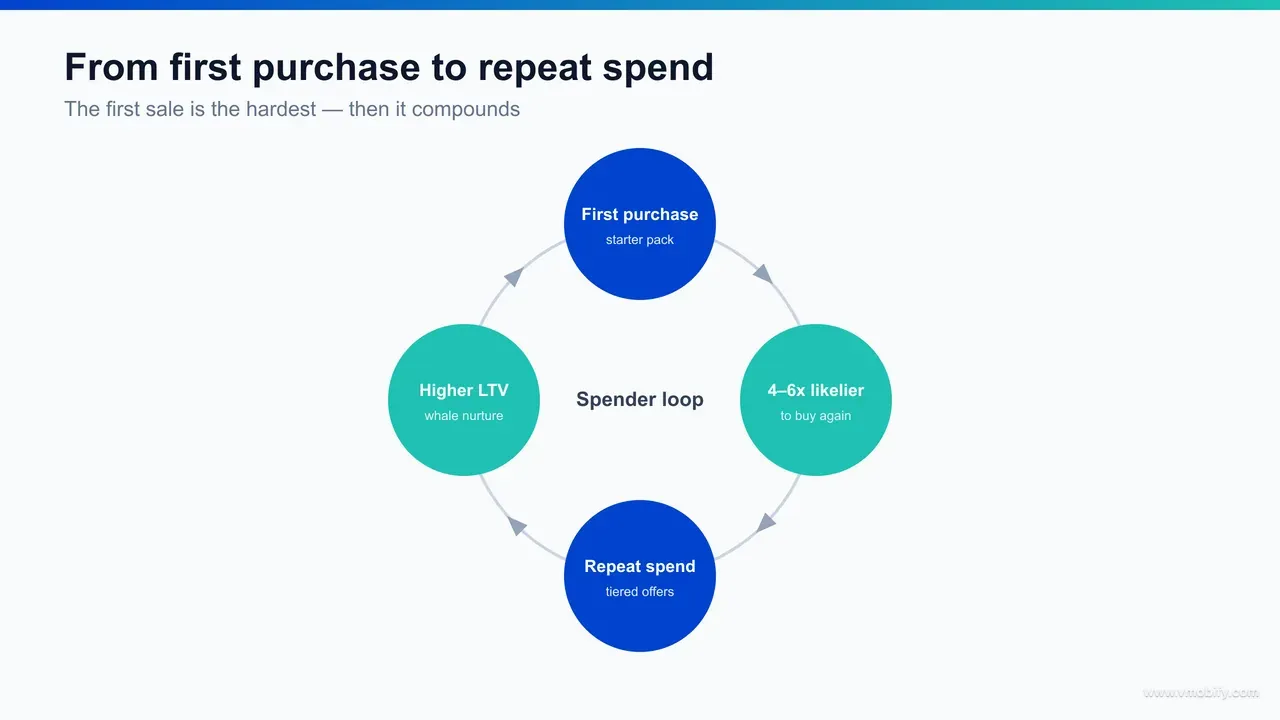
You solve the first-purchase problem by manufacturing an early, low-risk, high-value first transaction — a starter pack or first-time offer priced and positioned so the decision feels trivial — because once a user buys once, they become roughly 4-6x more likely to buy again. The first rupee is not about the revenue on that transaction; it is about crossing the psychological line from "I am a free user" to "I am someone who pays for this app".
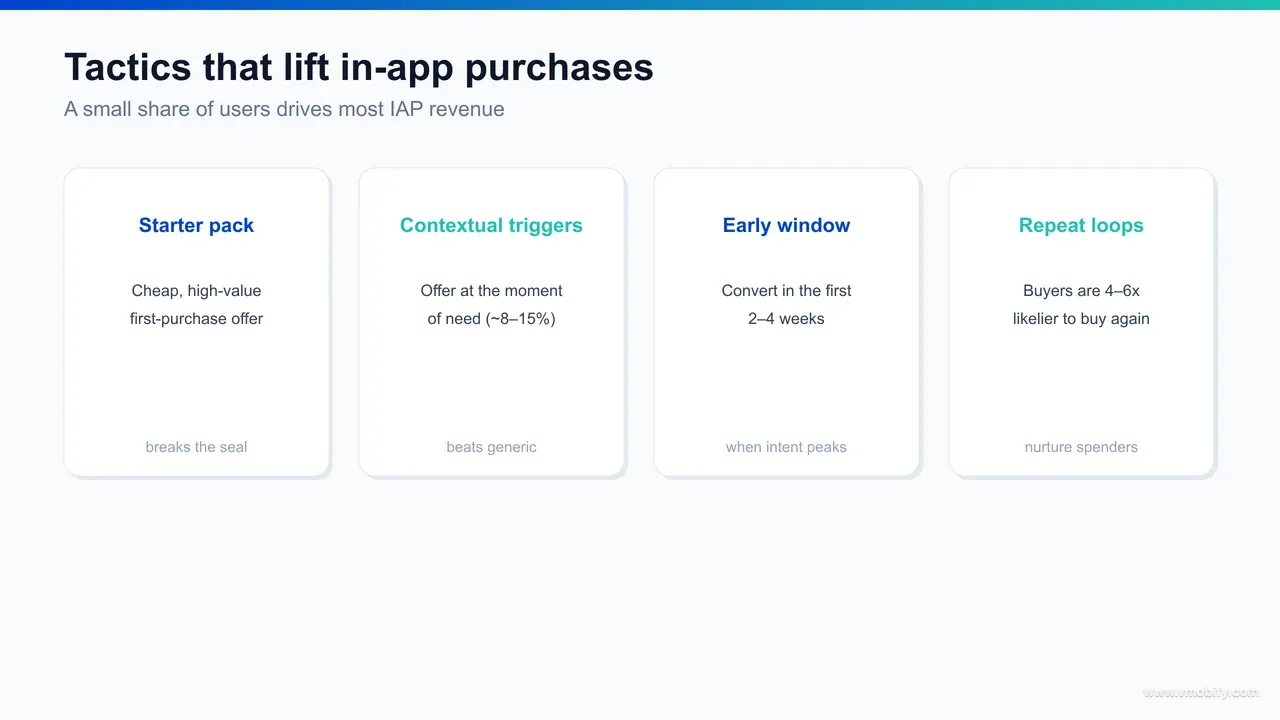
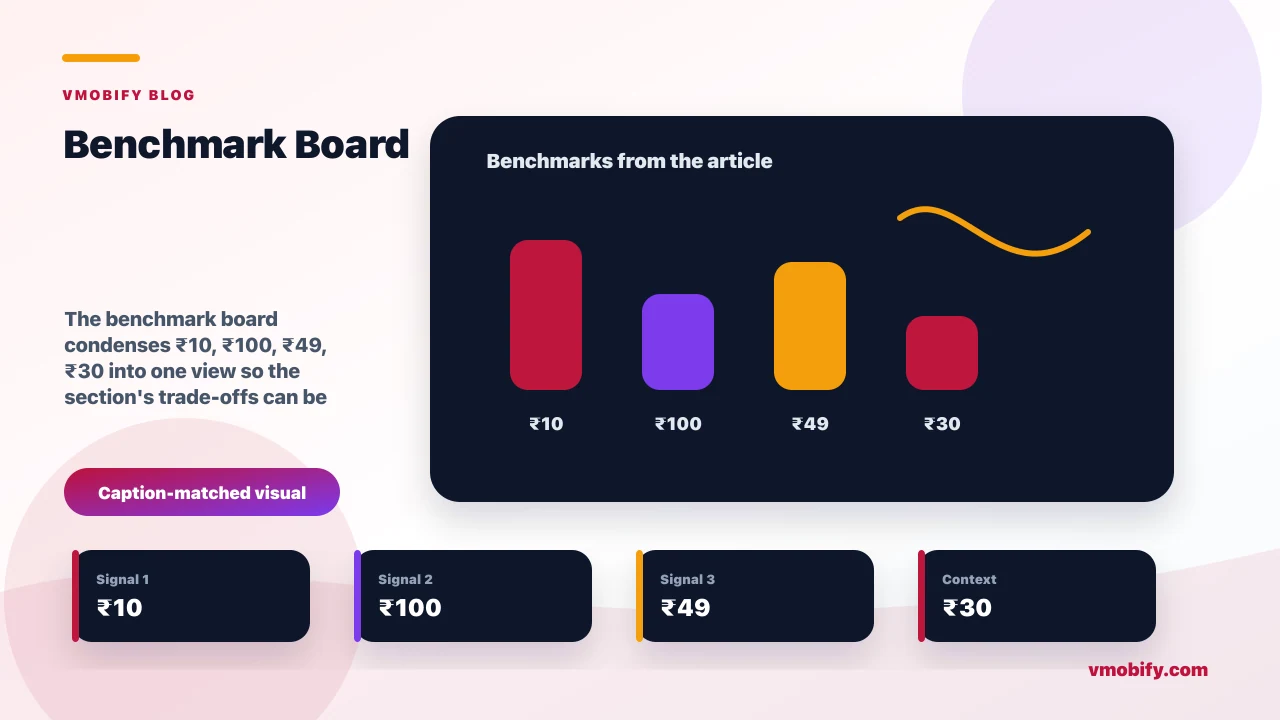
That 4-6x repeat-likelihood multiplier is the single most important number in IAP strategy. It means a starter pack that earns you ₹49 today is not a ₹49 event — it is the opening of a relationship with a user who is now several times more likely to spend again. Judged on that basis, a generous, almost-too-cheap first offer is not "leaving money on the table". It is buying the most valuable behaviour change in the entire funnel at a discount.
- Starter packs: a one-time, heavily-loaded bundle (currency + a useful item + a cosmetic) at an entry price, available only to users who have never purchased. The value-to-price ratio should look unmistakably better than any standard pack.
- First-time-buyer offers: a flagged discount or bonus that triggers the very first time a user reaches the store, ideally tied to a moment where they actually need what is on sale.
- Double-your-first-purchase: a "we will match your first top-up" bonus that anchors the decision on getting twice the value rather than on spending money.
The mechanics that make starter packs work also explain where they go wrong. CleverTap's work on app conversion stresses targeting the offer to the right user at the right moment rather than blasting it to everyone — a starter pack shown to a user who has not yet felt any need is just a banner. And as we cover in our deep dive on in-app purchase pricing experiments, the trap is judging a starter pack on first-purchase conversion alone: a pack so generous that nothing afterwards looks like good value can lift first buys while quietly suppressing the second purchase that the whole strategy depends on. Judge it on second-purchase rate, not just the first.
Why do contextual, need-based offers convert so much better?
Contextual, need-based offers convert far better than generic ones — typically in the region of 8-15% when shown in-context — because they meet the user at the exact moment they feel the friction the offer resolves, rather than asking them to invent a reason to spend. The same item, at the same price, can convert several times higher purely because of when and where you show it.
The mechanism is psychological, not promotional. A player who has just run out of lives at the boss fight has a problem your "5 extra lives" pack solves right now. A user who just hit a storage limit understands why the upgrade exists. Offered in that window, the purchase is the obvious next action. Offered on an always-on store shelf an hour earlier, it is noise. The discount is not what moves conversion — the relevance is.
- Failure / loss moments: running out of a consumable (lives, energy, moves, ammo) is the highest-intent trigger there is. Surface a top-up exactly there.
- Aspiration moments: a user lingering on a locked feature, level, or cosmetic is telling you what they want — meet that intent with an offer for that specific thing.
- Progress-protection moments: a streak about to break, a timer about to expire, a near-complete collection — loss-aversion makes these convert well when the offer protects what the user has already earned.
The reason most apps under-earn here is that they treat the store as a destination users visit, when it should be a set of triggers the app fires. CleverTap frames this as the move from broadcast to behaviour-triggered messaging, and it is exactly what separates an 8-15% in-context offer from a sub-2% store-shelf one. In our portfolio, simply re-pointing existing offers from "always available in the shop" to "fired at the moment of need" has repeatedly produced the largest single conversion lift on an IAP catalogue — without changing a single price or piece of art.
When does in-app purchase conversion actually peak?
In-app purchase conversion tends to peak in the first 2-4 weeks after install, not later, which means your best first-purchase offer should be front-loaded into that early window rather than held back until a user has "proven" their engagement. Many teams instinctively wait — they want users to be retained and committed before they ask for money. The data says that instinct costs them conversions.
Early users are at their most enthusiastic, most curious, and most willing to invest in an app they have just chosen to keep. As weeks pass, the novelty fades, the most engaged users have often already converted, and the remaining free users settle into a free-forever pattern that gets harder to break. The probability of a first purchase is highest while the relationship is new. Waiting does not increase willingness to pay; it usually erodes it.
This does not mean assault a brand-new user with a hard paywall on minute one — that is how you lose the install entirely, and it is why placement and trial structure matter so much, as we lay out in the paywall optimisation benchmarks. It means sequencing: let the user reach a genuine "aha" moment, then make your strongest, time-limited first-purchase offer inside that early window while intent is high. The classic pattern is a starter pack that appears after the user has experienced the core loop two or three times, framed as a welcome offer that expires.
The corollary is that an offer which expires creates urgency that an always-available one cannot. A "new player" starter pack visible for the first 72 hours converts the early-window enthusiasm into a transaction before it cools. We have seen teams recover a meaningful slice of lost first purchases simply by adding a countdown to an offer that was previously permanent — the scarcity does the work the discount alone could not.
How should you segment minnows, dolphins and whales?
You should segment payers into spender tiers — commonly called minnows (small spenders), dolphins (mid spenders) and whales (heavy spenders) — and run a distinct offer and retention strategy for each, because a single catalogue priced for the average payer simultaneously over-charges the minnow and under-serves the whale. The tiers behave so differently that treating them as one audience leaves money on the table at both ends.
Minnows
- Spend: small and occasionally
- Price sensitivity: price-sensitive
- Respond to: low-ticket, high-frequency offers — the ₹10-30 microtransactions that feel like nothing
- Your job: volume and habit — make small purchases frequent and frictionless, and nudge a fraction of them up to dolphin behaviour
Dolphins
- Spend: regularly at mid price points
- Respond to: value bundles, season passes, and recurring offers that reward consistency
- Your job: your most growable tier — the realistic path to more revenue is moving minnows into this band and keeping dolphins from lapsing
Whales
- Spend: heavily, accounting for a disproportionate share of revenue
- Price sensitivity: not price-sensitive in the usual sense — value- and status-sensitive
- Respond to: exclusivity, high-ceiling offers, early access, and being recognised
- Your job: losing one whale can dent a month; a VIP or concierge motion for this tier pays for itself
The strategic error is designing your entire store for the middle. Price every pack for the dolphin and you give whales nothing aspirational to buy and offer minnows no entry point cheap enough to start. The fix is a laddered catalogue: genuine sub-₹30 entry points at the bottom, value bundles in the middle, and high-ceiling, status-laden bundles at the top that only whales will ever buy — and that exist partly to anchor everything beneath them. RevenueCat and the broader monetisation literature are consistent that the heaviest spenders justify a dedicated motion; in our portfolio, a named "VIP" track for the top tier is one of the most reliable ways to defend the revenue that is already concentrated there.
How do pricing and anchoring increase IAP revenue?
Pricing and anchoring increase IAP revenue by shaping which pack feels like the obvious choice — through a deliberate price ladder, a clearly-marked "best value" tier, and high anchor packs that make mid-tier bundles look reasonable — and the price ladder itself is usually a bigger lever than any individual discount. Most teams agonise over offers and never seriously test the numbers on their packs, which is the highest-impact experiment they are not running.
Anchoring is the most reliable of these effects. Put a very expensive pack at the top of the shelf and the mid-tier pack beside it suddenly reads as sensible rather than indulgent. Mark one tier "most popular" or "best value" and a large share of buyers gravitate to it precisely because you told them where the smart money goes. Bundle currency so the per-unit price drops as the tier rises, and you nudge spenders up the ladder without ever raising a price. None of this is manipulation — it is giving an undecided buyer a frame for a decision they were going to make anyway.
There is a narrative worth sitting with here, and we keep it as narrative rather than a fabricated statistic: counterintuitively, raising the price of your cheapest pack can lift total revenue. The cheapest pack often acts as an anchor that drags the whole shelf down — when the floor is too low, every other tier looks expensive by comparison. Lift that floor and the mid-tier packs become the relative bargain, average order value rises, and the handful of buyers you lose at the very bottom are more than offset. We are deliberately not attaching a percentage to that — it is an experiment to run, not a promise — and the discipline for running it cleanly is the whole subject of our piece on in-app purchase pricing experiments.
The rule we hold clients to is simple: never judge a price change on conversion alone. A cheaper price that converts more buyers can still earn less in total, and a higher price that converts fewer can earn more. Judge every pricing move on revenue per user and lifetime value across a full repeat-purchase cycle, the way our monetisation team structures these tests, and treat the price ladder as a living thing you tune, not a list you set once and forget.
How should you merchandise the store and your offers?
You should merchandise the in-app store like a retail shelf — a clear hierarchy, a featured hero offer, scannable value cues, and limited choice — because a cluttered, undifferentiated catalogue of twelve near-identical packs paralyses buyers and depresses conversion regardless of how good the prices are. The offer is only half the sale; presentation is the other half.
- Feature one hero offer: give the store a single, obvious headline — the starter pack for non-payers, the season pass for regulars, the limited-time bundle for everyone. Do not make the user hunt for the thing you most want them to buy.
- Make value legible: show the bonus percentage, the "most popular" tag, the strike-through on the old price. A buyer should grasp why a tier is the smart choice in under a second, without doing arithmetic.
- Limit choice: a tight ladder of three to five well-differentiated tiers converts better than a wall of twelve. Too many similar options trigger decision paralysis and users leave without buying anything.
- Rotate and theme: a store that changes — festival bundles, weekend offers, event-tied packs — gives users a reason to return and creates the urgency a static shelf never can.
Themed and seasonal merchandising matters disproportionately in India, where festival moments are genuine spending occasions. A Diwali bundle is not a gimmick; it is a culturally-resonant reason to spend that a generic "20% off" never matches. Adjust's app trends research shows how sharply seasonal events spike engagement and spend, and the apps that plan a merchandising calendar around them capture demand the always-on shop leaves on the table. In our portfolio, simply giving the store a featured hero slot and cutting the catalogue from a sprawling list to a tight five-tier ladder has lifted conversion on the same underlying offers — proof that how you show the shelf is itself a tactic.
How do you reduce purchase friction on mobile?
You reduce purchase friction by collapsing the number of taps, decisions, and payment hurdles between intent and confirmation — and in India specifically, by making UPI the default, because every extra step between "I want this" and "done" leaks a measurable share of buyers. Conversion is won and lost in the seconds after a user decides to buy, and most apps add friction they never measured.
The principle is that intent decays fast. A user who has decided to top up is at peak willingness for a few seconds; every screen, form field, or unexpected step gives doubt a chance to creep in. The best purchase flows feel like one continuous motion: tap the offer, confirm, return to the moment that triggered the purchase. The worst ones bounce the user to a separate store screen, ask them to pick a payment method they have not saved, and make them re-enter details they entered last week.
- Default to the saved payment method so repeat buyers confirm in a single tap rather than re-selecting every time.
- Keep the purchase in-context — fire the confirmation over the gameplay or screen that triggered it, not via a jarring jump to a full-screen store.
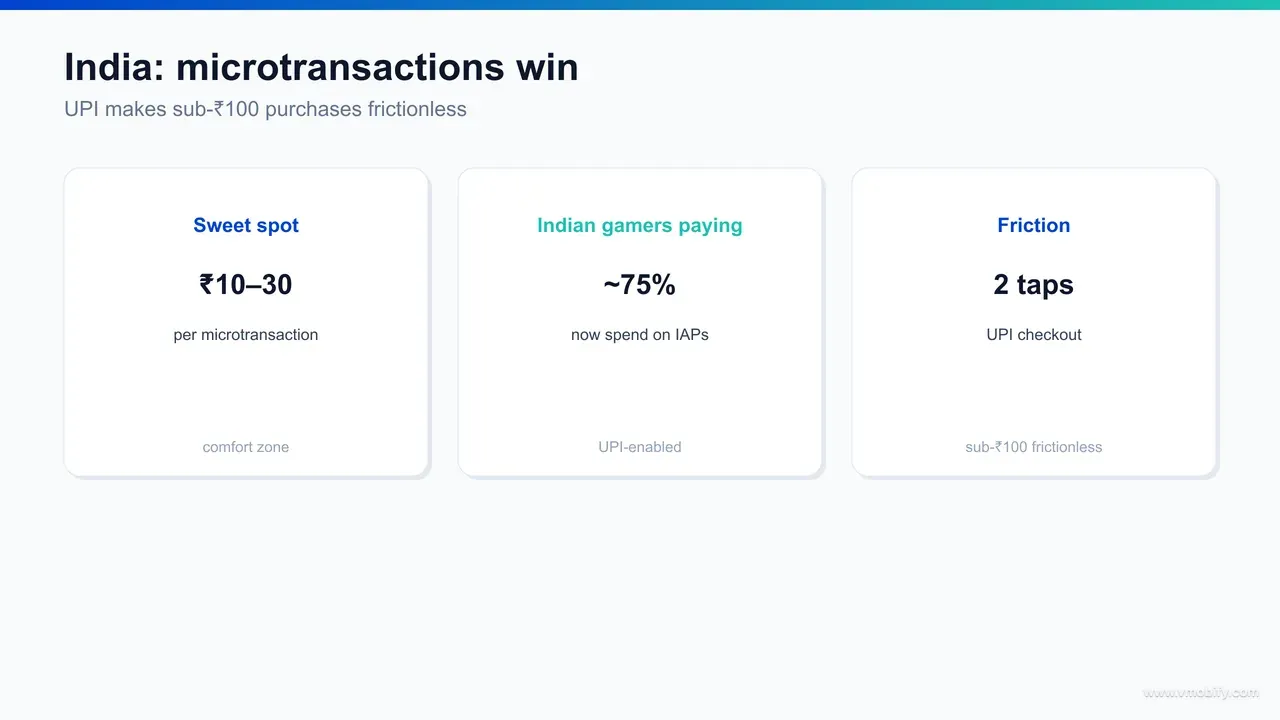
- Make UPI first-class in India: UPI is the rail Indian users trust and reach for, and it makes sub-₹100 purchases close to frictionless. A flow that buries UPI behind a card form is quietly taxing every Indian transaction.
For subscriptions and recurring purchases, UPI AutoPay extends this frictionless logic to renewals — the user authorises once and recurring charges flow without re-entry, which is exactly the mechanism we unpack in our guide to UPI AutoPay for app subscriptions. The broader point holds for one-off IAP too: the payment method is not a back-office detail, it is part of the conversion rate. RevenueCat's monetisation data consistently shows checkout friction as a silent killer of conversion, and the cheapest IAP lift available to most Indian apps is simply making the rail their users already prefer the one-tap default.
How do you build repeat-purchase loops?
You build repeat-purchase loops by turning the first purchase into a habit — through recurring offers, balance mechanics, progression systems and gentle re-engagement — because the 4-6x repeat-likelihood lift from a first buy only pays off if you actually give that newly-converted payer a reason to come back. Converting the first rupee is the hard part; the second, third and tenth purchases are where IAP revenue compounds.
The loops that work share a shape: they create a recurring reason to spend that is woven into normal use rather than bolted on as a sales pitch. A user who bought once and then never saw a relevant follow-up offer has been left to lapse. A user who is gently re-engaged at the next moment of need — with the right offer, on the right rail — keeps the habit alive.
- Battle passes and season passes: a recurring, time-boxed purchase that resets each season builds a predictable repeat cadence and a reason to return on a schedule.
- Currency and balance design: a soft virtual currency that users top up and spend down creates natural re-purchase moments every time the balance runs low — far smoother than asking them to make a fresh buying decision each time.
- Loyalty and streak rewards: recognising repeat spend with escalating perks gives dolphins and whales a reason to keep their streak — and their spend — intact.
- Behaviour-triggered win-back: when a known payer goes quiet, a relevant, contextual offer beats a generic discount blast every time. The fact that they bought before is the strongest signal you have.
The connective tissue across all of these is the same contextual targeting that powers first purchases — fire the right offer at the right moment, not a calendar blast to everyone. CleverTap frames repeat-purchase growth as a segmentation-and-timing problem rather than a discounting one, which matches what we see in our portfolio: the apps that grow lifetime value are the ones that treat a payer's second purchase as deliberately as their first, not as something that will happen on its own.
What is the right India microtransaction strategy?
The right India microtransaction strategy is to price for volume at the bottom of the ladder — a comfort zone of roughly ₹10-30 per item — lean on UPI to make those small buys frictionless, and accept that India monetises through frequency of tiny purchases rather than a handful of large ones. Porting US price points into India is the most common and most expensive mistake an app makes here.
The Indian IAP market has matured fast. Around 75% of Indian gamers now pay for in-app purchases, and the behaviour is built on small, frequent, low-friction transactions rather than the high-ticket spend common in Western markets. As Outlook's Respawn coverage of in-app purchases in the new Indian economy documents, UPI is central to this shift — it makes a sub-₹100 purchase feel as casual as a chai, and that frictionlessness is what unlocks high-frequency microtransaction behaviour at scale.
- Anchor your entry points at ₹10-30: this is where Indian buyers feel comfortable spending without a second thought. A genuine sub-₹30 starter offer converts where a ₹500 pack stalls.
- Optimise for frequency, not ticket size: Indian IAP revenue compounds from many tiny purchases. Design the loop so a habit-forming ₹19 buy can happen often, not so a single big spend has to carry the user.
- Make UPI the default rail: a flow that puts UPI first removes the single biggest tax on Indian conversion. Bury it behind a card form and you forfeit the frictionlessness that makes the ₹10-30 zone work.
This is also where India's spender distribution differs in texture from the West: the whale tier exists, but the engine is the enormous base of minnows making frequent micro-purchases. There is a second-order effect worth naming: a low, frictionless price point does not just convert more buyers, it changes how often each buyer returns. A ₹19 purchase that feels inconsequential can recur several times a week; a ₹499 purchase, however good the value, forces a deliberate decision every single time and so happens rarely. Frequency is the multiplier, and the ₹10-30 ladder on UPI is what makes high frequency possible. For genre-specific tactics — where the ₹10-30 microtransaction loop is sharpest in Indian gaming — our guide to gaming app marketing in India goes deeper. Across the India-first apps in our portfolio, the teams that re-priced from "global default" to a true ₹10-30 ladder on UPI did not just convert more buyers — they unlocked a frequency of repeat spend the higher price points had been suppressing entirely.
How do you measure IAP conversion and avoid the pitfalls?
You measure IAP conversion by cohort and by spender tier — never as one blended average — tracking payer conversion rate, average revenue per payer, repeat-purchase rate and lifetime value separately, because a single headline number hides exactly the dynamics you most need to see. The metric you watch determines the decisions you make, and the wrong metric quietly steers teams into the most common pitfalls.
Start with the metrics that actually drive decisions. Payer conversion rate (share of users who ever buy) tells you how well the first-purchase motion works. Average revenue per paying user tells you how well the ladder and whale motion work. Repeat-purchase rate tells you whether the loop is alive. Lifetime value by cohort ties it all together and is the only metric on which a pricing or offer change should ultimately be judged. Watch them as a panel, by install cohort, so you can see whether last month's change actually moved the population it was meant to.
- Optimising the blended average: a rising ARPU can mean more first-time buyers or three lucky whale months. Split payers from non-payers and tiers from each other, or you will misread your own numbers.
- Judging price and offer tests on conversion alone: a cheaper pack that converts more can earn less. Always settle the test on revenue per user and LTV across a full repeat-purchase cycle, the discipline we detail in the pricing experiments guide.
- Over-discounting: blanket discounts train users to wait for the next sale and erode the value perception your anchor packs depend on. Use targeted, contextual offers, not a permanent fire-sale.
- Ignoring the early window: holding back your best first-purchase offer until users "prove" themselves forfeits the 2-4 week peak when conversion is highest.
- Starter packs that suppress repeat spend: an offer so generous nothing after it looks like value lifts the first buy and kills the second. Watch second-purchase rate, not just first.
The thread running through every pitfall is the same: optimise the tails and the cohorts, not the average. If you want this set up and measured properly — a laddered catalogue, contextual triggers, an India-priced microtransaction loop, and a measurement panel that separates first purchases from whale retention — that is precisely the work our monetisation team runs, and you can talk to us about your specific app. Get the first purchase, the timing, and the measurement right, and the eleven tactics above stop being a checklist and start compounding into real IAP revenue.
Frequently Asked Questions
What is the single fastest way to increase in-app purchases?+
Convert more first-time buyers with a contextual starter-pack offer shown in the early window after install. Because a first purchase makes a user roughly 4-6x more likely to buy again, manufacturing that first transaction is the highest-impact move available to most apps.
Why do contextual offers convert better than generic discounts?+
Because they meet the user at the moment they feel the friction the offer resolves — running out of lives, hitting a limit, eyeing a locked feature. Shown in-context, need-based offers convert in the region of 8-15%, several times higher than the same offer on an always-on store shelf.
When does in-app purchase conversion peak after install?+
It tends to peak in the first 2-4 weeks after install, while novelty and willingness to invest are highest. Front-load your strongest first-purchase offer into that early window rather than waiting for a user to warm up.
How should I price in-app purchases for India?+
Anchor entry points at roughly ₹10-30, optimise for frequency of small purchases rather than large ones, and make UPI the default rail. Around 75% of Indian gamers now pay for IAPs, and UPI makes sub-₹100 buys close to frictionless — do not port US price points.
What are minnows, dolphins and whales?+
They are spender tiers: minnows spend small and occasionally, dolphins spend regularly at mid price points, and whales spend heavily and drive a disproportionate share of revenue. Each tier needs its own offer and retention strategy rather than one catalogue priced for the average.
Can raising my cheapest pack price really increase revenue?+
It can, because the cheapest pack often anchors the whole shelf downward and makes every other tier look expensive. Lifting the floor can raise average order value enough to offset the few buyers lost at the bottom — but treat it as an experiment judged on revenue per user and LTV, not a guarantee.
What does Vmobify do to increase in-app purchases?+
Our monetisation team builds laddered catalogues, contextual offer triggers, India-priced microtransaction loops on UPI, and a measurement panel that separates first-purchase conversion from whale retention. You can see the approach at /services/monetization or reach us via /contact.
Sources
- RevenueCat — Monetisation blog and benchmarks — Payer concentration, repeat-purchase behaviour and checkout-friction data
- CleverTap — How to increase app conversion rate — Contextual, behaviour-triggered offers versus broadcast messaging
- Outlook Respawn — In-app purchases and the new Indian economy — India microtransaction behaviour, ~75% of gamers paying, and UPI
- Adjust — Mobile app trends and resources — Seasonal event spikes and engagement-driven spend patterns
- AppsFlyer — App marketing and monetisation resources — Cohort measurement and post-install spend benchmarks
- Sensor Tower — Mobile market and IAP insights — IAP and spend trends across markets and categories
- Google Play — Developer content and billing policy — Play Billing requirements for in-app purchases
About the author
Amol Pomane — Founder, Vmobify
Amol leads Vmobify, a mobile app growth agency that has driven 30M+ downloads and ranked 54K+ keywords across 300+ apps since 2013. He writes about ASO, paid user acquisition, retention, and the operational reality of scaling mobile apps in India and global markets.