How Notion Grew: A Product-Led Growth Teardown
Notion crossed tens of millions of users and a multi-billion-dollar valuation without buying its way there — it grew through product-led, bottoms-up adoption, a template gallery that ran as a content engine, and a community that compounded the word of mouth. This is a teardown of that playbook, with the transferable lesson for app teams at the end of every section.
On this page
- What did Notion's growth actually look like?
- Why did product-led, bottoms-up adoption beat top-down sales?
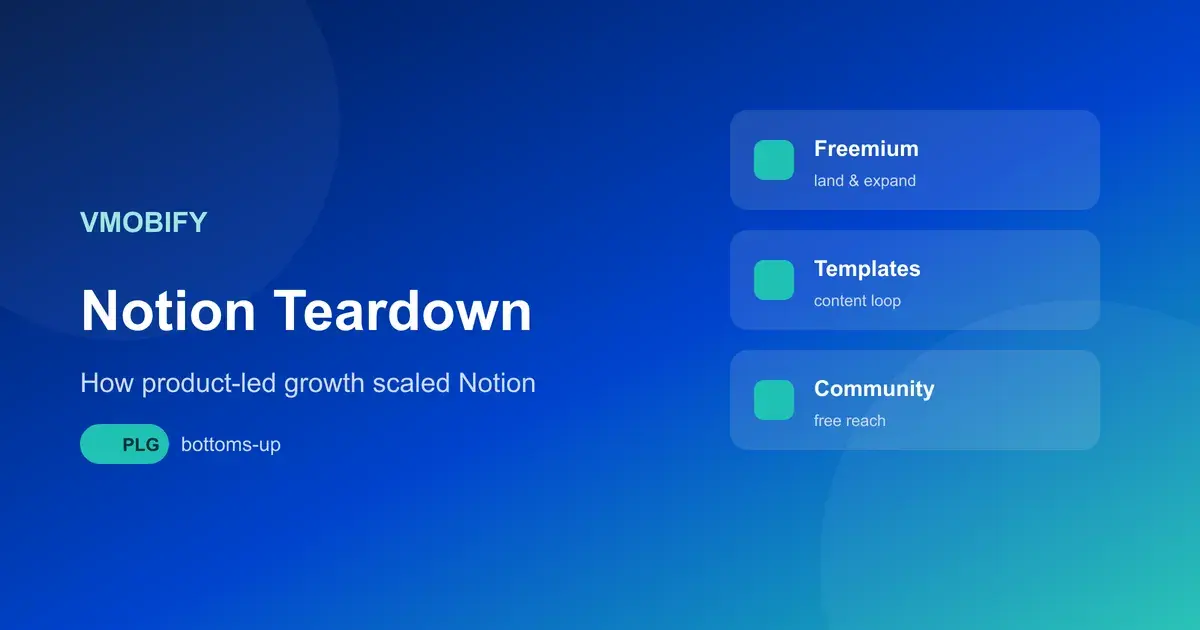
- How did the template gallery become a content loop?
- How did the community and ambassador programme compound growth?
- How did generous freemium drive team expansion?
- How does the product design create stickiness?
- What is transferable to a mobile app — and what is not?
- What are the limits and risks of the PLG playbook?
- How do you apply one Notion lesson this quarter?
- Frequently Asked Questions
What did Notion's growth actually look like?
Notion grew from a niche productivity tool into a workspace used by tens of millions of people and a company valued in the billions, and the defining feature of that growth is that it happened mostly through the product spreading itself — bottoms-up adoption and word of mouth — rather than through a proportionate paid-acquisition budget. That is what makes Notion a product-led growth story rather than a marketing-spend story, and it is why it rewards a proper teardown.
The broad shape is well documented across the growth-strategy community. As laid out in the Competitive Intelligence Alliance's breakdown of how Notion grows, and echoed in practitioner accounts on Lenny's Newsletter, Notion reached enormous scale with comparatively light paid marketing — its acquisition engine was the product, the templates and the community around it. The company crossed into tens of millions of users and a multi-billion-dollar valuation on the back of that engine.
It is worth being precise about what these figures are and are not. The "tens of millions of users" and "multi-billion-dollar valuation" are widely reported, round, public characterisations — not numbers we are inventing a decimal place for. We are deliberately not citing a single exact user count or a precise valuation here, because the argument does not need one. The point is directional and robust: a company reaches that kind of scale on light paid spend only when the product itself is doing the acquiring. That is the signature of a working growth loop, and it is the thing worth understanding.
Why does one productivity app deserve a full teardown for mobile app teams? Because the primitives underneath it — a generous free tier, user-generated templates that double as searchable content, a creator community that compounds reach, and a land-and-expand path from one user to a paying team — are not specific to note-taking software. They are available, in some form, to a very wide range of apps, and most teams either ignore them or implement a hollow version. Across our 300+ apps managed since 2013, the most common growth question we field is some version of "how do we grow without simply buying every install?" — and Notion is one of the clearest worked answers.
The rest of this teardown works through that engine one layer at a time, and every section ends with the transferable lesson — the part you can actually take back to your own roadmap. Treat the scale numbers above as the why; the sections below are the how.
Why did product-led, bottoms-up adoption beat top-down sales?
Product-led, bottoms-up adoption beat top-down sales because Notion let a single individual adopt the product for free, get value within minutes, and then pull their team in from the inside — which is far cheaper and far more durable than a sales team persuading an executive to buy software the eventual users have never touched. The product did the selling, and the people who would actually live in the tool were the ones who chose it.
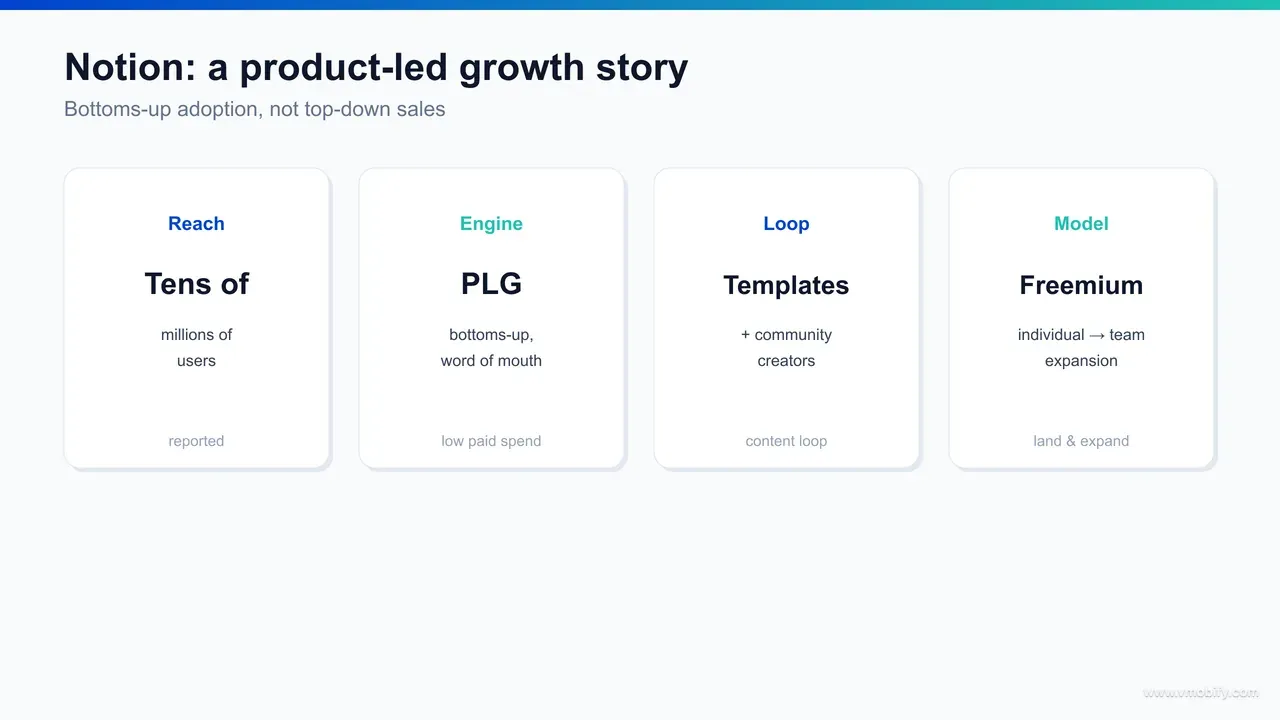
The contrast with the traditional enterprise motion is stark. Top-down sales spends heavily to reach a decision-maker, runs a long procurement cycle, and then hopes the workforce adopts a tool that was chosen above their heads — adoption that frequently never arrives. Bottoms-up inverts the order: usage comes first and the purchase decision comes later, once the tool is already embedded in how people work. By the time anyone is asked to pay, the product has already proven itself to the very people who will use it daily. That is a structurally cheaper and stickier path to revenue.
The mechanics of why this compounds are the same compounding mechanics behind any growth loop: an acquired user is not a terminal output, they are an input that produces the next user. With Notion, one person adopts the free product, builds something useful in it, invites collaborators or shares their set-up publicly, and each of those actions exposes new people who then adopt it themselves. As the Competitive Intelligence Alliance and growth writers at Reforge both describe, this is a self-reinforcing loop rather than a linear funnel — and loops, unlike funnels, do not need a constant cash injection at the top to keep running.
There is a unit-economics reason this dominates over time. Paid user acquisition gets more expensive as you scale — every fresh cohort of users is harder and pricier to reach than the last, a slope every performance team eventually hits. A product-led loop has the opposite slope: each happy user lowers the cost of the next, because the acquisition work is being done by the product and its users rather than by a media budget. For a horizontal tool that almost everyone could plausibly use, that difference is the whole game.
The transferable lesson: before you scale a paid channel, ask whether your product can do its own selling. If a single user can adopt your app, reach value quickly, and then bring others in or broadcast what they built, you have the raw material for a bottoms-up loop that compounds — and that loop will outlast any campaign. If they cannot, no amount of media spend fixes the underlying problem; it only rents you growth that stops the moment the budget does.
How did the template gallery become a content loop?
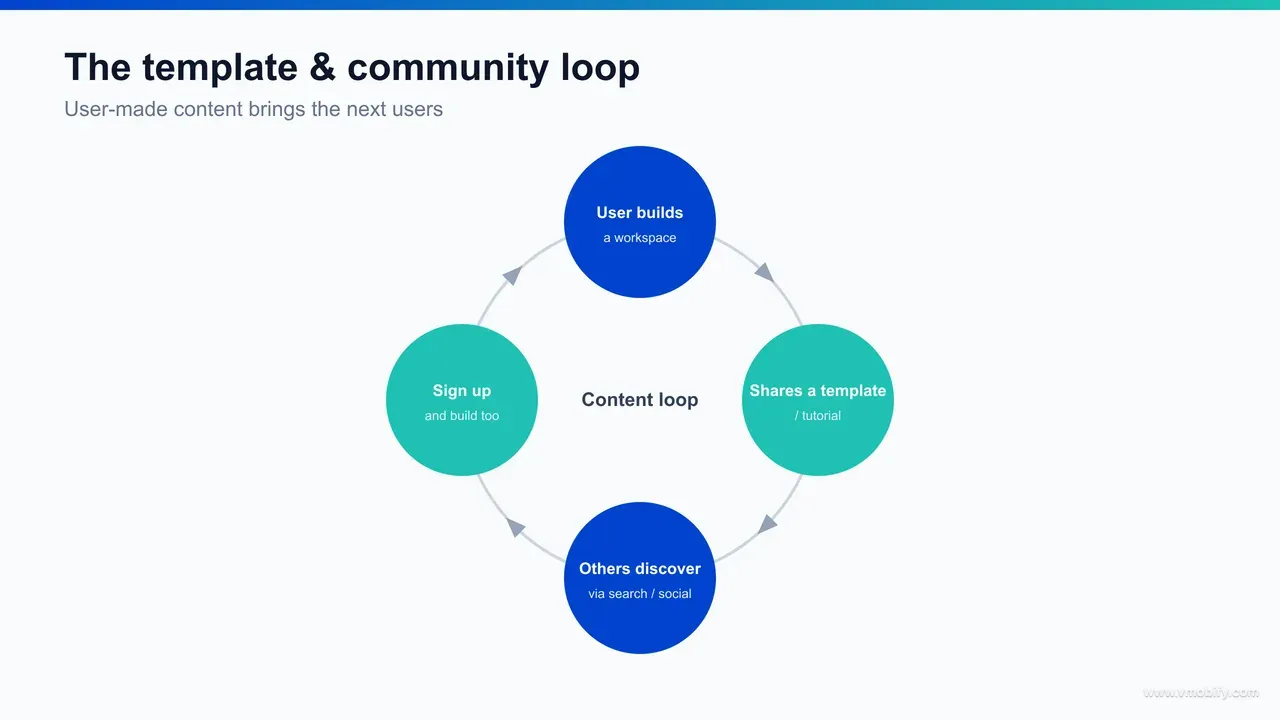
The template gallery became a content loop because every template is simultaneously a piece of searchable content that ranks in Google, a finished use case that shows a newcomer exactly what Notion is for, and a one-click on-ramp into the product — and crucially, the users and creators made most of that content, not Notion. It turned the empty-canvas problem into a discovery engine.
Notion's core strength — a blank, flexible workspace that can become almost anything — is also its hardest onboarding problem. A blank page is intimidating, and "it can do anything" is a famously weak pitch because it tells a new user nothing about what to do first. Templates solve that directly: a habit tracker, a content calendar, a startup wiki, a reading list. Each one converts the abstract promise into a concrete, ready-made artefact the user can adopt in one tap and edit into their own. That is also, not coincidentally, a textbook way to deliver an early activation aha moment — the new user reaches a working result before they have to build anything from scratch.
The content-loop part is what makes it growth rather than just onboarding. People search Google for "Notion template for X" — project management, students, freelancers, content planning — and template pages, both Notion's own and the thousands published by creators, rank for that long-tail demand. A searcher lands on a template, sees a finished solution to their exact problem, and signs up to use it. As the Competitive Intelligence Alliance's analysis of Notion spells out, this means a near-endless library of acquisition surfaces is being produced by the userbase itself, each one targeting a specific intent Notion never had to research.
That is the loop closing on itself. A user builds a useful template, publishes it to grow their own audience or reputation, that template ranks and attracts searchers, those searchers become Notion users, and some of them go on to build and publish templates of their own. Notion's job shifted from producing content to curating and showcasing it — a far more scalable position, because the marginal cost of the ten-thousandth template is borne by a creator, not by Notion's marketing team. In our portfolio, the apps that achieve durable organic discovery almost always have some version of this: user-generated artefacts that double as indexable, shareable acquisition surfaces.
The transferable lesson: look for the artefact in your product that a user would naturally want to create and share, and turn it into content that both ranks and onboards. The template gallery works because a Notion template is useful, specific, searchable and instantly adoptable all at once. Your equivalent might be a public profile, a shareable result, a saved configuration or a published collection — but the design goal is the same: every artefact a user makes should be able to recruit the next user.
How did the community and ambassador programme compound growth?
The community and ambassador programme compounded growth by giving creators a personal incentive to grow Notion's audience alongside their own — ambassadors ran local groups, YouTubers published tutorials, and template sellers built small businesses on top of Notion, so thousands of independent people were marketing the product because doing so served their own goals. Notion aligned its growth with other people's ambitions, which is the most scalable marketing arrangement there is.
Consider the YouTube layer alone. A vast genre of productivity and "build a second brain" content uses Notion as its centrepiece, because the creators get an engaged, monetisable audience and a steady stream of video ideas, while Notion gets continuous, credible, free exposure to exactly the people most likely to adopt it. The creator is not doing Notion a favour; they are pursuing their own channel growth, and Notion's reach is a by-product of that pursuit. Multiply this across thousands of creators and the result is a marketing machine no in-house team could staff or afford.
The formal ambassador and community programme structured and amplified this energy. As described in growth analyses on Reforge and across the competitive-intelligence community, Notion invested in supporting its most enthusiastic users — recognising ambassadors, enabling local and online communities, and giving template creators a path to actually sell their work. That last point matters more than it looks: by letting creators monetise templates, Notion turned its most engaged users into a self-funding salesforce. A person earning income from Notion templates is motivated to bring more people into Notion, because their livelihood now depends on the platform's reach.
This is where the community layer and the template layer fuse into one loop. Templates need creators; creators need an audience and a reason to keep producing; the community and the monetisation path supply both; and every template and tutorial they publish recruits new users, some of whom become the next cohort of creators. It is the same word-of-mouth and content engine described in the section above, now powered by durable personal incentives rather than one-off goodwill.
The lesson we draw across our own client work is that community compounds only when it serves the member's self-interest — communities built purely to serve the company's funnel tend to wither.
The transferable lesson: do not try to manufacture word of mouth with prizes; build a structure where promoting your product advances the promoter's own goals. Give your most engaged users status, an audience, tools to create, and ideally a way to earn — and their self-interested effort becomes your most credible and most scalable acquisition channel. The agency does the marketing because it serves them, and that is what makes it durable.
How did generous freemium drive team expansion?
Generous freemium drove team expansion by removing every barrier to that first individual adoption, then letting paid revenue arrive later and naturally once a whole team was already depending on the workspace — the free tier was the on-ramp that seeded Notion inside companies, and the paid tiers monetised the collaboration, administration and security that teams need once they are committed. The free tier is the acquisition engine; the paid tier harvests the expansion it produces.
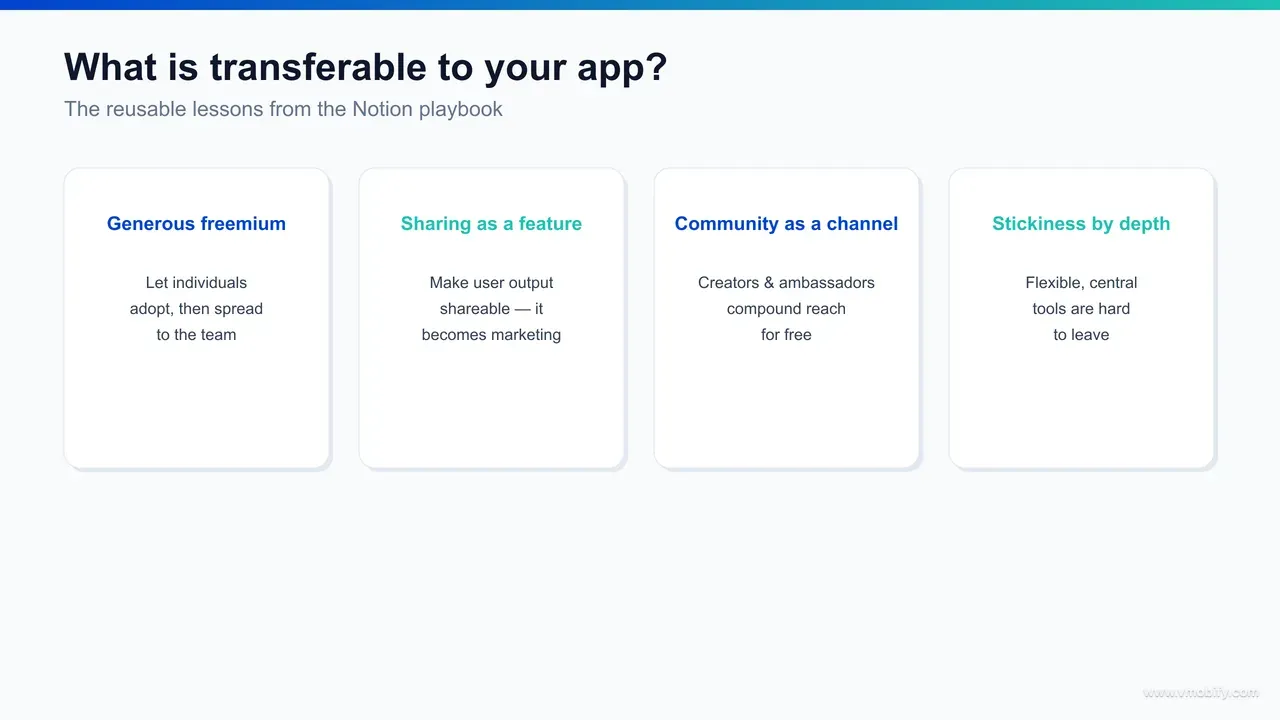
The logic is land-and-expand, executed bottoms-up. One person uses Notion free for their own notes and projects. They invite a colleague to collaborate, then another, and soon a team is running real work inside it. At that point the friction of switching away is high and the need for team-grade features — shared admin, permissions, more members, security controls — becomes real. That is the moment paid conversion happens, and it is a fundamentally easier conversion than a cold sale, because the buyer is approving a tool their team already lives in and would resent losing. Retention and embeddedness are upstream of monetisation, not separate from it.
The generosity of the free tier is a deliberate investment, not a giveaway. A stingy free tier protects short-term revenue but starves the loop: if the individual cannot get real value for free, they never adopt, never invite their team, and never create the conditions for expansion. Notion chose to let individuals do genuinely useful work for free precisely because that seeding is what produces the paying teams later. This mirrors the principle we see repeatedly across our 300+ apps managed since 2013 — the apps that monetise sustainably tend to sell expansion and convenience on top of a free core, rather than paywalling the core experience and suffocating their own acquisition.
It is worth naming why bottoms-up freemium specifically suits Notion's category. The product is horizontal and personal — useful to a single person before it is useful to a team — so an individual can extract value alone, which a purely collaborative tool cannot offer. That solo value is what makes free adoption frictionless, and frictionless free adoption is what feeds the whole expansion motion. The free tier and the team upsell are not two strategies; they are two ends of one pipeline that starts with a single person and ends with a paying organisation.
The transferable lesson: design your free tier to maximise adoption and embedding, not to protect revenue, and put your paywall at the point of expansion rather than at the point of entry. Let one user get real value alone and for free, make it natural for them to bring others in, and charge when the team's needs — scale, control, collaboration — genuinely begin. A free tier that blocks the first valuable action is not freemium; it is a demo, and demos do not seed themselves through an organisation.
How does the product design create stickiness?
The product design creates stickiness because Notion positions itself as a single flexible "all-in-one workspace" that absorbs notes, documents, wikis, tasks and databases — so the more a user builds inside it, the more of their working life lives in one place, and the higher the cost of ever leaving becomes. Flexibility is not just a feature here; it is the retention mechanic, because consolidation is what makes the tool hard to give up.
The mechanism is accumulated investment. Every page a user creates, every database they design, every workflow they wire together is effort deposited into Notion, and that deposit compounds. A user with two years of notes, a personal wiki, a project system and a team's shared knowledge inside Notion is not going to casually switch to something else — recreating all of it elsewhere would be enormous work. This is the same loss-aversion and sunk-cost dynamic that powers the streak in our Duolingo teardown, expressed through accumulated documents rather than a consecutive-day counter. The investment is the moat.
The all-in-one positioning multiplies this effect by encouraging consolidation. If Notion were only a note app, a user might keep it alongside five other tools and churn from any of them easily. By being flexible enough to replace several tools at once, it concentrates more of the user's workflow into a single surface, which raises switching cost and lowers the chance any competitor can peel off just one job. Each additional job the user moves into Notion deepens the dependency and makes the product more central to how they work — and centrality is the strongest form of stickiness there is.
There is a real trade-off inside this design, and it is honest to name it. The same flexibility that creates stickiness also creates the blank-canvas onboarding problem discussed earlier — a tool that can be anything is hard to start with — which is exactly why the template gallery is load-bearing. The two halves of the system are co-dependent: the flexibility produces the long-term stickiness, and the templates rescue the short-term activation that the flexibility would otherwise jeopardise. Remove the templates and the flexibility becomes a barrier; remove the flexibility and the stickiness evaporates.
The transferable lesson: stickiness comes from accumulated user investment, so design your product so that using it deposits something durable the user would hate to lose — a knowledge base, a history, a configured system, a body of content. But pair any flexible or open-ended surface with a strong activation path, because the very openness that makes a product sticky in the long run is what makes it intimidating on day one. Build the moat, but build the on-ramp to it first.
What is transferable to a mobile app — and what is not?
What transfers is the architecture — a generous on-ramp, an artefact users create and share that doubles as acquisition content, a community whose self-interest is aligned with your growth, and a paywall placed at expansion rather than entry — but the specific surfaces, a desktop-first template gallery and a horizontal productivity workspace, often do not map cleanly onto a focused mobile app, and copying them literally is usually a mistake. Take the loop, not the layout.
Start with what genuinely transfers. The first principle is the self-reinforcing loop itself: the question for any app is whether using it can produce the next user. That might be a shareable result, a public profile, an invite-native collaboration feature, or user-generated content that ranks and onboards. Finding and instrumenting that loop is an analytics exercise before it is a design one — which is precisely the diagnostic work our analytics service runs first with growth clients: identify the action that exposes new users, measure how often it fires, and engineer to increase it. You cannot optimise a loop you have not measured.
The second transferable principle is incentive alignment in community. Notion did not pay for word of mouth; it built structures where promoting Notion served the promoter — audience, status, income. Any app can ask the equivalent question: what would make my most engaged users want to bring others in for their own reasons? Referral mechanics that reward both sides, creator tools, social proof and status all sit on this spectrum. The durable version is always the one where the user benefits, not the one propped up by a temporary bounty.
Now what does not transfer. A template gallery is native to a flexible, document-based, largely desktop product; a single-purpose mobile app — a game, a fitness tracker, a payments app — has no direct equivalent, and bolting on a "gallery" because Notion has one would be cargo-culting the surface instead of the function. The function is "user-generated artefacts that double as searchable, shareable acquisition surfaces", and the right mobile expression of that might be something entirely different: shared workout plans, public leaderboards, exportable creations, referral-native invites. Translate the function; discard the form.
There is also a category caveat. Notion's bottoms-up motion depends on solo value before team value and on a product horizontal enough that almost anyone could use it. An app that is inherently single-player, or only valuable in a narrow vertical, will not produce the same viral surface area, and forcing collaboration or community where the use case does not support it produces hollow features users ignore. The honest first step is to assess which parts of the Notion architecture your product can actually support, rather than assuming all of them apply.
The transferable lesson: extract the four architectural moves — generous on-ramp, shareable artefact, aligned community, expansion-stage paywall — and ask how each one would express itself in your specific product, mobile and focused as it is. The teams that succeed adapt the architecture to their app; the ones that fail try to graft Notion's surfaces onto a product that was never shaped to hold them.
What are the limits and risks of the PLG playbook?
The biggest limit is that product-led growth only works when the core product is genuinely good enough to spread on its own — there is no loop to compound if the experience is not worth sharing — and the main risks are a slow, patient revenue curve that strains funding, a flexibility-driven activation problem that quietly caps the loop, and a dependence on a community whose goodwill you do not fully control. PLG is powerful where it fits and punishing where it is forced.
The product-quality precondition is the one teams most want to skip. A loop multiplies whatever it is given: a brilliant product spreads, a mediocre one spreads its own mediocrity and then stalls. Notion's loop worked because the underlying workspace was genuinely useful and worth talking about; the templates, community and freemium amplified real value rather than substituting for it. Pointing growth tactics at a product that has not earned word of mouth does not manufacture word of mouth — it just spends effort circulating something users will not recommend. Product-market fit is the prerequisite, not an output, of the PLG playbook.
The second risk is the patience the model demands. Bottoms-up freemium deliberately defers revenue: you give the product away to seed adoption and collect money only later, at the expansion stage. That is structurally cheaper over time, but it means a slow early revenue curve and heavy investment before the payoff — a profile that can strain a team without the runway or the conviction to wait for the loop to mature. Plenty of companies abandon a working loop too early because the near-term revenue looked thin, which is the PLG equivalent of pulling up a plant to check its roots.
The third risk is activation and control. The same flexibility that makes Notion sticky makes it hard to onboard, and any team copying the open-canvas approach inherits that blank-page problem; underestimate it and the top of your loop leaks before it ever compounds. And a community-led engine, by definition, runs partly on people you do not employ — creators can move on, sentiment can sour, and a programme that stops serving its members will quietly empty out. We treat this as a first-order design constraint rather than a footnote: a loop that depends on goodwill must keep earning that goodwill, or it decays.
The transferable lesson: pressure-test fit before you commit. Confirm the product is genuinely worth spreading, make sure you have the patience and runway for a deferred revenue curve, invest as hard in activation as in the loop itself, and keep the community's incentives aligned so the engine does not depend on goodwill you are not renewing. Used on a product that has earned it, this playbook compounds for years; forced onto one that has not, it is an expensive way to discover you did not have product-market fit.
How do you apply one Notion lesson this quarter?
Pick one lesson and ship it properly rather than copying the whole Notion machine at once: find the single moment in your product where one user could naturally expose or recruit another, make that moment effortless and rewarding for the existing user, and measure the result against new-user activation and downstream retention — not against a vanity share count. One well-built loop beats five disconnected growth features every time.
Here is a concrete quarter-long sequence you can actually run:
- Weeks 1-2 — find your loop: instrument the moments where an existing user already exposes your product to a non-user — an invite, a share, a public result, an exported artefact. Identify which of those fires most often and which most reliably produces a new signup. This is an analytics question, not an opinion, and if you cannot answer it, the instrumentation is the first thing to build.
- Weeks 3-4 — make the existing user's reason real: a loop only turns if the sharer benefits, so strengthen the existing user's own reason to take that action — collaboration value, status, a better result, or a genuine reward. Notion's creators shared because it served them; copy the incentive, not the gesture.
- Weeks 5-8 — remove friction from the exposed surface: make the thing the new user lands on — the shared artefact, the invite, the public page — instantly understandable and one tap from getting started, so it both onboards and acquires. This is where the template-gallery principle lives: the surface must deliver an activation aha moment immediately, not after a setup chore.
- Weeks 9-10 — place the paywall at expansion, not entry: if you monetise, make sure nothing in this loop sits behind the paywall. Charge for scale, collaboration or power later; never gate the first valuable action or the sharing action, because either gate strangles the loop you just built.
- Weeks 11-12 — measure against activation and retention: read new-user activation and week-four retention for users entering through the loop versus your baseline. Keep and tune it only if it produces activated, retained users — not merely shares or clicks that never convert.
The order matters. Most teams start at the broadcast end — they ship a "share" button in week one — and skip the analytics work that identifies which moment actually recruits users and the incentive work that makes anyone want to use it. That is how you end up with a share feature nobody touches. Notion's advantage was never a single button; it was the discipline of knowing exactly which user actions produced new users and then making those actions effortless and worthwhile, a discipline the growth community at Reforge documents across many product-led companies.
If you want help running that diagnosis — finding the loop already latent in your product, designing the incentives around it, and measuring it properly against activation and retention cohorts rather than vanity metrics — that is exactly the work our team does. Across our 300+ apps managed since 2013, the highest-return growth project is almost always uncovering and tightening a loop the product already half-supports. See how we approach acquisition and analytics, or talk to us directly about your app's growth loop.
Frequently Asked Questions
How did Notion grow so fast?+
Notion grew primarily through product-led, bottoms-up adoption rather than heavy paid spend. A generous free tier let individuals adopt it, a template gallery and creator community acted as a content and word-of-mouth engine, and teams converted to paid once the workspace was embedded in how they worked.
What is product-led growth in simple terms?+
Product-led growth means the product itself is the main driver of acquisition, conversion and expansion — users adopt it, get value, and bring others in — rather than a sales team or a media budget carrying that load. Notion is one of the clearest examples, growing largely on the product spreading itself.
Why was the Notion template gallery so important?+
The template gallery solved onboarding and acquisition at once. Each template showed a newcomer exactly what Notion is for and let them start in one tap, while ranking in search for long-tail queries — and because users and creators made the templates, it scaled without Notion writing the content.
How did the Notion community drive growth?+
Notion aligned its growth with creators' own goals — ambassadors, YouTubers and template sellers grew their audiences and income by featuring Notion, so they had personal reasons to keep recruiting users. Letting creators monetise templates turned the most engaged users into a self-funding salesforce.
Can a mobile app copy the Notion playbook?+
The architecture transfers — a generous on-ramp, a shareable artefact that doubles as acquisition content, an aligned community, and a paywall at expansion not entry — but the specific surfaces often do not. A focused mobile app should translate the function of a template gallery, not copy the gallery itself.
What is the single most transferable Notion lesson?+
Find the moment where one user can naturally recruit another, make that moment effortless and rewarding for the existing user, and measure it against new-user activation and retention rather than share counts. The self-reinforcing loop transfers; the desktop template gallery does not.
What does Vmobify do to help with growth loops?+
Our analytics team instruments your product to find the loop already latent in it, then helps design the incentives and measure the result against activation and retention cohorts. See /services/analytics and /services/user-acquisition, plus our guide to app growth loops for the wider framework.
Sources
- Competitive Intelligence Alliance — How Notion grows — Product-led, bottoms-up adoption, the template gallery and community engine
- Lenny's Newsletter — Growth and product writing — Practitioner accounts of product-led and bottoms-up growth motions
- Reforge — Growth loops and PLG material — The growth-loop model and incentive-aligned, community-led growth
- Notion — Template gallery — First-party view of the user- and creator-generated template library
- Notion — Official blog — First-party context on product positioning, community and ambassadors
- Notion — Affiliate and creator programmes — How Notion aligns creator and ambassador incentives with its own growth
About the author
Amol Pomane — Founder, Vmobify
Amol leads Vmobify, a mobile app growth agency that has driven 30M+ downloads and ranked 54K+ keywords across 300+ apps since 2013. He writes about ASO, paid user acquisition, retention, and the operational reality of scaling mobile apps in India and global markets.