How Duolingo Grew: A Retention & Gamification Teardown
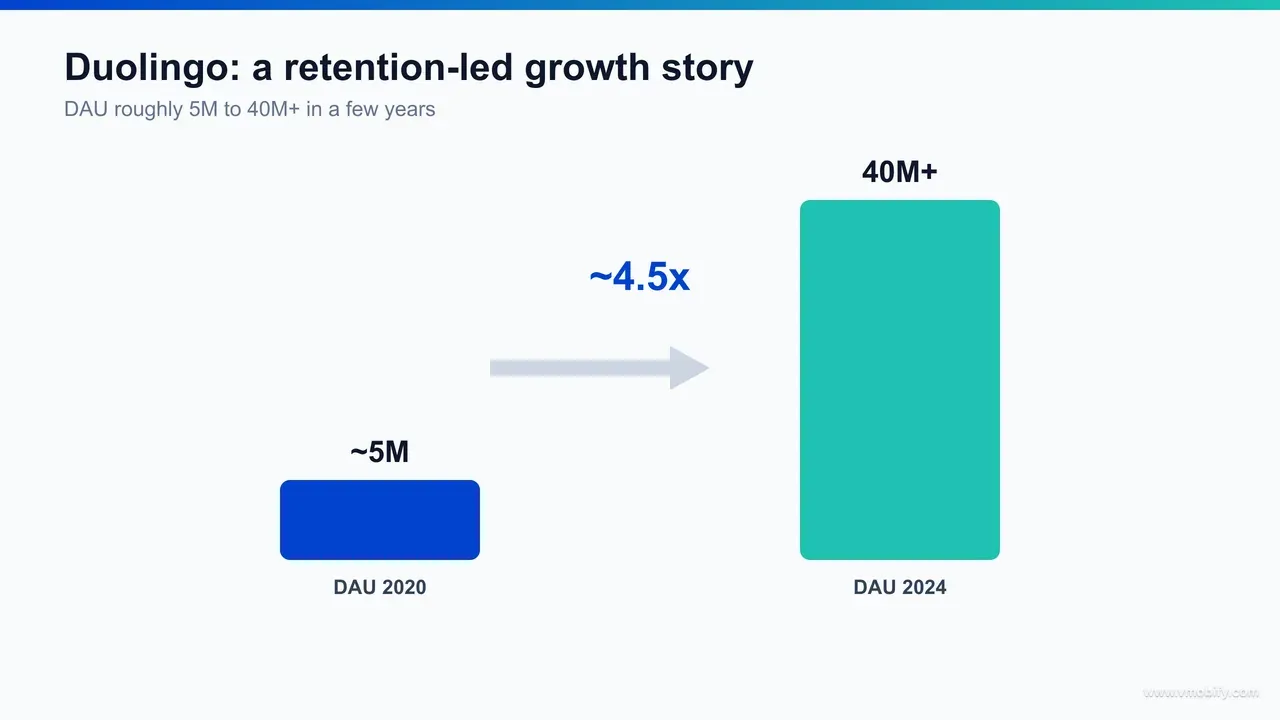
Duolingo's daily active users grew from roughly 5 million in 2020 to more than 40 million in 2024 — a ~4.5x jump driven not by buying more installs but by re-engineering retention. This is a teardown of the streak, notification, leaderboard and freemium system that compounds the habit, with the transferable lessons for your own app at the end of every section.
On this page
- What did Duolingo's growth actually look like?
- Why was retention, not acquisition, the real unlock?
- How do streaks engineer a daily habit?
- How did Duolingo rebuild notifications without being spammy?
- How do leaderboards and social features drive return visits?
- How does the freemium, widget and family-plan system monetise the habit?
- What is transferable to your app — and what is not?
- What are the limits and risks of copying this playbook?
- How do you apply one Duolingo lesson this quarter?
- Frequently Asked Questions
What did Duolingo's growth actually look like?
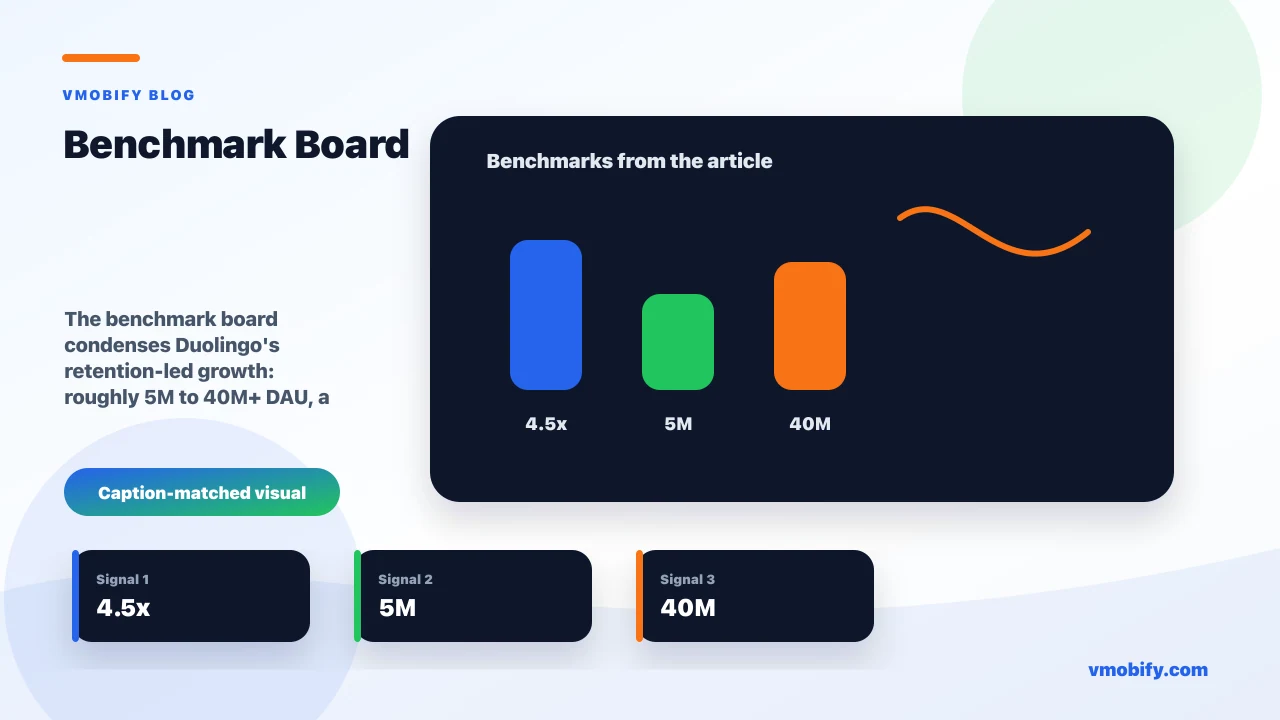
Duolingo's daily active users grew from roughly 5 million in 2020 to more than 40 million in 2024 — a rise of about 4.5x in a handful of years — and the striking part is that it happened without a proportionate increase in paid acquisition, which is what makes it a retention story rather than a spending one. The headline number is the daily active user (DAU) count, and the choice of metric is itself instructive: Duolingo's leadership has consistently treated DAU, not installs or registrations, as the number that matters.
The trajectory is well documented. As reported in Lenny's Newsletter's account of how Duolingo reignited user growth, the company's DAU curve flattened around 2020 and then re-accelerated sharply over the following years, reaching the 40 million-plus range by 2024. A flat curve turning into a steep one is the single most valuable shape in consumer software, and it almost never comes from buying more users — it comes from keeping the ones you already have.
It is worth being precise about what these figures are and are not. The ~5 million to 40 million+ DAU figures are reported company numbers, and the ~4.5x multiple follows directly from them. We are deliberately not inventing a more granular breakdown here, because the point does not need one: an order-of-magnitude move in daily actives, achieved while the install base grew far more modestly, can only be explained by users returning more often and churning less. That is the definition of a retention-led growth engine.
Why does a single app's curve deserve a full teardown? Because the mechanics underneath it — streaks, notifications, leagues, widgets, a freemium ladder — are not exotic. They are available to almost any consumer app, and most teams implement some version of them badly. Duolingo is the clearest worked example of the same primitives assembled into a system that compounds. Across our 300+ apps managed since 2013, the question we are asked most often is "how do we get our retention curve to bend upward like that?" — and the honest answer always starts with studying who already did it.
The rest of this teardown works through the system one layer at a time, and every section ends with the transferable lesson — the part you can actually take back to your own roadmap. Treat the numbers above as the why; the sections below are the how.
Why was retention, not acquisition, the real unlock?
Retention was the unlock because Duolingo had already proven it could acquire users cheaply through word of mouth and app-store presence — what was capping growth was how many of those users stayed, so the highest-impact work was reducing churn among already-engaged learners rather than buying a larger top of funnel. When acquisition is healthy and the curve is still flat, the leak is downstream, and pouring more water into a leaking bucket is the most expensive way to grow.
The mathematics of this are unforgiving and worth stating plainly. If you acquire users at a constant rate and retention is poor, your DAU settles at a ceiling: new users arriving roughly equal old users leaving, and the curve flattens no matter how much you spend. Improve retention even modestly and that equilibrium shifts upward, because each cohort contributes to the active base for longer. Improve it a lot — as Duolingo did among its most committed users — and the curve stops settling and starts climbing. This is the same compounding logic behind growth loops: a retained user is not a terminal output, they are an input to the next period's active base.
Duolingo's specific insight, as Lenny's reporting describes, was to focus relentlessly on its most-engaged cohort and the moments where they slipped. The team treated a committed daily learner breaking their habit as a defect to be engineered out, not an inevitability to be accepted. That reframing matters: most teams obsess over the new-user funnel and treat existing-user churn as background noise, when in fact the engaged-user churn rate is the number with the most influence on long-run DAU.
There is a strategic reason this works that goes beyond arithmetic. Acquisition costs rise as you scale — the next cohort of users is always harder and pricier to reach than the last, a dynamic every team running paid user acquisition learns the hard way. Retention has the opposite slope: a habit, once formed, costs almost nothing to maintain and pays back every single day. So the unit economics of fixing retention dominate the unit economics of buying installs, especially for a habit-frequency product like language learning where daily use is the whole point.
The transferable lesson: before you increase your acquisition budget, find out whether your problem is actually acquisition. Instrument your most-engaged cohort, measure where and when they churn, and ask whether a retention fix would move your active-user base more than the same money spent on installs. For habit apps, the answer is usually yes — and our wider guide to app retention strategy lays out how to diagnose that systematically.
How do streaks engineer a daily habit?
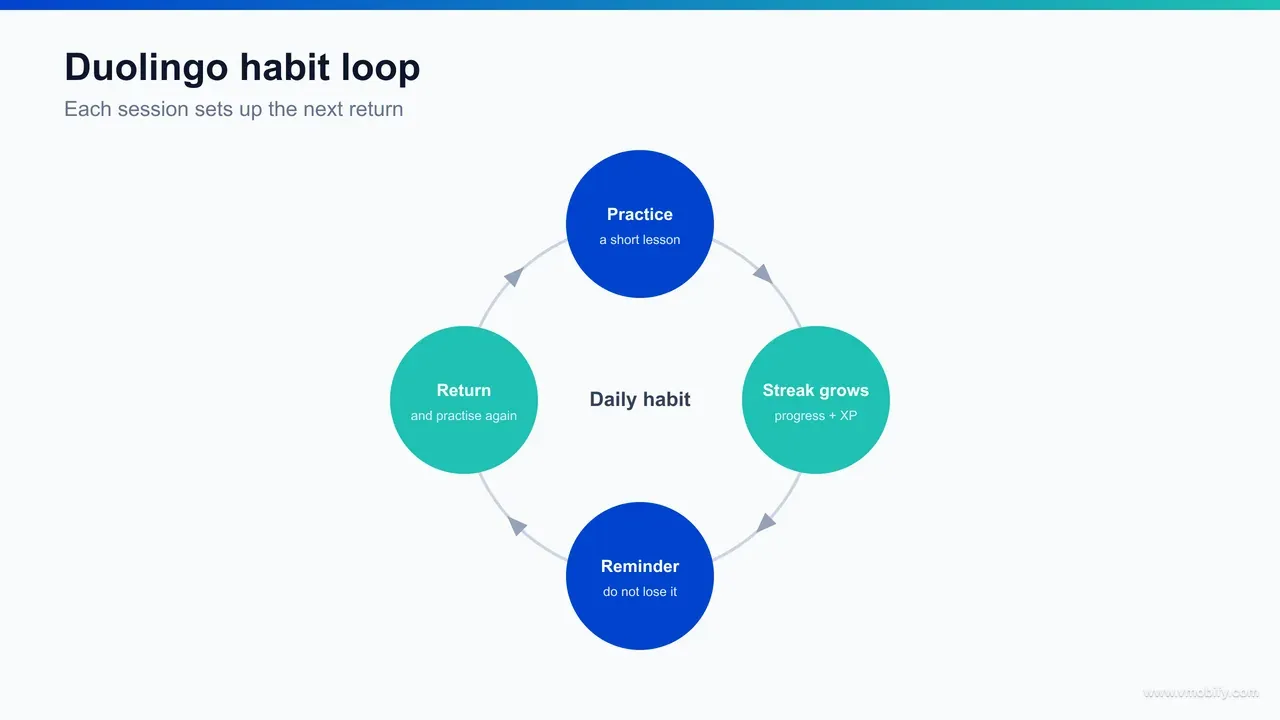
The streak engineers a habit by converting a vague intention — "I want to learn a language" — into a concrete, visible, daily obligation that the user is loath to break, and then protecting that obligation with repair mechanics so a single missed day does not collapse the whole thing. The streak is the load-bearing mechanic of the entire system; almost everything else exists to feed it or defend it.
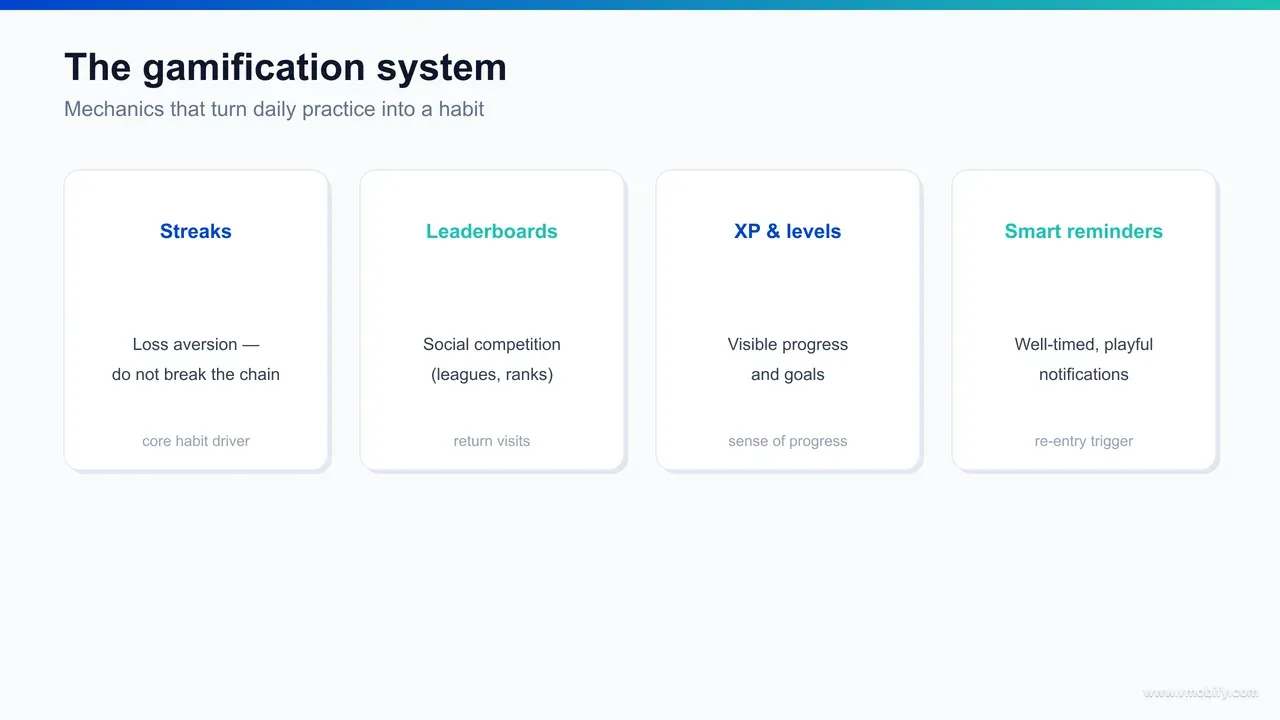
Its power comes from loss aversion and the sunk-cost instinct, both well documented in behavioural research. A 200-day streak is not just a counter — it is 200 days of accumulated effort the user does not want to forfeit. The longer the streak grows, the more there is to lose by skipping a day, so the mechanic gets stronger the longer it runs. In the language of the Hook Model that Nir Eyal popularised in his work on habit-forming products, the streak is the investment stage: a small daily deposit that raises the cost of leaving and loads tomorrow's trigger. We cover this loop in depth in our guide to mobile app UX that retains, and Duolingo is its textbook case.
What separates Duolingo's streak from the dozens of copycats is the defensive layer around it. A naive streak is brittle: miss one day and the user loses everything, which for a committed learner is so punishing that many simply give up rather than start again from zero. Duolingo softened that cliff with repair mechanics — streak freezes that absorb a missed day, and streak-repair options that let a lapsed user reclaim a broken streak. As StriveCloud's breakdown of Duolingo's gamification details, these recovery features are not generosity; they are retention engineering, because the moment a streak breaks is exactly the moment a habit is most likely to end for good.
The streak also gives every other mechanic something to point at. Notifications remind you to protect the streak. Widgets display it on the home screen so it is visible without opening the app. Leagues reward the consistency the streak measures. The streak is the spine that the rest of the gamification system attaches to — which is why bolting a streak onto an app as an afterthought rarely works. It has to be the thing the whole experience orbits.
The transferable lesson: a streak only works if the daily action it counts is genuinely valuable and achievable in a short session. Duolingo's daily lesson takes a few minutes — small enough to fit a commute, valuable enough to feel like progress. If your "daily action" is a chore or takes too long, a streak just manufactures guilt. Identify the smallest valuable daily behaviour in your product first, make it fast, then count it — and always build the repair mechanic, because the broken-streak moment is where habits die.
How did Duolingo rebuild notifications without being spammy?
Duolingo rebuilt notifications around relevance and timing rather than volume — sending reminders that land when a given user is actually likely to practise, in a voice that reinforces the habit instead of nagging it — because a notification that respects the user protects retention, while one that does not accelerates the uninstall and the OS-level mute. The overhaul of notifications, paired with the streak, is widely credited as a major driver of the DAU re-acceleration.
The hard constraint with notifications is that they are a finite trust budget. Every irrelevant or badly-timed push spends it down, and once a user mutes your app or revokes the permission, you have lost the channel permanently. So the goal is never "send more"; it is "send the right reminder to the right user at the right moment". Duolingo invested heavily in personalising send-time — learning when each user historically practises and aiming the reminder at that window — so the notification arrives as a useful nudge rather than an interruption. As Lenny's Newsletter recounts, the team ran extensive experimentation on notification content and timing, treating it as a core product surface rather than a marketing afterthought.
Tone did real work too. Duolingo's notification copy leaned into personality — the now-infamous owl, playful guilt, a recognisable character voice — which made the reminders memorable and even shareable rather than generic. There is a fine line here, and it is worth naming honestly: pushing too hard on guilt tips from motivating into manipulative, a failure mode that quietly burns the trust retention depends on. Duolingo has been criticised at times for leaning into the nagging-owl persona, and that criticism is the boundary of the technique: the same emotional lever that reactivates a lapsed learner can breed resentment if overused.
The deeper principle is that a notification should reference something the user has invested in. "Practise Spanish" is generic. "Your 47-day streak is about to end" is specific, personal and tied to the user's own accumulated effort — which is precisely why the streak and the notification system are co-dependent. The notification works because there is a streak to protect; the streak survives because the notification arrives in time to protect it. This is also the discipline behind effective lifecycle messaging generally: segment by behaviour, trigger on meaningful events, and measure each message against retention rather than open rate.
The transferable lesson: audit your notifications as a trust budget, not a megaphone. Personalise send-time to each user's actual usage pattern, tie every message to something the user has invested in, give an easy and granular opt-out, and measure each notification type against downstream retention — not the vanity open rate. A push that lifts opens today but raises mutes this week is a loss disguised as a win.
How do leaderboards and social features drive return visits?
Leaderboards drive return visits by adding a competitive, social reason to come back on top of the personal one — Duolingo's Leagues group learners into weekly cohorts that compete on points, so the user returns not only to protect their own streak but to hold or improve their rank before the week resets. Where the streak is an internal motivator, the leaderboard is an external one, and stacking both creates more reasons to open the app than either alone.
The mechanic is deliberately structured. Duolingo's Leagues sort users into divisions, give weekly promotion and relegation based on points earned, and reset on a fixed cadence — which creates recurring deadlines and a fresh competitive frame every week. The fixed reset is the clever part: it manufactures a regular, low-stakes urgency ("the week ends soon and I'm on the promotion line") that pulls return visits without the punishing all-or-nothing feel of a broken streak. As StriveCloud notes, the matchmaking that places you among similarly-active learners keeps the competition close enough to feel winnable, which is what makes it motivating rather than demoralising.
This is also a soft social loop. Even without explicit friend connections, competing against other real people changes the emotional texture of practice — it adds accountability and a sense that others are watching, both of which lift engagement. Layered on top are genuine social features: friend streaks, following, and shareable milestones that turn private progress into something a user can broadcast. Those shareable moments quietly double as acquisition, because a friend who sees a 365-day streak is a warm lead — retention mechanics and viral mechanics turning out to be two faces of the same system.
The risk with leaderboards is the same as with streaks: they can tip into compulsion or anxiety. A leaderboard that pits a casual learner against grinders who study for hours just makes the casual user feel hopeless and leave. Duolingo manages this through cohort matchmaking and divisions, so most users compete against a beatable peer group rather than the global top. The design lesson is that competition motivates only when it feels fair and winnable; unfair competition demotivates faster than no competition at all.
The transferable lesson: a leaderboard works when it is cohort-based, resets on a regular cadence, and matches users against beatable peers — never the global maximum. Used that way it manufactures recurring, low-stakes urgency that stacks cleanly on top of an individual habit metric like a streak. Used carelessly it crushes the very casual users who make up most of your base. Match carefully, reset regularly, and measure whether it lifts return frequency for the median user, not just the leaders.
How does the freemium, widget and family-plan system monetise the habit?
Duolingo monetises without breaking the habit by keeping the core daily learning loop free and frictionless, then selling convenience, comfort and reach around it — an ad-supported free tier, a subscription that removes friction (Super Duolingo), home-screen widgets that keep the streak visible, and a family plan that spreads the subscription across a household. The cardinal rule is that monetisation never blocks the habit; it sits beside it and sells things that make the habit smoother or shareable.
The freemium ladder is carefully tiered. The free tier carries ads and certain frictions — limited hearts, the occasional interruption — that are mildly annoying without being prohibitive, which is the whole design: the free experience has to be good enough to build the habit, because a user with no habit never converts. The paid tier (Super Duolingo) removes the ads and the friction, and crucially it is sold to users who are already retained and already value the product daily. Selling a subscription to someone who opens your app every day on a 100-day streak is a fundamentally easier conversion than selling to a stranger — which is why retention is upstream of monetisation, not separate from it.
Widgets are an underrated part of the system. A home-screen widget that displays the current streak and flame keeps the user's investment visible without them opening the app, which both reinforces the habit (the streak is always in view) and creates a one-tap re-entry point. It is a free, owned, always-on reminder surface that competes with — and complements — notifications. The family plan, meanwhile, is a monetisation and retention play at once: it lowers the per-person price to broaden the paid base, and a household where several people are learning creates social accountability that lifts everyone's retention.
Then there is the higher tier — Duolingo Max, which bundles AI-powered features at a premium price — extending the ladder upward for the most committed users. The pattern across all of it is a monetisation ladder matched to engagement: free for habit formation, mid-tier subscription for convenience, family plan for breadth, premium tier for power users. Nobody is forced to pay to maintain their streak, which is the line that keeps the habit intact. We see the same principle work across our portfolio: the apps that monetise sustainably sell on top of a free habit rather than holding the core hostage, a structure we detail in our work on retention-led monetisation strategy.
The transferable lesson: protect the core habit loop and never paywall it. Build your monetisation as a ladder that sells convenience, comfort, reach or power to users who are already retained — because a retained user converts far more readily than a fresh one, and a habit you have paywalled is a habit you have killed. Keep the daily action free, sell everything around it.
What is transferable to your app — and what is not?
What transfers is the system and the discipline behind it — identify the one daily action that predicts retention, engineer a visible habit metric around it, defend that metric with timely reminders and repair mechanics, and monetise on top of it — but the surface decorations (a streak counter, a cartoon mascot, a leaderboard) do not transfer on their own and copying them without the underlying logic usually backfires. The mistake teams make is cargo-culting the owl instead of the engine.
Start with what genuinely transfers. The first principle is choosing the right north-star behaviour: Duolingo picked daily lessons because daily practice is how language learning actually works, so the metric and the value are aligned. Your equivalent is the single repeated action that most strongly predicts whether a user is still around in week four — and finding it is an analytics exercise, not a guess. This is precisely the diagnostic work our analytics service runs first with any retention client: instrument the engaged cohort, isolate the behaviour that separates retained users from churned ones, and only then design mechanics around it.
The second transferable principle is the reinforcing system. Duolingo's components are not independent features bolted on by different teams; they interlock — the streak gives notifications something to protect, the leaderboard rewards the streak, the widget displays it, the subscription removes friction from it. A streak with no notification to defend it, or a leaderboard pointing at no underlying habit, achieves little. The lesson is to design the loop whole, not to ship four disconnected gamification features and hope.
Now what does not transfer. The mascot and the playful brand voice are specific to Duolingo's product and audience; pasting a guilt-tripping owl onto a banking app would read as absurd. More importantly, the entire playbook assumes a habit-frequency product — something a user has a genuine reason to open daily or near-daily. That is the load-bearing assumption, and the next section is devoted to it. A streak on an app a user has reason to open twice a year is not a habit mechanic; it is a source of confusion and guilt that actively harms the experience.
There is also a maturity caveat. Duolingo could invest in send-time personalisation and league matchmaking because it had the scale, the data and the engineering depth to do so. A pre-product-market-fit app trying to replicate the full apparatus before it has a core experience worth returning to is optimising the wrong thing — the gamification will sit on top of nothing. Build the valuable core first; the mechanics are a multiplier on value, never a substitute for it.
The transferable lesson: take the method, not the motifs. Find your retention-predicting action, build one interlocking loop around it, and resist the urge to copy Duolingo's surface features until you have your own version of the habit they are reinforcing. In our portfolio, the teams that succeed adapt the system to their product; the ones that fail copy the screenshots.
What are the limits and risks of copying this playbook?
The biggest limit is frequency fit — the entire playbook assumes a product users have a real reason to open daily, and it fails or backfires on low-frequency apps — and the biggest risks are gamification tipping into manipulation, optimising a vanity metric while real value stalls, and burning trust with pressure-based mechanics that lift this week's numbers and corrode next quarter's. Duolingo's system is powerful precisely because it fits its product; bolted onto the wrong product, the same mechanics do harm.
The frequency point is the one most teams get wrong. Language learning, fitness, journalling, news, social — these reward daily use, so a daily streak aligns the mechanic with genuine value. But a tax-filing app, an insurance app, a travel-booking app or a real-estate app has no honest reason for daily engagement. Forcing a streak onto a low-frequency product manufactures guilt over a behaviour the user has no real cause to perform, and savvy users see straight through it. The first risk-screen for this entire playbook is a single question: does my product have a legitimate daily or near-daily use case? If not, copy the retention discipline but not the daily-streak mechanic.
The second risk is the slide from motivation into manipulation. The same loss aversion that makes a streak motivating can be weaponised into anxiety — aggressive streak-loss warnings, guilt-laden notifications, fear-of-missing-out pressure. Duolingo itself has drawn criticism for leaning hard on guilt, and that criticism marks the boundary. Engagement bought with stress is brittle: it inflates daily-active numbers while quietly teaching users to associate the app with pressure, and pressure-associated apps get muted, then deleted. We treat this as a first-order design constraint, not a footnote: engagement bought with pressure is the kind that churns with a bad taste.
The third risk is metric tunnel vision. Gamification can drive a number — DAU, sessions, points earned — that drifts away from real value. A user who opens the app daily to tap through a meaningless lesson just to save a streak is engaged on the dashboard and learning nothing in reality, and eventually that hollowness shows up as churn anyway. The defence is to measure gamification against genuine value delivered and long-run retention cohorts, not against the engagement metric the mechanic most directly inflates — the same discipline of measuring against retention rather than instant numbers that should govern every UX change.
The transferable lesson: pressure-test fit before you build. Confirm your product earns daily use, design every mechanic to reflect real progress rather than to coerce, and instrument against long-run retention and real value — not the vanity metric the gamification touches first. Used on the right product with honest motivation, this playbook compounds; used on the wrong one or with manipulative intent, it spends trust you cannot easily buy back.
How do you apply one Duolingo lesson this quarter?
Pick one lesson and ship it properly rather than copying the whole system at once: find the single daily or weekly action that most strongly predicts whether your users stay, make that action fast and valuable, then build one visible progress mechanic and one well-timed reminder around it — and measure the result against your week-four retention cohort, not against opens. One well-executed loop beats five half-built gamification features every time.
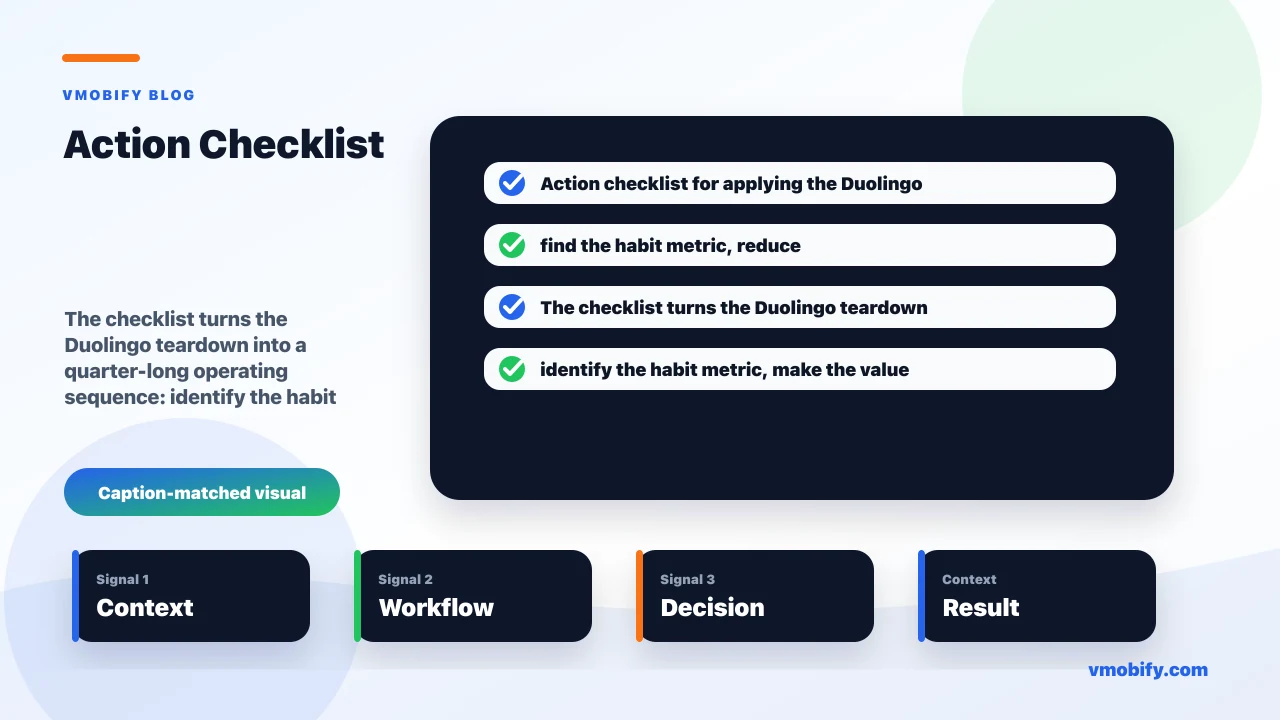
Here is a concrete quarter-long sequence you can actually run:
- Weeks 1-2 — find your habit metric: instrument your engaged cohort and identify the one repeated behaviour that best separates retained users from churned ones. This is the equivalent of Duolingo's daily lesson, and it is an analytics question, not an opinion. If you do not have the instrumentation to answer it, that is the first thing to fix.
- Weeks 3-4 — make the action fast and valuable: strip friction from that core action so it can be completed in a short session and reliably delivers a sense of progress. A streak on a chore is just guilt; the action has to be worth doing daily before you count it.
- Weeks 5-8 — build one visible progress mechanic: a streak, a progress bar, a completion ring — whatever reflects real progress on your habit metric — and always include a repair or grace mechanic so a single lapse does not end the habit. The repair mechanic is not optional; the broken-streak moment is where habits die.
- Weeks 9-10 — add one timely, personalised reminder: tie a single notification to the user's own investment ("your streak is about to end"), aim it at their actual usage window, and make opt-out easy and granular. Resist the urge to add five notifications — add the one that protects the habit.
- Weeks 11-12 — measure against retention, not opens: read the week-four retention cohort for users exposed to the new loop versus a control. Keep it only if it lifts genuine return frequency and retention, not just a same-week vanity metric.
The order matters. Most teams start at the gamification end — they ship a streak counter in week one — and skip the analytics work that tells them whether they are reinforcing the right behaviour. That is how you end up with a beautifully animated streak attached to an action nobody values. Duolingo's advantage was never the streak; it was the discipline of knowing exactly which behaviour to reinforce and then reinforcing it relentlessly, an approach the product-analytics community at Amplitude documents across many habit-forming products.
If you want help running that diagnosis — finding your retention-predicting action, designing the loop around it, and measuring it properly against cohorts rather than vanity metrics — that is exactly the work our team does. Across our 300+ apps managed since 2013, the single highest-return retention project is almost always this one. See how we approach it across our case studies, or talk to us directly about your app's habit loop.
Frequently Asked Questions
How much did Duolingo grow?+
Duolingo's daily active users grew from roughly 5 million in 2020 to more than 40 million in 2024 — about a 4.5x increase. These are reported company figures, and the move came mainly from improved retention rather than a proportionate rise in paid acquisition.
What drove Duolingo’s growth?+
The dominant driver was retention engineering — a major overhaul of streaks, notifications and gamification that reduced churn among already-engaged learners. Keeping committed daily users coming back compounded far faster than spending more on installs.
Why is the Duolingo streak so effective?+
The streak converts a vague intention to learn into a concrete daily obligation, and loss aversion makes a long streak feel too valuable to break. Streak-freeze and repair mechanics stop a single missed day from ending the habit, which is the moment most habits otherwise die.
How did Duolingo make notifications work without being spammy?+
It personalised send-time to each user’s actual practice window, tied each reminder to something the user had invested in (like a streak about to end), and used a memorable brand voice. The principle is treating notifications as a finite trust budget, not a megaphone.
Can any app copy the Duolingo playbook?+
Only habit-frequency apps should copy it directly. The whole system assumes a product users have a real reason to open daily or near-daily; forcing a streak onto a low-frequency app like tax filing or insurance just manufactures guilt and backfires.
What is the single most transferable Duolingo lesson?+
Find the one daily or weekly action that predicts whether users stay, make it fast and valuable, then build a visible progress mechanic and a timely reminder around it — and measure against week-four retention cohorts, not opens. The method transfers; the mascot does not.
What does Vmobify do to help with retention?+
Our analytics team instruments your engaged cohort to find the behaviour that predicts retention, then helps design and measure the habit loop around it. See /services/analytics, and our guides on app retention strategy and growth loops for the wider framework.
Sources
- Lenny's Newsletter — How Duolingo reignited user growth — DAU trajectory, the retention focus, and the notification overhaul
- StriveCloud — Duolingo gamification breakdown — How streaks, repair mechanics and leagues drive the daily habit
- Amplitude — Product analytics and retention blog — Habit-metric instrumentation and retention-driver analysis
- Nir Eyal — The Hook Model — Trigger, action, variable reward and investment loop behind streaks
- Duolingo — Official blog — First-party context on streaks, leagues and product features
- Duolingo — Investor relations — Reported daily-active-user and engagement figures
- Nielsen Norman Group — UX research — Evidence base for habit, friction and notification UX
About the author
Amol Pomane — Founder, Vmobify
Amol leads Vmobify, a mobile app growth agency that has driven 30M+ downloads and ranked 54K+ keywords across 300+ apps since 2013. He writes about ASO, paid user acquisition, retention, and the operational reality of scaling mobile apps in India and global markets.