How Instagram Grew: A Virality & Network-Effects Teardown
Instagram reportedly reached its first million users within weeks of launch and went on to surpass a billion — and it did it without a clever paid-acquisition trick. This is a teardown of the sharp single use-case, the frictionless cross-posting, the follow-driven content and notification loop, the fast simple product, and the later Stories expansion that compounded it all, with the transferable lesson at the end of every section.
On this page
- What did Instagram's early growth actually look like?
- How did a sharp single use-case and filters drive word of mouth?
- How did cross-posting and sharing seed the network?
- How do follows create a content and notification growth loop?
- How did product speed and simplicity reduce friction?
- How did Stories extend the growth loop later?
- What is transferable to your app?
- What are the limits and risks of copying this?
- How do you apply one Instagram lesson this quarter?
- Frequently Asked Questions
What did Instagram's early growth actually look like?
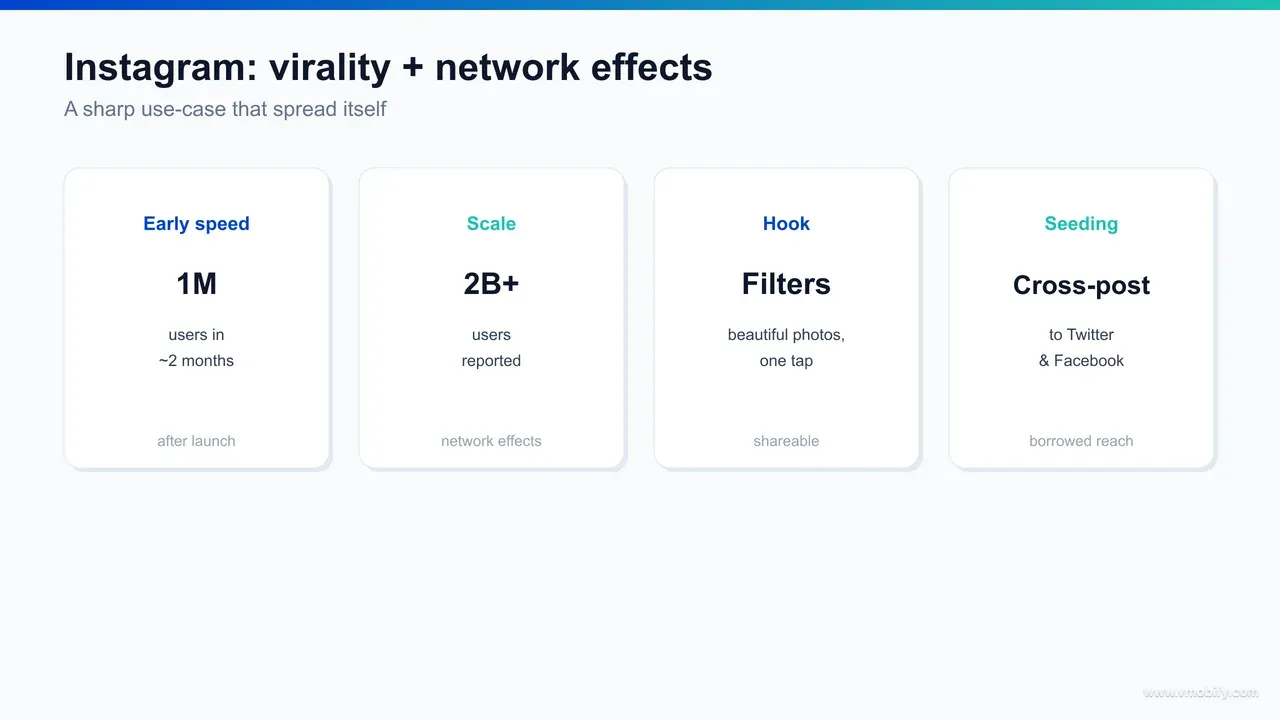
Instagram launched in October 2010 and, as widely reported, reached its first million users within a matter of weeks — then kept compounding until it passed a billion users years later — and the reason it deserves a teardown is that this curve was driven by product loops and word of mouth rather than by an outsized paid-acquisition budget. The early growth was not a slow grind; it was a near-vertical line that took almost everyone, including the founders, by surprise.
The trajectory is well documented across the growth-writing canon. Accounts on Lenny's Newsletter and the network-effects writing of Andrew Chen describe the same shape: a tiny team, a single iOS app, a launch-week surge that overwhelmed the servers, and a user base that kept doubling without a corresponding spend line to explain it. A flat launch that turns into a steep climb almost never comes from buying installs — it comes from a product people use and then tell other people about.
It is worth being precise about what these figures are and are not. The October 2010 launch date, the first-million-in-weeks milestone, and the eventual billion-plus user count are widely reported public facts; we are deliberately not inventing a more granular week-by-week breakdown, because the point does not need one. An app that adds a million users in weeks with a handful of engineers and negligible media spend can only be explained by mechanics inside the product that turn each user into a source of more users. That is the definition of a viral, network-effect-led growth engine.
Why does a decade-old photo app deserve a full teardown now? Because the primitives underneath it — a narrow use-case, cross-posting into existing networks, a follow graph, a content-and-notification loop, a fast share — are available to almost any consumer app today, and most teams assemble them badly. Instagram is the cleanest worked example of the same primitives composed into a system that compounds. Across our 300+ apps managed since 2013, the question we hear most from consumer-app founders is "how do we get a curve that bends upward on its own?" — and the honest answer always starts with studying who already did it.
The rest of this teardown works through the system one layer at a time, and every section ends with the transferable lesson — the part you can actually take back to your own roadmap. Treat the numbers above as the why; the sections below are the how.
And as a frame for all of it: Instagram did not grow because it had filters; it grew because the filters fed a loop.
How did a sharp single use-case and filters drive word of mouth?
Instagram drove word of mouth by being ruthlessly narrow — it did one thing, make an ordinary phone photo look beautiful in a single tap and share it, which gave every user an instantly obvious reason to use the app and, just as importantly, an obvious thing to show their friends. The filters were not a gimmick; they were the visible, shareable proof that the product worked, and shareable proof is the raw fuel of word of mouth.
The narrowing was a deliberate act. The product that became Instagram was, as widely retold in startup lore, carved out of a bloated check-in app called Burbn; the founders stripped away everything except photos, filters and the social feed. That focus is the whole lesson. A product that does ten things is hard to describe, hard to recommend and hard to form a habit around. A product that does one thing exceptionally well — "it makes your photos look amazing" — is a single sentence anyone can repeat, and a recommendation you can compress into one sentence travels far faster than one you cannot.
The 2010 context made the filters genuinely valuable rather than cosmetic. Phone cameras then produced flat, often disappointing images; a filter that turned a dull lunch photo into something with mood and warmth delivered a real, visible upgrade in a single tap. That visible before-and-after is what made the app demonstrable: you could hand someone your phone, apply a filter, and the value was self-evident in under a second. As the network-effects writing at a16z repeatedly stresses, products that grow virally almost always have an output that is itself the advertisement — and a beautiful photo posted publicly is exactly that.
This is the part most teams miss when they chase virality. They bolt a "share" or "invite a friend" button onto a product whose core output is invisible or unremarkable, then wonder why nobody shares. Instagram never needed to beg for shares, because the act of using the product — creating a beautiful image — produced an artefact that people wanted to post for their own reasons. The growth was a by-product of the value, not a tax bolted on top of it. That distinction is the difference between a referral programme that limps and one that compounds, which is why we treat the shape of the shareable artefact as the first design question in any mobile app referral programme.
The transferable lesson: find the single most valuable thing your product does, make it demonstrable in seconds, and make its output something a user is proud to show. Resist the urge to launch broad. A sharp, one-sentence use-case is both easier to recommend and easier to build a loop around than a feature-rich product nobody can summarise. Narrow your scope until the value is undeniable in a single tap — then let the artefact do your marketing.
How did cross-posting and sharing seed the network?
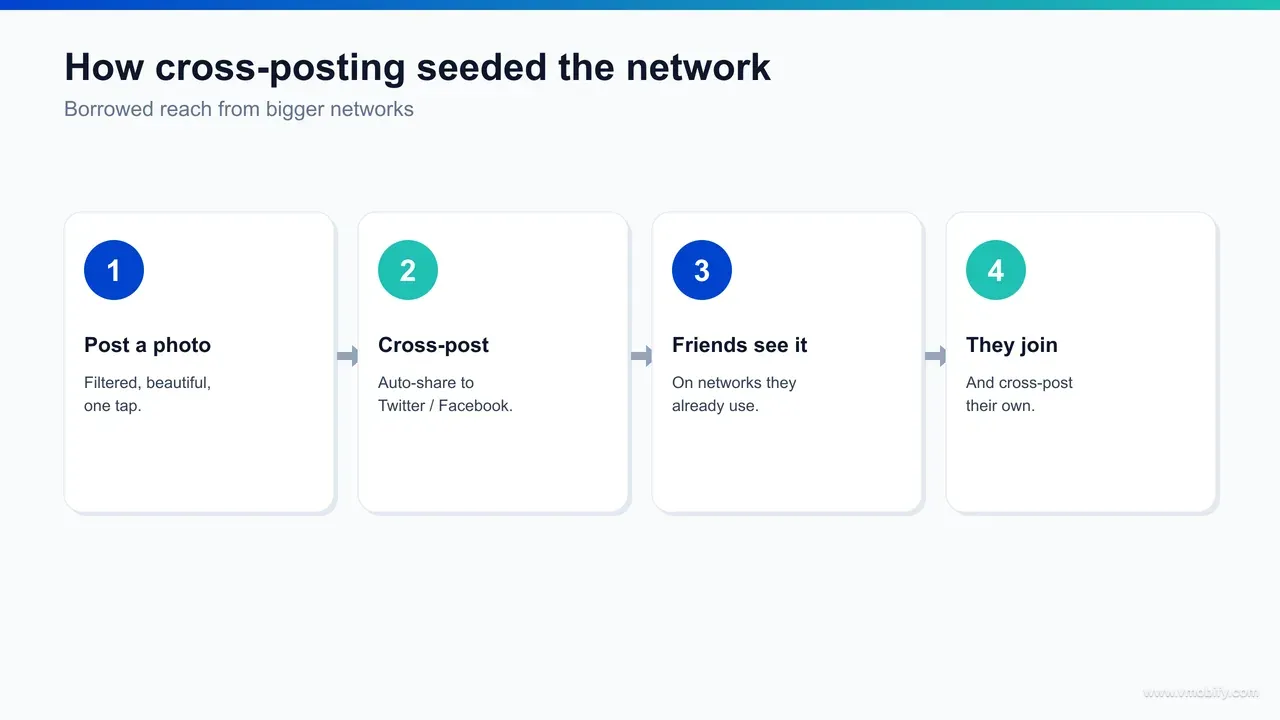
Cross-posting seeded Instagram by making it trivial to push a freshly-filtered photo straight to Twitter and Facebook — networks that already had hundreds of millions of active users — so every shared image became a free advertisement inside someone else's audience, complete with a link or a recognisable look that pulled curious viewers back to the app. Instagram did not have to build distribution from zero; it borrowed the distribution of the incumbents.
This is the move that separates a viral product from a merely good one. A new social app faces a brutal cold-start problem: it is empty, and an empty network is worthless, so nobody stays. Instagram sidestepped the empty room by letting users broadcast their Instagram content to the populated rooms next door. When someone posted a beautiful Instagram photo to Twitter, their existing followers saw it, noticed the distinctive look, asked what it was, and a fraction of them downloaded the app. The full-size photo and the in-app social graph lived on Instagram, so the cross-post was a teaser that drove traffic home. As Andrew Chen's writing on network effects and the cold-start problem argues, riding an adjacent network's distribution is one of the very few reliable ways to solve cold start.
The mechanics mattered. Cross-posting was not buried three menus deep — it was offered right at the moment of sharing, as a default-friendly toggle, so the path of least resistance produced free external distribution. Every friction point removed from that step multiplied the number of seeds planted on Twitter and Facebook. This is a recurring pattern in viral design: the loop only compounds if the step that exposes new people to the product is the easy, obvious, almost-automatic path rather than an extra chore.
There is a subtler effect too. Because the photos were beautiful and visibly different from the flat snapshots filling other feeds, an Instagram cross-post stood out. The product's core value — the filtered look — was also its acquisition hook on rival platforms: people did not just see "a photo", they saw "a better-looking photo, and a small badge telling them where it came from". The artefact carried both the value and the attribution, which is the ideal shape for a growth loop. We dig into how to design exactly this kind of self-distributing artefact in our guide to app growth loops, because it is the single highest-leverage structure a consumer app can have.
The transferable lesson: do not try to build a network in a vacuum. Identify the large, established platforms where your users already are, and make sharing your product's output to those platforms effortless and rewarding for the user. Design the shared artefact so it both delivers value to the viewer and carries a path back to you. Borrowing distribution from incumbents is how almost every viral consumer app, Instagram included, escaped the cold-start trap — and it is far cheaper than buying that audience through paid user acquisition.
How do follows create a content and notification growth loop?
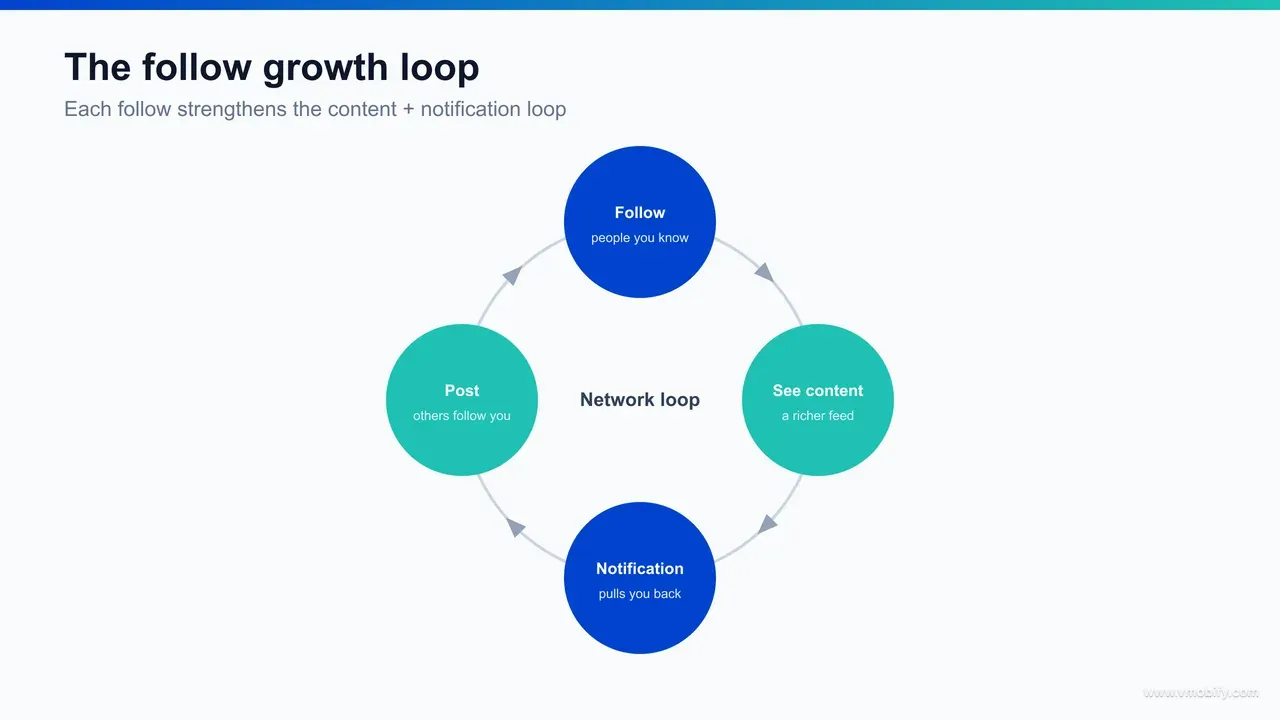
Follows create a growth loop because each new follow does two compounding things at once: it adds someone's content to your feed, giving you a reason to come back, and it adds a relationship that justifies a notification — a like, a comment, a new post — which pulls you back even when you were not planning to open the app, and each return visit tends to produce more posts, more follows and therefore more of both. The follow graph is the engine room of Instagram's retention and its virality at the same time.
Walk the loop one turn at a time. You follow a handful of people, so your feed now has content worth checking. You open the app, see their posts, like a few, maybe post your own. Your post triggers notifications to your followers, some of whom open the app, engage, and post in turn — triggering notifications back to you. Meanwhile the app suggests more accounts to follow, each of which thickens your feed and widens the notification surface. Every loop adds content, adds connections and adds reasons to return. This is a textbook reinforcing system: the output of one turn (engagement, posts, follows) is the input to the next — the same compounding structure that powers every durable growth loop.
Notifications are the part that makes the loop active rather than passive. A feed alone is a pull mechanism — it only works if the user decides to open the app. Notifications are a push mechanism — they reach out and create the visit. The genius of a social follow graph is that it manufactures a near-endless, personalised supply of legitimate notification triggers: someone you know liked your photo, commented, started following you, posted something new. Each of these is genuinely relevant because it concerns people and content you chose to connect with, which is why they pull return visits instead of being muted. The same discipline that makes a notification welcome rather than spammy — relevance, personalisation, tying the message to something the user invested in — is the one we tore down in detail in our teardown of how Duolingo grew.
The loop also has a virality outlet baked in. Engagement and posting do not just retain existing users; they spill outward through cross-posts, shared links, tagged friends and "join me" moments, each of which exposes new people to the product. So the very same follow-driven loop that keeps current users returning is also pulling new users in — retention and acquisition turn out to be two faces of one mechanism. That dual nature is precisely what makes network-effect products so hard for competitors to dislodge once the graph is dense: leaving means abandoning your audience and your feed at once.
The transferable lesson: if your product has any social or collaborative dimension, the connection graph is your most valuable growth asset — invest in making the first few connections fast and obvious, because an empty graph produces no content and no notifications, and a user who reaches the app with an empty feed usually churns. Engineer the loop so that each connection adds both content (a reason to return on the user's own initiative) and a notification trigger (a reason you can create the return). Then measure return frequency, not just installs.
How did product speed and simplicity reduce friction?
Speed and simplicity were a growth feature in their own right — Instagram made the core action of capturing, filtering and sharing a photo feel almost instant by uploading in the background and keeping the interface stripped to the essentials, which lowered the friction on the exact action that drives the entire loop, so more people completed it more often. Every loop in this teardown depends on users actually posting; anything that slows the post slows the whole engine.
The cleverest piece of engineering was perceived speed. Rather than make a user stare at a progress bar after tapping share, Instagram let them choose a filter and write a caption while the image was already uploading in the background, so by the time they hit "post" the photo was effectively ready. The share felt immediate even on the patchy 3G connections of 2010. This is friction reduction at the precise moment it matters most — the moment of contribution — and shaving seconds off that step compounds across millions of posts into a meaningfully higher posting rate. More posts means more feed content, more notifications, more cross-posts, more growth.
Simplicity did parallel work. The early app had a tiny surface area: a feed, a camera, a profile, and not much else. A new user could understand the entire product in seconds, which crushed the time-to-value and meant almost nobody bounced in confusion before reaching the first beautiful photo. A simple product is also a fast product to build, test and keep reliable — and reliability was load-bearing, because an app that crashes or stalls during the share breaks the loop at its most fragile point. The discipline of doing few things well kept both the user experience and the codebase fast.
There is a measurement lesson hiding here. The teams that win on friction are the ones that instrument the core action as a funnel — open camera, capture, filter, caption, share, confirmed-posted — and hunt down the step with the biggest drop-off. In our portfolio, the single highest-return optimisation for consumer-social and creator apps is almost always tightening this contribution funnel rather than adding features, and finding the leak is an analytics exercise, which is exactly the diagnostic our analytics service runs first. You cannot reduce a friction you have not measured.
The transferable lesson: treat the latency and step-count of your core loop action as a growth metric, not a polish detail. Find the one action your loop depends on — the post, the message, the upload, the booking — instrument it as a funnel, and relentlessly cut steps and perceived wait, including by doing slow work in the background while the user does something useful. A loop that depends on a slow or confusing action will always underperform one built on a fast, obvious one, no matter how clever the mechanics layered on top.
How did Stories extend the growth loop later?
Stories extended Instagram's loop years later by adding a second, lower-pressure way to contribute — ephemeral, full-screen, casual posts that disappear after a day — which dramatically widened the pool of people willing to post and thereby pumped far more content and far more notification triggers into the same follow graph that already powered the app. It was not a new product; it was a new on-ramp into the existing engine.
The insight behind Stories was that the main feed had become high-stakes. As Instagram matured, the permanent grid felt like a curated portfolio, and the pressure to post only polished, lasting content suppressed casual sharing — many users became lurkers who consumed but rarely contributed. A loop starves when the contributor pool shrinks: fewer posters means a thinner feed and fewer notifications for everyone. Stories solved this by lowering the stakes. Because a Story vanishes in 24 hours and sits outside the permanent grid, the bar to post drops, and people who never touched the main feed started sharing daily fragments of their lives.
That reopened contribution had compounding effects on the loop. More people posting means more content to consume, which lifts time-in-app; more posts means more reactions, replies and views, which means more notifications, which means more return visits, which produce yet more posts. Stories also introduced lightweight, near-real-time interactions — quick reactions and replies — that generated a fresh stream of notification triggers without the weight of a public comment. It was the same content-and-notification loop from earlier in this teardown, but now fed by a much larger share of the user base.
The strategic lesson is about loop maturity. A growth loop is not a "set it and ship it" structure; it decays as a product ages and as user behaviour shifts. Instagram's original loop was being throttled by social pressure on the contributor side, and rather than accept the decay, the team added a new contribution mode that re-expanded the input to the loop. The companies that sustain network-effect growth over a decade are the ones that keep re-opening the contribution funnel as the old one narrows. Across our portfolio, the mature apps that keep compounding are invariably the ones that periodically add a lower-friction way to contribute, rather than assuming the launch-day loop will run forever.
The transferable lesson: watch the contributor side of your loop, not just the consumer side. If posting, contributing or inviting becomes high-stakes as your product matures — if active contributors shrink into passive lurkers — the loop is quietly starving even when top-line numbers still look fine. The fix is usually a new, lower-pressure contribution mode that re-expands who is willing to feed the loop, not a wholesale rebuild. Protect and periodically widen the on-ramp to contribution, because content supply is the input the entire engine runs on.
What is transferable to your app?
What transfers is the method and the loop logic — launch one sharp valuable use-case, make its output a shareable artefact, borrow distribution from networks where your users already are, and engineer a connection-driven content-and-notification loop you can measure — but the specific surface decorations (photo filters, a square feed, ephemeral Stories) do not transfer on their own, and copying them without the underlying loop usually achieves nothing. The mistake teams make is cargo-culting the filters instead of the engine that the filters happened to feed.
Start with what genuinely transfers. The first principle is the narrow, demonstrable use-case: Instagram won by doing one thing so well that its output advertised itself. Your equivalent is the single most valuable action your product performs, made so good and so demonstrable that users want to show it. Finding that action and making its output shareable is a product-design exercise, not a marketing one — the marketing is a consequence of getting the product shape right.
The second transferable principle is borrowed distribution. You almost never need to build an audience from scratch; you need to identify the large platforms where your prospective users already gather and make sharing your output into those rooms effortless and rewarding. This is how Instagram beat the cold-start problem, and it is available to nearly any consumer app willing to design its artefact to travel. The third principle is the reinforcing loop: connections that add both content and notification triggers, with each return visit producing more of both. Design that loop whole — do not ship a feed with no notifications, or a notification system pointing at no underlying connection graph, because the halves are worthless apart.
Now what does not transfer. The filters and the square photo format were specific to 2010's weak phone cameras and a particular cultural moment; pasting "add filters" onto an unrelated app is meaningless. More fundamentally, Instagram's defensibility came from network effects — the value of the dense follow graph — and network effects are notoriously hard to manufacture on demand, which is the entire subject of the next section. You can copy the tactics; you cannot copy the accumulated graph. A like-button and a follow-button on a product nobody has a social reason to use will not summon a network into being.
There is also a sequencing caveat. Instagram could invest in a follow graph because it had a genuine reason for people to connect — they wanted to see each other's photos. A pre-product-market-fit app bolting on social features before it has a core experience worth returning to is building the loop on top of nothing. Get the narrow valuable core right first; the loop is a multiplier on value, never a substitute for it. In our portfolio, the teams that succeed adapt this method to their own product and audience; the ones that fail copy the screenshots and wonder why the graph stays empty.
The transferable lesson: take the loop, not the look. Find your demonstrable use-case, make its output a self-distributing artefact, borrow distribution from where your users already are, and build one measurable content-and-notification loop around your connection graph — and resist the urge to copy Instagram's surface features until you have your own version of the value they were reinforcing.
What are the limits and risks of copying this?
The biggest limit is that network effects are extremely hard to copy — Instagram's durable advantage was an accumulated, dense follow graph that cannot be conjured on demand — and the biggest risks are timing dependence, the brutal cold-start problem, survivorship bias in the lesson, and the fact that virality without genuine retention just fills a leaky bucket faster. The mechanics in this teardown are powerful where they fit, and actively misleading where they do not.
The network-effects point is the one most teams underestimate. A follow graph is valuable precisely because it is hard to rebuild — which means it is just as hard for you to build as it was for any would-be Instagram competitor. You can copy the follow button, the feed and the share flow in a weekend, and still have nothing, because the asset was never the buttons; it was the millions of relationships and the content they produce. If your product has no honest reason for users to form a dense web of connections, no amount of social UI will manufacture a network effect. The first risk-screen for this entire playbook is a single question: does my product have a genuine reason for users to connect to each other? If not, borrow the distribution and friction lessons but do not expect the defensibility.
The second risk is timing and survivorship. Instagram launched into a specific window — weak phone cameras that filters dramatically improved, a fresh App Store with room to be discovered, and incumbent networks (Twitter, Facebook) that openly permitted cross-posting before they grew defensive about it. Those conditions were partly luck, and they have largely closed: cameras are excellent now, the stores are crowded, and the big platforms guard their distribution jealously. Reading Instagram's story as a pure repeatable formula ignores how much the environment cooperated, and the writing at a16z is candid that for every viral breakout there are countless structurally similar products that never caught. Survivorship bias makes the playbook look more reliable than it is.
The third risk is mistaking virality for retention. A viral loop that acquires users fast but a product that does not retain them just empties the bucket faster than it fills — you pay (in engineering, in distribution goodwill) to pour users into a leaking container. Instagram worked because the follow graph drove genuine retention underneath the virality; the loop both acquired and kept. We treat this as a first-order constraint, not a footnote: chase the viral coefficient before you have a retention floor and you will manufacture a spike that collapses, which is exactly the failure mode a poorly-built referral programme produces when it is bolted onto an app people do not actually want to keep using.
The transferable lesson: pressure-test fit before you copy. Confirm your product has a real reason for users to connect, be honest that the 2010 conditions were partly timing you will not get back, account for the products that tried the same moves and failed, and never optimise virality ahead of retention. Used on a genuinely social product with a real retention floor, these mechanics compound; used on a product without a reason to connect, they produce a brief, expensive spike and not much else.
How do you apply one Instagram lesson this quarter?
Pick one lesson and ship it properly rather than trying to replicate the whole system at once: identify the single shareable artefact your product can produce, make creating it fast and the output something users are proud to show, wire effortless sharing into one network where your users already are, and measure the result against new-user acquisition and week-four retention — not against raw shares. One well-built loop beats five half-finished viral features every time.
Here is a concrete quarter-long sequence you can actually run:
- Weeks 1-2 — find your shareable artefact: identify the one output your product creates that a user would genuinely want to show someone — a result, a creation, a milestone, a beautiful screen. If your product has no such artefact, that is the first thing to design, because a loop with nothing worth sharing has no fuel.
- Weeks 3-4 — make creating it fast and demonstrable: strip the contribution flow to its essentials and cut perceived latency, including by doing slow work in the background. The artefact has to be quick to produce and self-evidently good, or people will not make it often enough to feed a loop.
- Weeks 5-8 — wire effortless sharing into one existing network: pick the single platform where your users already gather and make sharing your artefact there a one-tap, default-friendly path, with the shared output carrying both value to the viewer and a clear route back to you. Borrow distribution; do not try to build an audience from nothing.
- Weeks 9-10 — close the loop with one relevant notification: when a shared artefact or a new connection generates engagement, send one genuinely relevant, personalised notification that pulls the user back — tied to a real person or a real reaction, not a generic nag. Make opt-out easy and granular.
- Weeks 11-12 — measure against acquisition and retention, not shares: read how many new users each shared artefact actually brought in and whether those users retained to week four, versus a control. Keep the loop only if it lifts real acquisition and retention, not just a same-week vanity share count.
The order matters. Most teams start at the viral end — they ship an "invite a friend" button in week one — and skip the work of making the product's output something worth sharing in the first place, which is why those buttons sit unused. Instagram's advantage was never the share button; it was that the product produced an artefact people wanted to post for their own reasons, and the sharing was the easy, obvious consequence. Get the artefact right and the loop follows; bolt a share button onto a forgettable output and nothing happens.
If you want help running that work — finding your shareable artefact, designing the loop around it, borrowing distribution from the right network, and measuring it properly against acquisition and retention cohorts rather than vanity metrics — that is exactly what our team does. Across our 300+ apps managed since 2013, the single highest-return consumer-growth project is almost always this one. Talk to us directly about your app's growth loop.
Frequently Asked Questions
How fast did Instagram grow?+
Instagram launched in October 2010 and, as widely reported, reached its first million users within weeks, then kept compounding until it surpassed a billion users years later. These are reported public figures, and the growth came mainly from product loops and word of mouth rather than a large paid-acquisition budget.
What drove Instagram’s early growth?+
A sharp single use-case (make a phone photo beautiful in a tap and share it), filters that produced a self-advertising artefact, frictionless cross-posting to Twitter and Facebook, a follow-driven content and notification loop, and a fast, simple product. Together these formed a viral, network-effect-led engine.
How did cross-posting help Instagram grow?+
Cross-posting let users push filtered photos straight to Twitter and Facebook, which already had hundreds of millions of users. Each shared photo acted as a free advertisement inside an existing audience and pulled a fraction of viewers back to the app, which is how Instagram beat the cold-start problem.
What is a content and notification growth loop?+
It is a self-reinforcing system where each new connection (a follow) adds content to a feed and adds a reason to send a relevant notification. The notification pulls a return visit, the visit produces more posts and follows, and those add more content and more notification triggers — each turn feeding the next.
Can any app copy the Instagram playbook?+
Only partly. The method — a narrow shareable use-case, borrowed distribution, and a measurable loop — transfers widely, but the durable defensibility came from a dense follow graph, and network effects are very hard to copy on demand. Apps with no genuine reason for users to connect should borrow the friction and distribution lessons but not expect the network-effect moat.
What is the single most transferable Instagram lesson?+
Make your product’s core output a shareable artefact people are proud to post, then make sharing it into a network where your users already are effortless. The marketing becomes a by-product of the value, instead of a share button bolted onto a forgettable output. Take the loop, not the look.
What does Vmobify do to help with growth loops?+
Our analytics team instruments your core contribution funnel and acquisition loop to find where users drop off and where shareable artefacts can travel, then helps design and measure the loop against acquisition and retention cohorts. See /services/analytics and /services/user-acquisition, and our guide on app growth loops for the wider framework.
Sources
- Lenny's Newsletter — growth case studies and teardowns — Reporting on consumer-app growth curves, loops and the launch-surge pattern
- Andrew Chen — network effects and the cold-start problem — Framework for borrowing distribution and solving cold start with adjacent networks
- a16z — network effects and viral growth writing — Why viral products have self-advertising outputs, and survivorship-bias caveats
- Nir Eyal — The Hook Model — Trigger, action, reward and investment loop behind the follow-and-notification engine
- Nielsen Norman Group — UX research — Evidence base for friction, perceived speed and time-to-value in mobile UX
- Amplitude — product analytics and retention blog — Instrumenting contribution funnels and measuring loops against retention
- AppsFlyer — app marketing performance and benchmarks — Context on owned-versus-paid acquisition and loop-driven growth
About the author
Amol Pomane — Founder, Vmobify
Amol leads Vmobify, a mobile app growth agency that has driven 30M+ downloads and ranked 54K+ keywords across 300+ apps since 2013. He writes about ASO, paid user acquisition, retention, and the operational reality of scaling mobile apps in India and global markets.