How Headspace Grew: An Onboarding & Habit Teardown
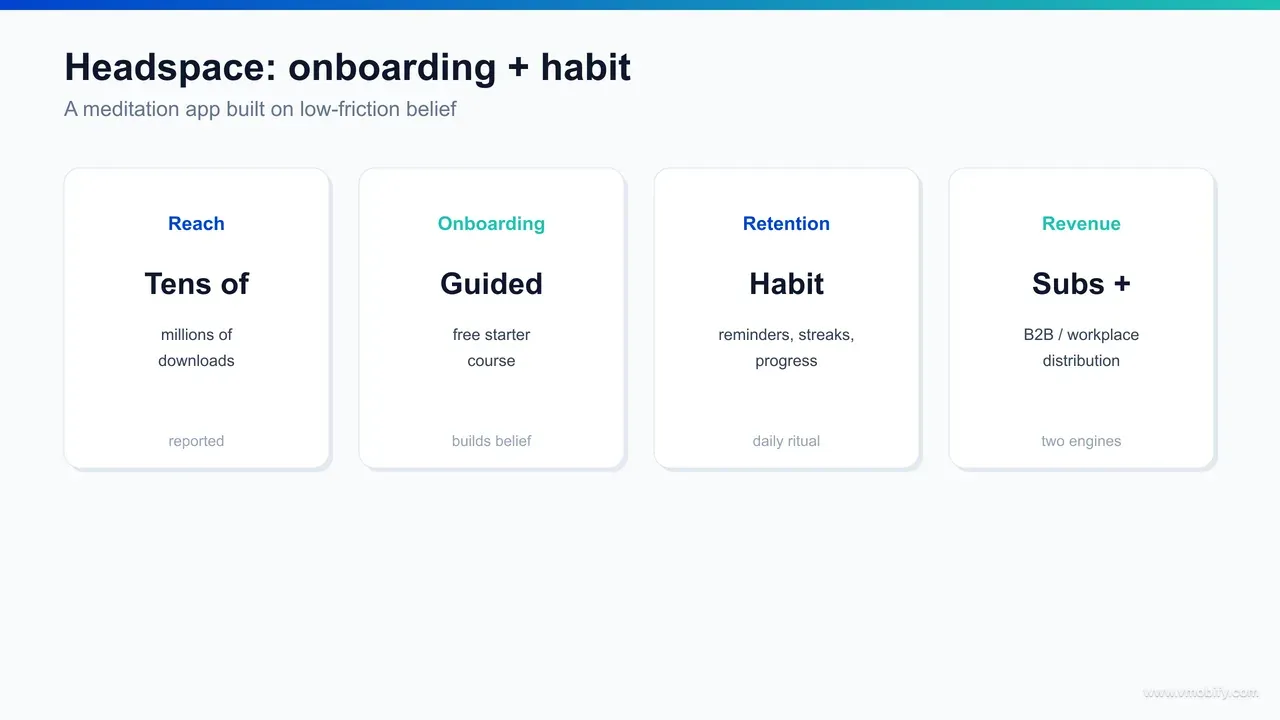
Headspace turned an abstract, intimidating behaviour — meditation — into a daily habit for tens of millions of people, and built a large paying subscriber base on top of it. This is a teardown of the onboarding, habit mechanics, subscription balance, brand and workplace-distribution system that did it, with the transferable lesson at the end of every section.
On this page
- What did Headspace's growth actually look like?
- How does the starter course reduce friction and build belief?
- How do reminders, streaks and progress drive retention?
- How does the subscription and free-content balance convert?
- How do brand and content compound trust over time?
- How did B2B and workplace distribution expand reach?
- What is transferable to your app — and what is not?
- What are the limits and risks of copying this playbook?
- How do you apply one Headspace lesson this quarter?
- Frequently Asked Questions
What did Headspace's growth actually look like?
Headspace grew from a small meditation events company into one of the most downloaded wellness apps in the world — reaching tens of millions of downloads across dozens of countries and building a large base of paying subscribers — and the striking part is how much of that came from making an intimidating behaviour feel easy rather than from outspending rivals on installs. The headline is reach, but the real story underneath it is conversion of curiosity into habit.
The shape of the growth is what matters for a teardown. Headspace did not invent meditation, and it was not the only mindfulness app in the store. What it did better than almost anyone was take a practice that most newcomers find vague, slightly mystical and easy to abandon, and package it as a structured, guided, beginner-safe product. As reported in product-growth analyses such as Lenny's Newsletter, the consumer subscription wellness category rewards exactly this: apps that lower the activation barrier and then engineer a repeat habit are the ones that compound, while apps that simply list content libraries stall.
It is worth being precise about what these figures are and are not. The "tens of millions of downloads" and "large paying subscriber base" framing reflects widely reported public figures, not a number we have audited line by line. We are deliberately not inventing a more granular breakdown, because the point does not need one: a wellness app reaching that scale, with a paid tier that converts at a meaningful rate, can only be explained by users experiencing the value quickly and then returning often enough to justify a subscription. That is an activation-and-retention engine, not a media-spend engine.
Why does a single meditation app deserve a full teardown? Because the mechanics underneath it — a free starter course, reminders, streaks, visible progress, a freemium ladder, a distinctive brand, and a B2B channel — are not exotic, and they are available to almost any consumer app. Headspace is the clearest worked example of those primitives assembled into a system where each part feeds the next. Across our 300+ apps managed since 2013, the question we are asked most often is some version of "how do we get first-time users to actually come back?" — and Headspace is one of the cleanest answers in the consumer category.
The rest of this teardown works through the system one layer at a time, and every section ends with the transferable lesson — the part you can take back to your own roadmap. Treat the scale above as the why; the sections below are the how, starting with the single most important surface in the whole product: the first session.
How does the starter course reduce friction and build belief?
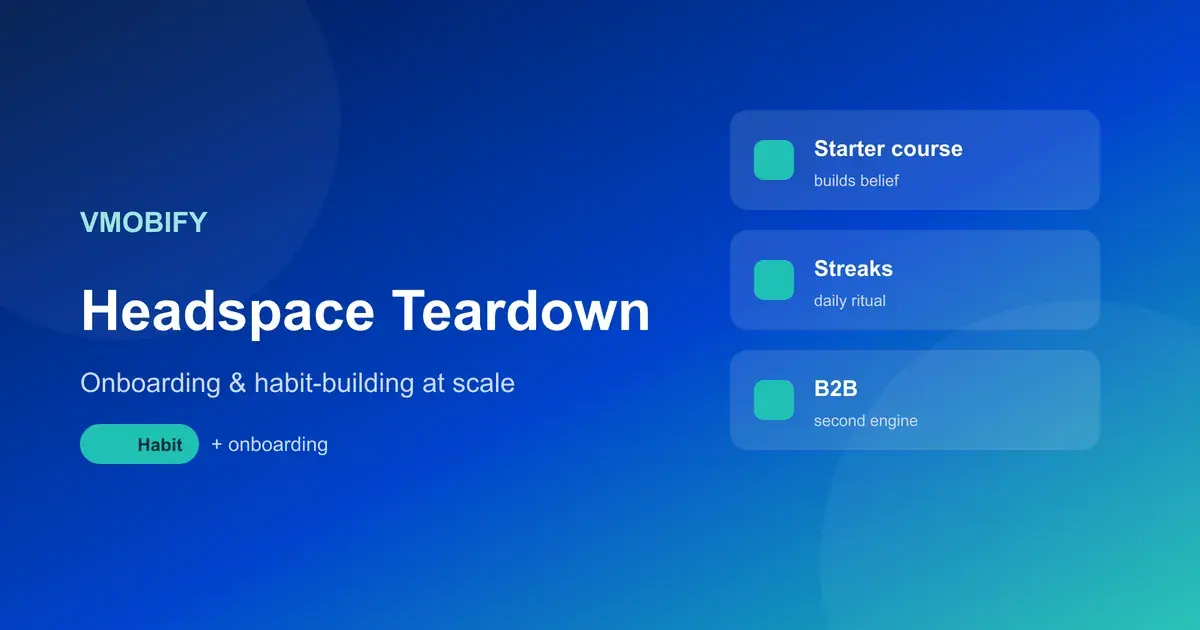
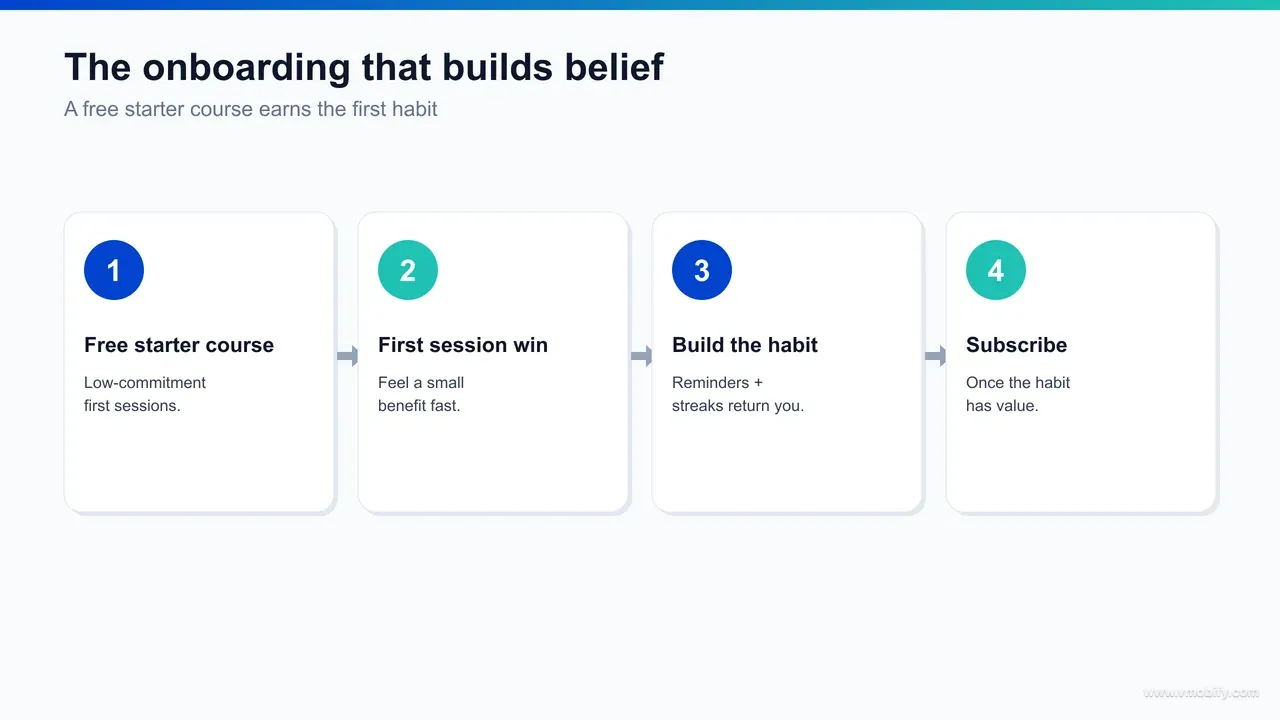
Headspace's onboarding works by getting a complete beginner to a genuinely good first meditation in minutes — a short, free, guided starter course that removes every decision and intimidation a newcomer would otherwise face — because the job of onboarding is not to explain the product, it is to let the user feel the value before they have any reason to trust it. The starter course is the load-bearing mechanic of the entire funnel.
Consider the problem from the new user's side. Someone curious about meditation downloads the app carrying a pile of objections: I will not be able to clear my mind, I do not have time, I will not know if I am doing it right, this is probably not for someone like me. A content library that opens onto a grid of hundreds of sessions makes all of those objections worse — choice paralysis on top of self-doubt. Headspace's answer is to collapse the choice: a guided, sequenced introductory course with short sessions and a calm, reassuring narrator who explicitly tells the user that a wandering mind is normal. The friction the design removes is not just taps; it is doubt.
This is the difference between onboarding that teaches features and onboarding that delivers an outcome. The starter course is not a product tour — it is the product, experienced in a beginner-safe form. By the end of a few short sessions, the user has not been told meditation works; they have felt slightly calmer, which is the only argument that converts a sceptic. As the product-analytics community at Amplitude repeatedly documents, the single biggest predictor of long-term retention is whether a user reaches their activation moment — the first experience of real value — fast. Headspace engineered its entire opening around reaching that moment quickly and reliably.
Two design choices compound the effect. First, the sessions are short, so the time cost of trying is trivial and the "I do not have time" objection collapses. Second, the experience is sequenced rather than open — the user is guided to the next session rather than dropped back into a library to choose, which removes decision fatigue and keeps momentum. This is the same principle we lay out in our guide to app onboarding best practices: the fastest path to value beats the most complete tour every single time, and a guided sequence beats a free-for-all for first-time users.
The transferable lesson: design your onboarding to deliver one real outcome fast, not to explain everything. Identify the single moment where a new user first feels your product was worth opening, then strip every decision, every form field and every distraction between download and that moment. If your activation experience requires the user to make choices before they understand the value, you are asking for trust you have not yet earned — guide them to the value first, and let earned belief do the converting.
How do reminders, streaks and progress drive retention?
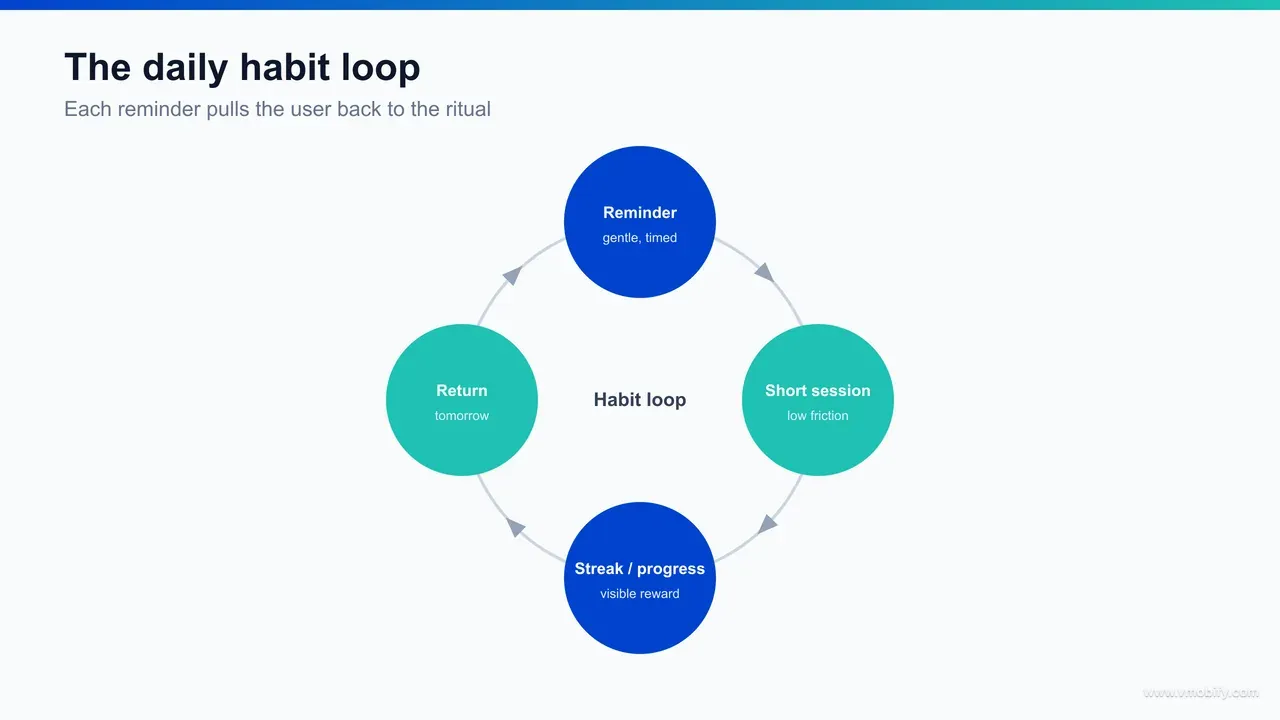
Headspace turns a good first session into a daily habit with three reinforcing mechanics — gentle reminders timed to the user's intended practice, a streak that makes consistency visible and worth protecting, and progress tracking that shows accumulated effort — because meditation only delivers its benefit through repetition, so the product's central job after activation is manufacturing the next visit. A single great session that is never repeated is a failure; the habit is the whole point.
Reminders do the first job: closing the gap between intention and action. A user who decides to meditate every morning still forgets, gets busy, or simply never builds the trigger. A reminder timed to their stated practice window acts as the external cue that the habit has not yet internalised. The discipline here is the same one we stress everywhere — a reminder is a finite trust budget, not a megaphone. Headspace's notifications lean on a calm, encouraging tone rather than nagging, which keeps the channel alive instead of getting it muted.
A push that respects the user reinforces the habit; one that pesters them accelerates the uninstall.
Streaks do the second job: converting a vague intention into a concrete, visible commitment. A run of consecutive days is a tangible record of effort, and loss aversion makes a growing streak feel increasingly costly to break — the longer it runs, the stronger the pull to protect it. As StriveCloud's analyses of habit and gamification mechanics describe, this is among the most reliable retention levers in consumer apps, and it works precisely because it gives the user something of their own to defend. It is the same mechanic that powers the language-learning playbook we tear down in how Duolingo grew — different product, identical psychology.
Progress tracking does the third job: making invisible benefit visible. Meditation's payoff is gradual and internal, which is a retention problem — if the user cannot see they are improving, motivation fades. Surfacing minutes practised, sessions completed and milestones reached gives the user evidence of accumulating value, which sustains effort through the inevitable flat patches. In our portfolio we have seen this repeatedly: the apps that visualise a user's accumulated investment retain markedly better than functionally identical apps that leave that progress hidden in a database.
The transferable lesson: after activation, your product's main job is engineering the next visit, and three mechanics do most of the work — a respectful, well-timed reminder, a visible streak or commitment record, and a progress view that makes accumulating value legible. Build all three around a daily action that is genuinely worth repeating. A streak on a chore manufactures guilt; a streak on a behaviour the user actually values manufactures a habit. Pick the valuable behaviour first, then reinforce it.
How does the subscription and free-content balance convert?
Headspace converts by keeping enough of the experience free to build a real habit — the starter course and a meaningful slice of content — and then selling a subscription that unlocks the full library to users who are already retained, because a subscriber who already meditates daily is a fundamentally easier conversion than a stranger who has never felt the value. Retention is upstream of monetisation, and the free tier exists to manufacture retention, not to be a teaser.
The balance is delicate and deliberate. If the free tier gives away too little, the user never builds the habit, and a user with no habit never converts — you have optimised the paywall and starved the funnel that feeds it. If it gives away too much, there is no reason to pay. Headspace's answer is to make the free experience good enough to form the habit and feel the benefit, while reserving the breadth — the deep library of courses for sleep, focus, anxiety, specific situations — for the subscription. The free tier sells the habit; the paid tier sells the depth the now-committed user wants.
This sequencing matters because of who is being asked to pay. Selling an annual subscription to someone who downloaded the app an hour ago and has never meditated is selling to a stranger. Selling it to someone on a two-week streak who opens the app every morning and credits it with sleeping better is selling to a believer. The conversion rates of those two situations are not close. Headspace's funnel is built so that the subscription offer arrives after the value has landed, not before — which is the entire reason the free starter course is free. As we argue in our work on retention-led monetisation, the apps that monetise sustainably sell on top of a free habit rather than holding the core experience hostage.
The pricing structure reinforces it. An annual plan priced well below the monthly run-rate nudges committed users toward the longer commitment, which both improves cash flow and lifts retention — a user who has paid for a year has a strong reason to keep using the product. Trials let users experience the full library before the charge lands, again front-loading value before commitment. Each of these is a small, deliberate lever, and together they form a ladder matched to engagement rather than a wall placed in front of it.
The transferable lesson: structure your free tier to build the habit, not to tease the paid one, and time your monetisation to arrive after the value has landed. The question to obsess over is not "how do we get people to pay sooner" but "how do we get more users to the point where paying is obvious." Protect the path to the habit, keep the daily action accessible, and sell depth, convenience or breadth to the users who have already proven they value the core.
How do brand and content compound trust over time?
Headspace compounded trust through two assets that strengthen with scale rather than decay — a distinctive, calming brand that made an abstract category feel safe and credible, and a steadily expanding content library that gave users a reason to keep finding new value — and both are defensive moats, because a sceptical newcomer trusts a recognisable brand and a returning user stays for a library they have not exhausted. Brand and content are the slow-compounding layer beneath the fast mechanics.
Start with brand. Meditation is an unusually trust-sensitive category: the user is being asked to spend quiet, vulnerable time with a voice in their ear, and the practice carries cultural baggage that can read as mystical or intimidating. Headspace's brand answer — friendly illustration, a warm and consistent narrator, plain non-judgemental language, an unmistakable visual identity — made the category approachable for the mainstream. That distinctiveness is itself a growth asset: a recognisable brand lowers the trust barrier for every new user and makes word-of-mouth recommendations land harder, because a friend recommending "Headspace" is recommending something specific and known, not a generic meditation app.
Now content. A wellness subscription lives or dies on whether the library keeps giving the user new reasons to return. Headspace invested continuously in breadth — courses for sleep, focus, stress, movement, specific life situations — so that a user who has worked through the basics always has somewhere new to go. This is what makes the subscription durable: the value is not a fixed thing the user eventually exhausts but a growing library that keeps the renewal decision easy. Content depth and brand trust reinforce each other, too, because a trusted brand earns the patience for users to explore the library, and a rich library justifies the trust the brand asks for.
There is a quieter compounding effect worth naming. Both brand and content are assets that the competition cannot quickly copy. A rival can clone a streak counter in a sprint; it cannot clone years of accumulated brand recognition or a deep, professionally produced content catalogue in the same time. In our portfolio we have consistently seen that the durable consumer winners pair fast-compounding mechanics with these slow-compounding assets — the mechanics win the first month, the brand and content win the third year.
The transferable lesson: invest in the slow-compounding assets even though they will not show up in this quarter's dashboard. A distinctive, trustworthy brand lowers the activation barrier for every future user, and a library or catalogue that keeps growing keeps the renewal decision easy. Fast mechanics get users in the door; brand and content are what stop a better-funded competitor from taking them straight back out. Build both deliberately, not as an afterthought.
How did B2B and workplace distribution expand reach?
Headspace opened a second growth channel by selling to employers through Headspace for Work — bundling subscriptions as a workplace wellbeing benefit — which reached users the consumer app's organic and paid funnels never could, while shifting acquisition cost onto a company budget and arriving with the credibility of an employer endorsement. B2B distribution is not a side business; it is a fundamentally different way to put the same product in front of millions more people.
The logic is compelling once you see it. In the consumer channel, Headspace pays — in marketing spend or store competition — to reach one user at a time, and that user pays out of their own pocket. In the workplace channel, a single enterprise sale can put the app in front of thousands of employees at once, with the employer covering the cost as a wellbeing benefit. The customer-acquisition maths is transformed: one negotiation reaches an entire organisation, and the users arrive pre-qualified because their employer has effectively vouched for the product. An app recommended by your company carries a different weight than an ad in a feed.
There is a category tailwind underneath this. Employers became far more willing to fund mental-health and wellbeing benefits as workplace stress and burnout climbed up the corporate agenda, which gave Headspace a buyer with budget and motive. The product was already built — the same meditation, sleep and focus content — so the B2B offering was largely a distribution and packaging innovation rather than a new product line. That is the efficient kind of channel expansion: a new way to reach users that reuses the asset you already have.
The two channels also reinforce one another. A strong consumer brand makes the enterprise sale easier, because HR buyers recognise the name and trust it; and the enterprise channel seeds the consumer habit in employees who may keep the subscription, recommend it to family, or renew personally if they change jobs. In our portfolio we have repeatedly seen that the most durable consumer apps eventually find a second distribution channel — B2B, partnerships, embedded distribution — because relying on a single funnel caps growth and concentrates risk. Headspace for Work is the textbook version of that move.
The transferable lesson: ask whether your already-built product has a buyer beyond the individual consumer. Employers, platforms, partners and institutions can each become a channel that reaches users your direct funnel cannot, often with better unit economics and borrowed credibility. You do not always need a new product to unlock a new channel — sometimes you need to repackage the product you have for a buyer who can distribute it at scale. The second channel is frequently where the next order of magnitude of reach hides.
What is transferable to your app — and what is not?
What transfers is the sequence and the discipline behind it — reduce onboarding friction to deliver a felt outcome fast, engineer the next visit with reminders, streaks and visible progress, keep the habit-forming core accessible, then monetise the retained user and expand distribution — but the surface specifics (a meditation course, a calming owl-like mascot, a particular price) do not transfer on their own, and copying them without the underlying logic usually backfires. The mistake teams make is copying the screenshots instead of the engine.
Start with what genuinely transfers. The first principle is the activation-first onboarding: find the single moment where a new user first feels your product was worth opening, and engineer the fastest reliable path to it. For Headspace that moment is a first calm session; for your app it is something else entirely, but the discipline of identifying it and stripping every obstacle in front of it is universal. This is precisely the diagnostic work our analytics service runs first with any retention client: instrument the new-user journey, isolate the activation moment that separates retained users from churned ones, and only then redesign the onboarding around it.
The second transferable principle is the reinforcing system. Headspace's components are not independent features bolted on by different teams; they interlock — onboarding produces a believer, reminders bring them back, the streak gives them something to protect, progress shows them it is working, the subscription monetises the now-retained user, and the brand and B2B channel scale the whole thing. A great onboarding with no habit mechanic leaks users a week later; a streak with no valuable daily action manufactures guilt. The lesson is to design the loop whole, the way we frame it in our guide to mobile app UX that retains, not to ship disconnected features and hope.
Now what does not transfer. The specific content, the mascot, the tone of voice and the exact price points are particular to Headspace's category and audience — pasting a meditation narrator onto a logistics app would read as absurd. More importantly, the entire playbook assumes a product whose value only lands through repeated use: meditation, fitness, learning, journalling. That is the load-bearing assumption, and the next section is devoted to it. An app a user has a genuine reason to open only occasionally does not need a streak, and forcing one on creates confusion rather than a habit.
The transferable lesson: take the method, not the motifs. Find your activation moment, build one interlocking loop from onboarding through habit to monetisation, and resist the urge to copy Headspace's surface features until you have your own version of the value they are reinforcing. The teams that succeed adapt the sequence to their product; the ones that fail clone the interface and wonder why the retention curve never bends.
What are the limits and risks of copying this playbook?
The biggest limit is frequency-and-value fit — the playbook assumes a product whose benefit compounds through repeated use, and it fails on apps where that is not true — and the biggest risks are pressure-based habit mechanics tipping into guilt, a free tier mistuned so it either starves the funnel or gives away the business, and over-investing in mechanics before the core experience is actually good. Headspace's system works because it fits its product; bolted onto the wrong product, the same mechanics do harm.
The fit point is the one most teams get wrong. Meditation, fitness, language learning and journalling all reward daily repetition, so a streak and daily reminders align the mechanic with genuine value. But a tax-filing app, an insurance app or an occasional-use utility has no honest reason for daily engagement, and forcing a streak onto it manufactures guilt over a behaviour the user has no real cause to perform. The first risk-screen for this entire playbook is a single question: does my product's value genuinely compound with repeated use? If not, copy the onboarding discipline but not the daily-habit mechanic.
The second risk is the slide from encouragement into pressure. The same loss aversion that makes a streak motivating can be weaponised into anxiety — aggressive streak-loss warnings, guilt-laden notifications, manufactured fear of missing out. This is especially fraught in a wellbeing context, where an app that is supposed to reduce stress instead becomes a source of it. Engagement bought with pressure is brittle: it inflates this week's active-user numbers while quietly teaching users to associate the app with obligation, and obligation-associated apps get muted, then deleted. We treat this as a first-order design constraint, not a footnote.
The third risk is mistuning the free-or-paid balance, and the fourth is sequence inversion — building elaborate mechanics on top of a core experience that is not yet worth returning to. A streak attached to a mediocre product just helps users feel guilty about abandoning something they never valued. As the habit research that Nir Eyal popularised makes clear, a habit loop is a multiplier on an underlying value, never a substitute for it. Build the genuinely good core experience first; the mechanics amplify value, they cannot create it from nothing.
The transferable lesson: pressure-test fit before you build. Confirm your product's value compounds with use, design every mechanic to encourage rather than coerce, tune the free tier to build the habit without giving away the business, and never ship the gamification before the core is worth returning to. Used on the right product with honest intent, this playbook compounds; used on the wrong one or with manipulative mechanics — especially in a wellbeing context — it spends trust you cannot easily buy back.
How do you apply one Headspace lesson this quarter?
Pick one lesson and ship it properly rather than copying the whole system at once: find the single moment where a new user first feels your product was worth opening, then rebuild your onboarding to reach that moment as fast and reliably as possible — and measure the result against your week-one and week-four retention cohorts, not against sign-ups. One well-executed onboarding fix beats five half-built gamification features every time, because onboarding is upstream of everything else in the loop.
Here is a concrete quarter-long sequence you can actually run:
- Weeks 1-2 — find your activation moment: instrument the new-user journey and identify the specific event that most strongly separates users who are still active in week four from those who churn. This is the equivalent of Headspace's first calm session, and it is an analytics question, not an opinion. If you do not have the instrumentation to answer it, that is the first thing to fix.
- Weeks 3-5 — rebuild the path to it: strip every decision, form field and distraction between download and that moment. Replace an open library or feature tour with a guided sequence that carries the first-time user straight to the value, the way the starter course does. Measure how many new users now reach the activation moment, and how fast.
- Weeks 6-8 — add one timely reminder: tie a single, calm, well-timed notification to bringing the user back for their next session, aimed at their stated or observed usage window, with an easy and granular opt-out. Resist the urge to add five — add the one that closes the intention-action gap.
- Weeks 9-10 — make progress visible: add one mechanic that shows accumulating value — a streak, a progress view, a milestone — and always include a grace or repair option so a single lapse does not end the habit. The broken-streak moment is where habits die.
- Weeks 11-12 — measure against retention, not sign-ups: read the week-one and week-four retention cohorts for users exposed to the new onboarding and loop versus a control. Keep the change only if it lifts genuine return rates, not just a same-week vanity metric.
The order matters. Most teams start at the monetisation or gamification end — they tune a paywall or ship a streak counter in week one — and skip the onboarding work that determines whether anyone reaches the value in the first place. That is how you end up optimising a subscription offer that a funnel of un-activated users will never accept. Headspace's advantage was never the meditation content alone; it was the discipline of getting a sceptical beginner to a felt outcome fast and then engineering the return, an approach the product-analytics community at Amplitude documents across many habit-forming products.
If you want help running that diagnosis — finding your activation moment, rebuilding the onboarding around it, and measuring it properly against cohorts rather than vanity metrics — that is exactly the work our team does. Across our 300+ apps managed since 2013, the single highest-return retention project is almost always this one. Talk to us directly about your app's onboarding and habit loop, and we will help you find the one lesson worth shipping this quarter.
Frequently Asked Questions
How did Headspace grow so fast?+
Headspace scaled by making an intimidating behaviour feel easy: a free, guided starter course delivered a good first meditation in minutes, and habit mechanics like reminders, streaks and progress brought users back. Reach into tens of millions of downloads followed from activation and retention, not from outspending rivals on installs.
What is the Headspace starter course and why does it matter?+
It is a short, free, sequenced introduction that guides a complete beginner to a genuinely good first session while removing every decision and intimidation. It matters because the job of onboarding is to let users feel the value before they have any reason to trust it, and the starter course is the load-bearing mechanic of the whole funnel.
Why does Headspace keep so much content free?+
The free tier exists to build a real habit, not to tease the paid one. A user with no habit never converts, so Headspace makes the free experience good enough to feel the benefit, then sells the deep library to users who are already retained — which is a far easier conversion than selling to a stranger.
How do streaks and reminders improve retention?+
Reminders close the gap between intention and action as an external cue, a streak makes consistency visible and worth protecting through loss aversion, and progress tracking makes the gradual, internal benefit legible. Together they manufacture the next visit, which is the product’s main job once a user is activated.
What was Headspace for Work and why did it matter?+
It was the B2B channel that sold subscriptions to employers as a workplace wellbeing benefit. It mattered because a single enterprise sale could reach thousands of employees at once, shifted acquisition cost onto a company budget, and arrived with the credibility of an employer endorsement — reaching users the consumer funnel never could.
Can any app copy the Headspace playbook?+
Only apps whose value compounds through repeated use should copy it directly. The whole system assumes a habit-forming product like meditation, fitness or learning; forcing daily streaks and reminders onto an occasional-use app such as tax filing just manufactures guilt and backfires.
What does Vmobify do to help with onboarding and retention?+
Our analytics team instruments the new-user journey to find the activation moment that predicts retention, then helps redesign onboarding and the habit loop around it and measure against cohorts. See /services/analytics, and our guides on app onboarding best practices and mobile app UX that retains for the wider framework.
Sources
- Lenny's Newsletter — Consumer subscription and growth analyses — Activation-led growth in consumer subscription and wellness apps
- Amplitude — Product analytics and retention blog — Activation-moment and retention-driver instrumentation
- StriveCloud — Gamification and habit mechanics analyses — How streaks, reminders and progress drive the daily habit
- Headspace — Official site — First-party context on the starter course, content library and subscription
- Headspace for Work — Workplace wellbeing — The B2B / employer distribution channel
- Nir Eyal — The Hook Model — Trigger, action, variable reward and investment loop behind habit mechanics
- Nielsen Norman Group — UX research — Evidence base for onboarding friction, habit and notification UX
About the author
Amol Pomane — Founder, Vmobify
Amol leads Vmobify, a mobile app growth agency that has driven 30M+ downloads and ranked 54K+ keywords across 300+ apps since 2013. He writes about ASO, paid user acquisition, retention, and the operational reality of scaling mobile apps in India and global markets.