Food Delivery App Marketing: From Launch to Category Leader
Food delivery is one of the toughest verticals to compete in — duopoly markets, supply-side cost, and a frequency game. Here is the playbook for new entrants and specialised players.
On this page
- What does the Indian food delivery market actually look like?
- Where can you play if you are not Swiggy or Zomato?
- Why do first-order economics decide everything?
- How does hyperlocal targeting actually work?
- Why is supply-side marketing as important as demand?
- How do you build retention and frequency in food delivery?
- Frequently Asked Questions
What does the Indian food delivery market actually look like?
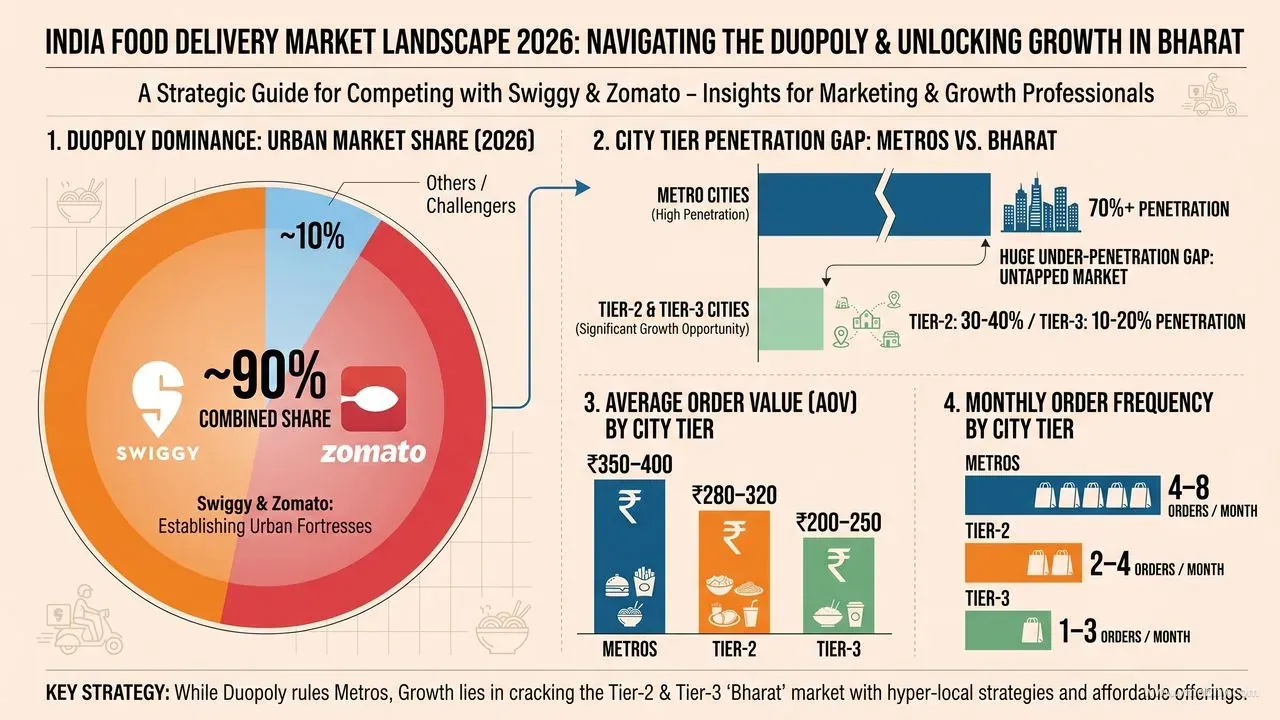
Indian food delivery in 2026 is a near-pure duopoly — Swiggy and Zomato together control roughly 90% of urban food-delivery orders, and quick-commerce platforms (Blinkit, Zepto, Instamart) are eating adjacent categories like ready-to-eat, snacks, and groceries. Any new-entrant thesis has to confront this reality on day one. A "better Swiggy" pitch in a Bangalore or Mumbai metro is not a strategy — it is a way to spend ₹50Cr in 18 months and exit the market.
The duopoly's structural advantages are real. Both apps sit on every relevant smartphone in metro India, both have multi-year-built rider networks, both run subscription programs (Swiggy One, Zomato Gold) that lock in high-frequency users at near-zero marginal delivery cost. According to Statista's India mobile internet data, smartphone penetration is now over 750M users, with food delivery as one of the top five most-used app categories in urban India — but the addressable user base for new aggregators is overwhelmingly already-served.
Adjacent quick-commerce is also reshaping the demand picture. Blinkit, Zepto, and Instamart now deliver ready-to-eat meals in 10-15 minutes — directly cannibalising 30-40 minute restaurant delivery for snack and single-item occasions. Quick-commerce data from Sensor Tower's State of Mobile reporting shows q-commerce apps consistently among the fastest-growing categories in India by session count.
Where opportunity genuinely exists in 2026: cloud-kitchen brands building owned apps to escape aggregator commissions, regional Tier-2 and Tier-3 plays targeting underserved cities, cuisine-specific apps (South Indian, Jain, Korean, vegan), corporate meal-delivery platforms operating B2B2C, and direct-to-restaurant apps for chains large enough to drive their own demand. In our portfolio across 300+ apps, the food-vertical apps that succeed almost always pick exactly one of these niches and refuse to dilute. The ones that try to be everything to everyone lose the LTV math inside 12 months.
Where can you play if you are not Swiggy or Zomato?
The five viable wedges for a new food-delivery app in India are Tier-3 geographic specialisation, cuisine-niche apps, corporate meal delivery, restaurant-owned single-brand apps, and quick-commerce ready-to-eat — and each demands a different marketing playbook entirely.
- Tier-3 city focus: Swiggy/Zomato are dense in Tier-1 and most Tier-2 cities but thin across Tier-3 (population 50K-300K). Competitor density is lower, CPIs land at ₹40-80 versus ₹120-200 in metros, but order frequency is also lower (1-3 orders/month vs 4-8 in metros). The play works only if you can match operating cost density to the lower revenue per user. Apps that import metro cost structures into Tier-3 lose money on every order.
- Cuisine-specific apps: Pure-vegan, Jain-only, regional cuisine (Bengali, Andhra, Kashmiri), Korean, or Japanese specialist apps capture a niche the aggregators serve poorly because they need to optimise for the average user. Order frequency is lower but loyalty is exceptional. Marketing leans heavily on community channels — diaspora WhatsApp groups, regional Facebook communities, niche influencers.
- Corporate meal-delivery (B2B2C): Companies pay a subsidy, employees order through the app. Different unit economics entirely — predictable order volume, contracted minimums, and far higher LTV per user. Marketing is enterprise sales-led, not consumer UA-led. The growth function looks more like SaaS than D2C.
- Restaurant-owned single-brand apps: Domino's, McDonald's, Pizza Hut, and Indian chains like Faasos and Behrouz already run successful owned apps. Marketing is retention-driven, not acquisition-driven — existing customers move from aggregator to owned channel to escape the 18-25% aggregator commission. ASO and email/SMS lifecycle do the heavy lifting; paid UA plays a supporting role.
- Quick-commerce ready-to-eat: 10-15 minute delivery of frozen meals, snacks, breakfast items, packaged food. Competes against q-commerce platforms more than restaurant delivery. CPI economics work because order frequency is high (6-12 orders/month) and basket sizes are predictable.
A useful self-test before committing to a wedge: can you articulate, in one sentence, why a user opens your app instead of Swiggy or Zomato that is not "lower prices" or "better deals"? If the answer is structural (only app with verified Jain food in your city, only app integrated with your corporate meal subsidy, only app that delivers from your specific society's preferred restaurants), the wedge is real. If the answer is promotional ("we have a launch offer"), the wedge collapses the moment the launch budget runs out. Wedge-led food apps survive the first 24 months; promo-led ones do not.
The wrong wedge is a "Swiggy clone, but cheaper commissions" pitch. Restaurants do not switch aggregators on commission alone — they switch on order volume, and order volume only comes after demand has already aggregated. New aggregators that try to bootstrap supply with commission discounts before they have demand end up with empty apps that disappoint the first wave of users and never recover. Pick a wedge that does not require you to build a two-sided marketplace from zero on both sides.
Why do first-order economics decide everything?
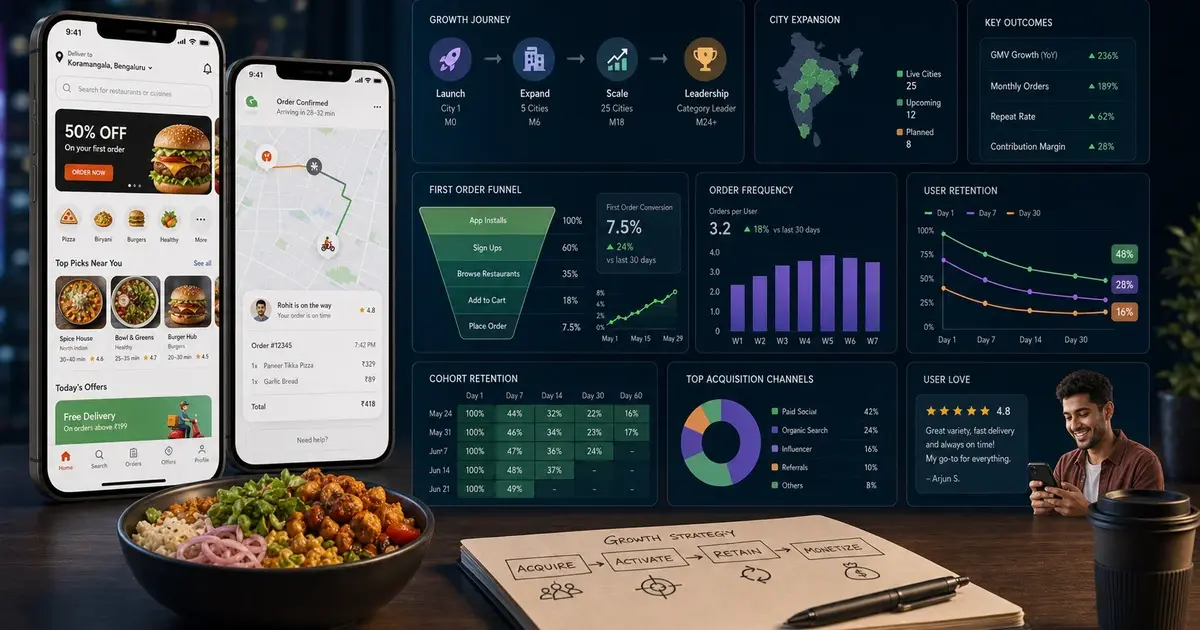
Food delivery LTV is a near-pure function of repeat-order frequency, and repeat-order probability is set in the first 20 minutes of the first order experience. Get the first order right and you have a high-frequency user for 18-36 months. Get it wrong and you have paid CAC for one order that never repeats. Five specifics decide first-order conversion and repeat probability:
- First-order discount is mandatory and non-skippable. Industry conditioning means Indian users expect 40-60% off the first order, capped at ₹100-150. Apps that remove this discount in pursuit of "better unit economics" see first-order conversion drop 40-50% immediately. The discount is not a growth lever — it is a price of entry.
- Lower free-delivery threshold for first order: ₹99 first-order minimum versus ₹199 standard. The friction of "add more items to qualify" is what kills hesitant first-time users at checkout. Lowering this threshold for the first order is one of the highest-ROI tweaks in the onboarding funnel.
- One-tap UPI or COD at checkout: Payment friction is the single biggest cause of cart abandonment on first orders. Apps that ship a one-tap UPI flow (with UPI ID prefilled from device contacts where possible) lift first-order conversion by 15-25%. COD remains a critical fallback in Tier-2/3 where UPI literacy varies.
- Time-to-first-delivery under 20 minutes drives 3x higher repeat probability. Across our food-vertical app portfolio, the cohort that received their first delivery in under 20 minutes had repeat-order rates roughly three times higher than the 40+ minute cohort. This is why supply density matters before demand spend matters — slow first deliveries permanently damage retention.
- First-order CAC ceiling: ₹150-300 in metros, ₹80-150 in Tier-2/3. Anything above means the LTV math will not work even with strong repeat frequency. Apps paying ₹500+ first-order CAC in metros are typically subsidising growth out of investor capital and have no path to contribution-positive economics.
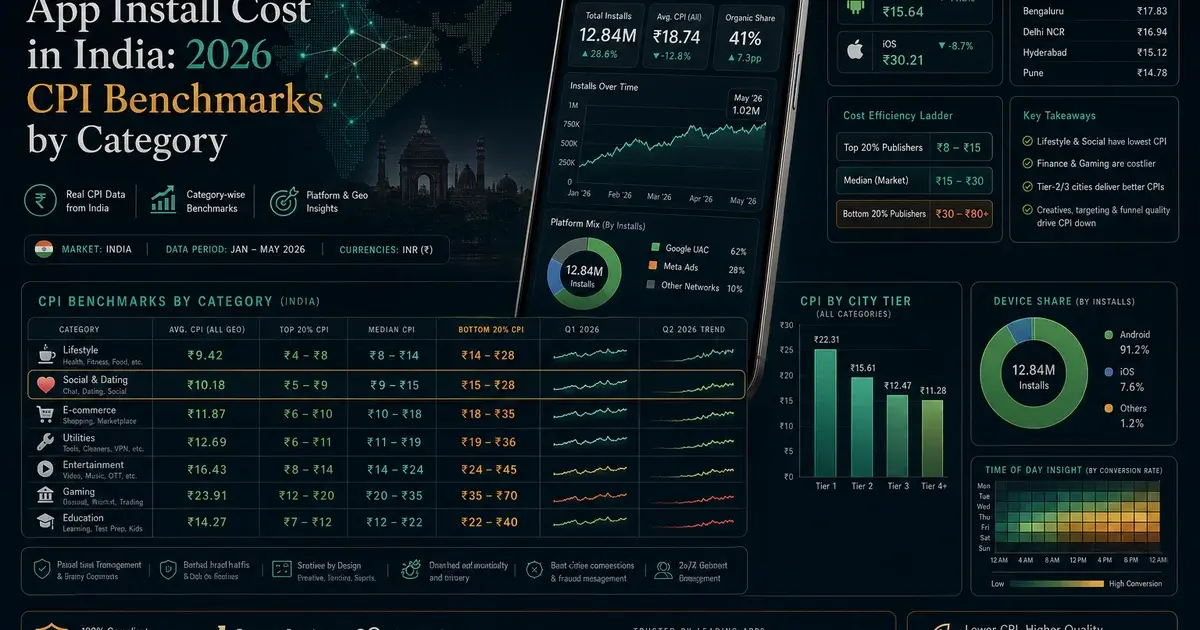
For benchmark CPI data by Indian geography see our India app install cost guide. The economics are unforgiving — a food app that pays ₹400 CAC and produces 1.8 orders/month at ₹40 contribution margin per order takes 5-6 months to break even per user, and that assumes no churn. Industry data from AppsFlyer's State of App Marketing report consistently shows food and delivery apps in the higher-CAC, higher-frequency cohort — meaning frequency optimisation, not CAC reduction alone, is where the biggest payback lives.
How does hyperlocal targeting actually work?
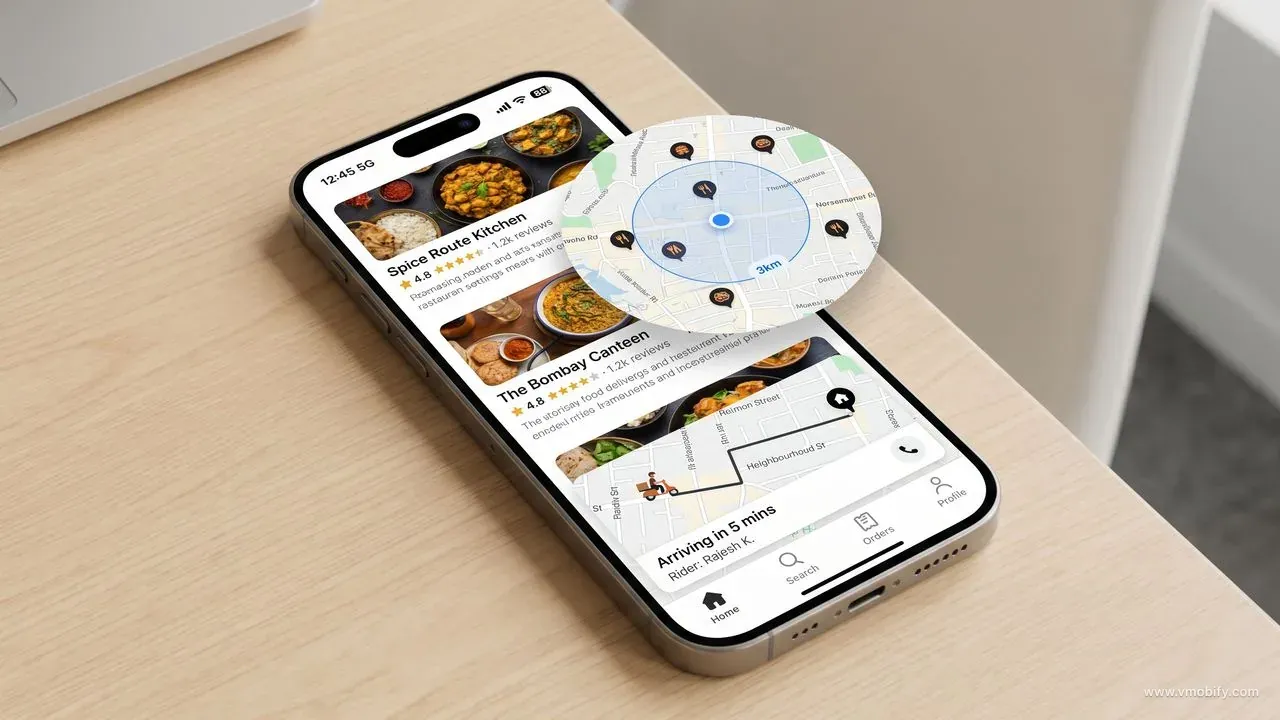
Food delivery is fundamentally hyperlocal — your effective serviceable radius is 4-6 km around each dark kitchen or restaurant cluster, which means every rupee of marketing spend outside that radius is wasted. Most new food-app marketing budgets bleed 30-40% of spend on impressions delivered to users who cannot be served. The fix is aggressive geo-discipline across every channel.
- Geo-fenced paid campaigns: Both Google App Campaigns and Meta Advantage+ App Campaigns support pin-code and radius-based targeting. Target by 2-3 km radius around each supply location, never by city-level. Use one ad group per supply zone so you can scale or pause individual zones based on supply availability. See our full playbook in user acquisition services.
- Local SEO and Google Business Profile: "Food delivery near me," "South Indian restaurant Bandra," "biryani delivery HSR Layout" — these high-intent local queries convert dramatically better than brand-level keywords. Maintain a Google Business Profile per kitchen location with menu, photos, and operating hours kept current. Local pack visibility drives sustained free demand.
- Hyperlocal influencer marketing: Bandra food bloggers convert Bandra users at 3-5x the rate of generic Mumbai food creators. Identify 5-15 micro-influencers per target neighbourhood (10K-100K followers, audience concentrated in that pincode). Pay flat fees plus per-install top-ups. Statista's India influencer market data shows neighbourhood-level creator inventory expanding faster than brand demand, keeping rates favourable in 2026.
- Society and apartment activation: Residential complex WhatsApp groups, RWA partnerships, society-specific first-order codes (use the society name as the promo code). One activated 500-flat society can generate 50-150 orders in the first week at near-zero acquisition cost. Field reps physically visit RWAs and security gates — high-touch but extremely efficient per user acquired.
- Outdoor selectively: Digital signage at society gates, bus stops near supply hubs, and metro pillars in high-density delivery zones drive brand awareness that converts when paired with concurrent paid retargeting. Outdoor in isolation rarely justifies its cost; outdoor stacked with digital retargeting on the same audience does.
An often-overlooked hyperlocal lever is delivery-bag and packaging branding. Every delivery rider entering a residential complex is a moving billboard; branded thermal bags, branded packaging, and rider t-shirts produce sustained neighbourhood-level awareness at near-zero marginal cost. Across our food-vertical portfolio, apps that invest in consistent packaging design see organic install rates lift 10-20% in zones where their riders are most active — a tail benefit that compounds for months after the initial investment.
The geo-discipline mindset extends to creative as well. A food app advertising in Koramangala should run creative referencing Koramangala — featuring real Koramangala restaurants, real Koramangala neighbourhoods, recognisable street landmarks. Generic "fast food delivery" creative loses to localised creative by a wide margin. We have run this test repeatedly in our portfolio and the localised variant wins on CTR and install rate every single time.
Why is supply-side marketing as important as demand?
Food delivery is a two-sided marketplace, and demand growth without matching supply growth produces churn — users open the app, do not find what they want, and never come back. The collapse of multiple well-funded food-delivery startups over the past decade traces back to this single failure: spending heavily on user acquisition before restaurant supply was dense enough to satisfy them. Supply marketing is not a "phase two" activity — it has to run in parallel with demand from week one.
- Restaurant onboarding fee waivers for the first 50-100 restaurants in a new geography. Standard onboarding fees of ₹3,000-5,000 are friction that kills early supply momentum. Waiving them costs trivial absolute money and dramatically speeds restaurant density in a launch zone.
- Lower commission tiers for early-stage restaurant partners: 8-12% commission for the first 6-12 months versus industry-standard 18-25%. Restaurants are extremely price-sensitive on commissions; a clear differentiator here is one of the few credible reasons for a restaurant to onboard onto a new aggregator at all.
- Field-sales supply acquisition: Door-to-door restaurant onboarding in target neighbourhoods. A two-person field team can onboard 8-15 restaurants per day in a dense urban zone. This is slow and operationally heavy, but it is also the only way to bootstrap supply density faster than competitors who rely on inbound restaurant sign-ups alone.
- Promised order minimums in the first 30-60 days: "We guarantee 50 orders in your first month or we refund commissions." This is a powerful trust-builder for restaurants nervous about onboarding onto a new platform with uncertain demand. The cost of honouring the guarantee on the rare miss is small versus the supply density it unlocks.
- Restaurant-success marketing: Case studies of high-performing partner restaurants, public dashboards of GMV growth per partner, and recognition programs ("top-rated restaurant of the month"). Treat the supply side with the same content-marketing rigour you treat consumer marketing.
The metric to watch is not "number of restaurants signed up" but "number of restaurants live with at least 5 orders in the past 7 days." Inactive restaurant inventory is worse than no inventory — it pollutes search results, leads to "restaurant unavailable" messages at checkout, and damages user trust. Supply marketing has to measure activation, not just acquisition. In our food-app portfolio, the apps that ship a weekly supply-activation report alongside their demand-side dashboard consistently outperform peers on contribution margin per zone.
How do you build retention and frequency in food delivery?
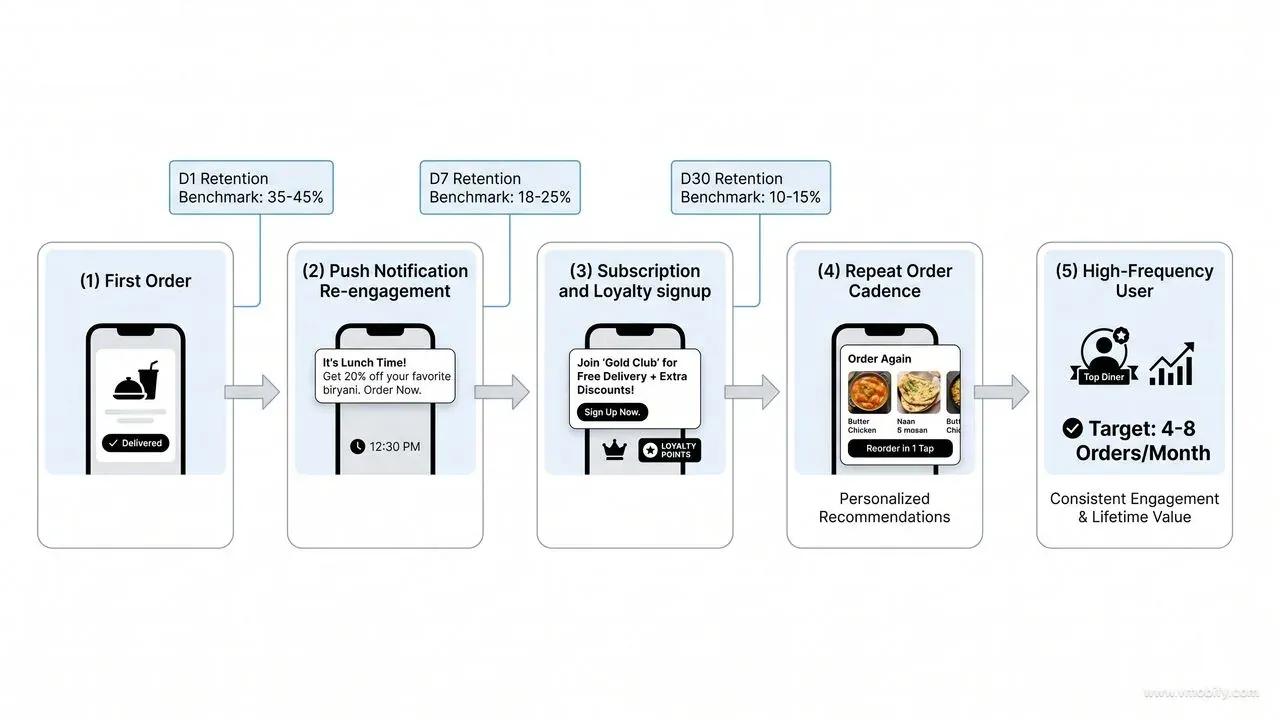
Food LTV is the product of orders per month × average order value × months active, and the single highest-leverage variable is orders per month. Doubling monthly order frequency lifts LTV more than any feasible CAC reduction or AOV increase. The retention stack that drives frequency in 2026:
- Subscription and loyalty programs: Swiggy One and Zomato Gold are the category benchmarks — monthly fees of ₹100-200 unlock free delivery and exclusive discounts. Subscribers order 2-3x more frequently than non-subscribers. For a new app, even a simplified "₹99/month for free delivery on all orders above ₹149" program lifts monthly order frequency materially. Build this in month 3-6 after launch, not at launch — you need order data to size the offer correctly.
- Personalised recommendations and "order again" surfaces: The most-clicked area of any food app home screen is the "order again" rail. Surface past orders prominently, then layer "tried this restaurant?" recommendations based on cuisine affinity, neighbourhood patterns, and meal-time. Apps that invest in recommendation infrastructure see 15-30% lift in repeat-order rate within 90 days.
- Meal-hour push notification timing: 11:30am-12:30pm lunch window and 6:30pm-7:30pm dinner window are when food intent peaks. Send personalised push at the exact meal-hour the user has historically ordered, referencing the specific restaurant or cuisine they prefer. Generic broadcast push notifications produce 0.5-1% CTR; personalised meal-hour push routinely hits 4-8%.
- Two-sided referral programs: ₹100 each for both referrer and referred friend's first order. Word-of-mouth in food delivery has unusually high conversion because the recommendation comes with implicit credibility ("my friend orders from this app, the food must be okay"). Track referrals via deep links and credit both sides automatically.
- Festival and occasion specials: Sunday brunch combos, Diwali sweet boxes, IPL-watching combos, late-night Friday menus. Concentrated frequency spikes around predictable cultural moments. Plan a 12-month calendar of occasion campaigns at the start of each year; consistent festival merchandising is one of the cheapest sustained-frequency levers available.
- Lifecycle email and SMS for win-back: Users who have not ordered in 14, 30, 60, and 90 days get progressively more aggressive win-back offers. A 30-day-dormant user re-activated with a 50%-off offer is still margin-positive over their reactivated lifetime — the alternative is total churn.
For deeper retention frameworks see our app retention strategy guide and case studies of food and delivery apps in our portfolio results. Industry data from Adjust's mobile app trends reports shows food and delivery apps with subscription programs in place have 2-3x higher Month-6 retention than comparable apps without subscriptions — the single highest-leverage retention investment in the vertical.
The honest summary of food-delivery growth in India 2026: the duopoly is real, the niches are real, and the math is unforgiving but workable for teams that pick a wedge, respect first-order economics, build supply in parallel with demand, and treat frequency as the LTV variable that matters most. Talk to our team about a food-delivery launch or scale plan for your city, cuisine niche, or restaurant-owned brand.
Frequently Asked Questions
Can a new food delivery app realistically compete with Swiggy/Zomato?+
Not head-to-head in metros. Realistic plays are niche cuisine, regional/Tier-3 specialisation, corporate meal delivery, or restaurant-owned single-brand apps. A "Swiggy clone but better" thesis has lost every time it has been attempted.
What is a healthy first-order CAC for food delivery?+
₹150-300 in metros, ₹80-150 in Tier-2/3. Beyond these numbers the LTV math breaks unless repeat-order frequency is two standard deviations above category baseline — which is rarely sustainable.
How important are first-order discounts?+
Essentially mandatory. Industry conditioning means users expect 40-60% off first order, capped. Removing this discount drops first-order conversion 40-50% immediately and is one of the fastest ways to kill a launch.
Should food delivery apps run TV ads?+
Only at large scale (₹10Cr+ annual marketing budget) and only for brand reinforcement after performance channels are mature. Below that spend threshold, performance marketing dominates ROI math by a wide margin.
How quickly can a new food delivery app reach unit economics?+
Typically 12-18 months of dense hyperlocal scaling. Subsidies are normal in months 1-12; positive contribution margin in month 12-18 is achievable in well-run launches, particularly in Tier-2/3 geographies with lower CAC and reasonable supply density.
How should restaurant-owned apps think about marketing differently from aggregators?+
Restaurant-owned apps acquire users who already know the brand. Marketing is therefore mostly retention and channel-migration (moving aggregator customers to owned channel) rather than cold acquisition. ASO, email/SMS lifecycle, and in-restaurant QR-driven downloads do the heavy lifting.
What role does quick-commerce play in the food delivery competitive picture?+
Quick-commerce (Blinkit, Zepto, Instamart) is cannibalising snack, breakfast, and single-item food occasions that previously went to 30-40 minute restaurant delivery. New food apps targeting ready-to-eat or packaged-food occasions should benchmark against q-commerce, not Swiggy/Zomato.
Sources
- Statista — India Mobile Internet Usage — Smartphone penetration and category-level app usage data for India
- AppsFlyer — State of App Marketing in India — CAC, LTV, and frequency benchmarks by vertical including food and delivery
- Sensor Tower State of Mobile — Quick-commerce growth data and category cannibalisation trends in India
- Google Ads — App Campaigns Help — Geo-fencing, radius targeting, and ad-group structure for hyperlocal campaigns
- Meta — Advantage+ App Campaigns — Pin-code and radius-based targeting for hyperlocal food delivery campaigns
- Statista — India Influencer Marketing Market Size — Growth of neighbourhood-level creator inventory and rate trends in 2026
- Adjust — Mobile App Trends — Retention benchmarks for food and delivery apps with and without subscription programs
About the author
Amol Pomane — Founder, Vmobify
Amol leads Vmobify, a mobile app growth agency that has driven 30M+ downloads and ranked 54K+ keywords across 300+ apps since 2013. He writes about ASO, paid user acquisition, retention, and the operational reality of scaling mobile apps in India and global markets.
Model an install budget
Turn CPI and activation assumptions into acquisition scenarios.
Open free tool