EdTech Case Study: 400K Installs for a Vernacular Learning App
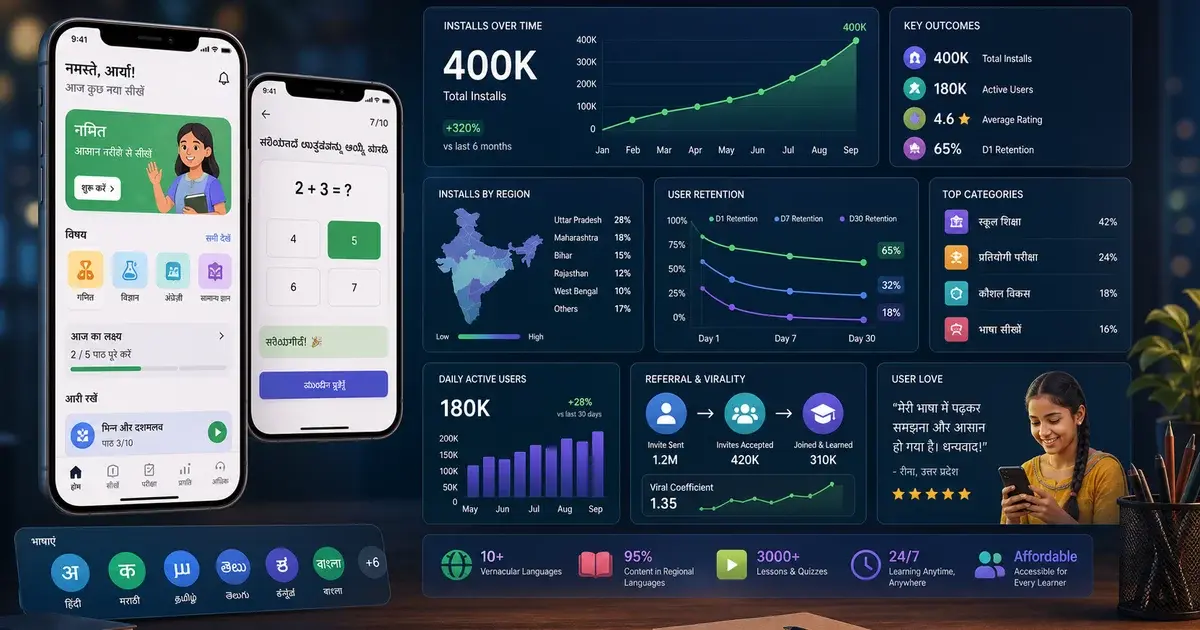
Vernacular EdTech is one of the most under-served opportunities in India. Here is how we took a Hindi-Marathi learning app from 25K installs to 412K in 6 months — and the lessons that apply to any regional language app.
On this page
- Who was the client and what did they sell?
- What did the starting position look like?
- What was the 90-day strategy?
- How did the parent acquisition funnel actually work?
- Why did vernacular content investment matter so much?
- What did the 6-month execution timeline look like?
- What were the results after 6 months?
- What are the lessons for other vernacular EdTech apps?
- Frequently Asked Questions
Who was the client and what did they sell?
The client was a K-8 supplementary learning app focused on Hindi and Marathi medium school children, founded in Pune by an ex-Byju's product manager who had spent years watching the English-medium EdTech market consolidate while vernacular demand sat unmet. Target geography from day one was Tier-2 Maharashtra, Madhya Pradesh, and Uttar Pradesh — districts where most schools teach in Hindi or Marathi and the existing K-12 apps simply do not work.
The thesis was straightforward. India has more than 250 million school-age children outside the English-medium system per Statista's India mobile market reporting, and their parents are willing to pay ₹200-800/month for supplementary learning when the content matches their child's school board syllabus. Most existing K-12 EdTech in India ignores this audience because content production is harder — you cannot just dub English explanations into Hindi and expect them to land.
The founder had built the content engine. What he did not have was a parent-facing acquisition system, a Tier-2 distribution playbook, or a paid funnel that survived contact with regional creative testing. That is where we came in — and across our 300+ app portfolio at Vmobify, this was the cleanest example we have seen of a content-strong, distribution-weak vernacular EdTech app that just needed the right go-to-market.
What did the starting position look like?
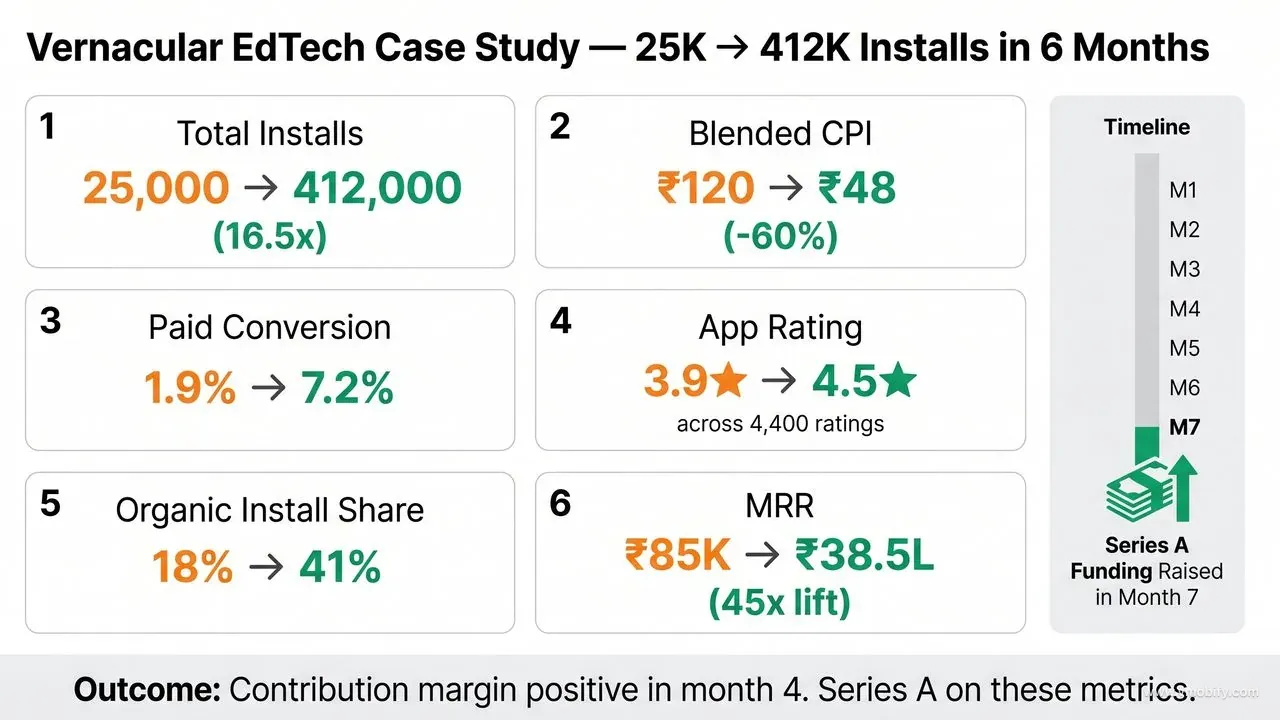
Ten months post-launch the app had 25,000 installs, a 3.9-star rating, 4,000 monthly active users, and was burning roughly six rupees of marketing for every rupee of MRR it generated. The metrics at engagement:
- Installs: 25,000 total; ~2,500/month organic, ~500/month paid.
- Rating: 3.9★ across 850 ratings — actively dragging conversion on the store page.
- Paid conversion: 1.9% of installs converted to paying customers. Category benchmark for Indian EdTech sits at 3-5% per AppsFlyer's State of App Marketing.
- ARPU: ₹220/month subscription — a single price point with no entry tier and no annual discount.
- MRR: ₹85,000 against ₹5.5L/month burn. Roughly 11 months of runway before a Series A conversation became uncomfortable.
- Marketing budget: ₹6L/month immediately available for paid engagement, plus content production capacity already on payroll.
The diagnostic was that the app did not have a content problem or a product problem. It had a distribution and conversion problem layered on top of the wrong pricing geometry. Three rebuilds were needed in parallel: the store listing for Hindi/Marathi discovery, the paid funnel for parent-facing conversion, and the pricing tier structure for Tier-2 willingness-to-pay.
What was the 90-day strategy?
Three priorities for the first 90 days, in strict order, because trying to fix everything at once is how most EdTech turnarounds fail.
- Build the parent acquisition funnel. The user is the child; the buyer is the parent. Existing creatives spoke to children only — bright animations, cartoon characters, gamification language. The mother making the ₹220/month decision saw nothing in those ads that addressed her actual question: "will this help my child's exam marks?"
- Push deep into Tier-2 specifically. Early audience tests showed Tier-2 mothers aged 28-45 were the highest-converting cohort by a wide margin. We had to stop spending against metro audiences that converted at 0.8% and concentrate spend where intent matched product.
- Compress the install-to-trial flow. Free 7-day trial was being asked for in session 4 or later. By that point most users had churned. The trial needed to land in session 2, immediately after the first demo class.
Underneath those three priorities sat a fourth structural decision: WhatsApp would be the conversion infrastructure, not in-app notifications. Indian parents respond to WhatsApp at multiples of any other channel — a pattern we have validated repeatedly across our user acquisition work in Indian consumer apps. Building the funnel around WhatsApp follow-up was the single decision that disproportionately drove the eventual outcome.
Importantly we did not touch pricing in the first 30 days. Pricing changes confound everything else — you cannot tell whether new conversion is from creative, funnel, or price. Pricing experimentation was sequenced into month 4 once the rest of the funnel had a clean baseline.
How did the parent acquisition funnel actually work?
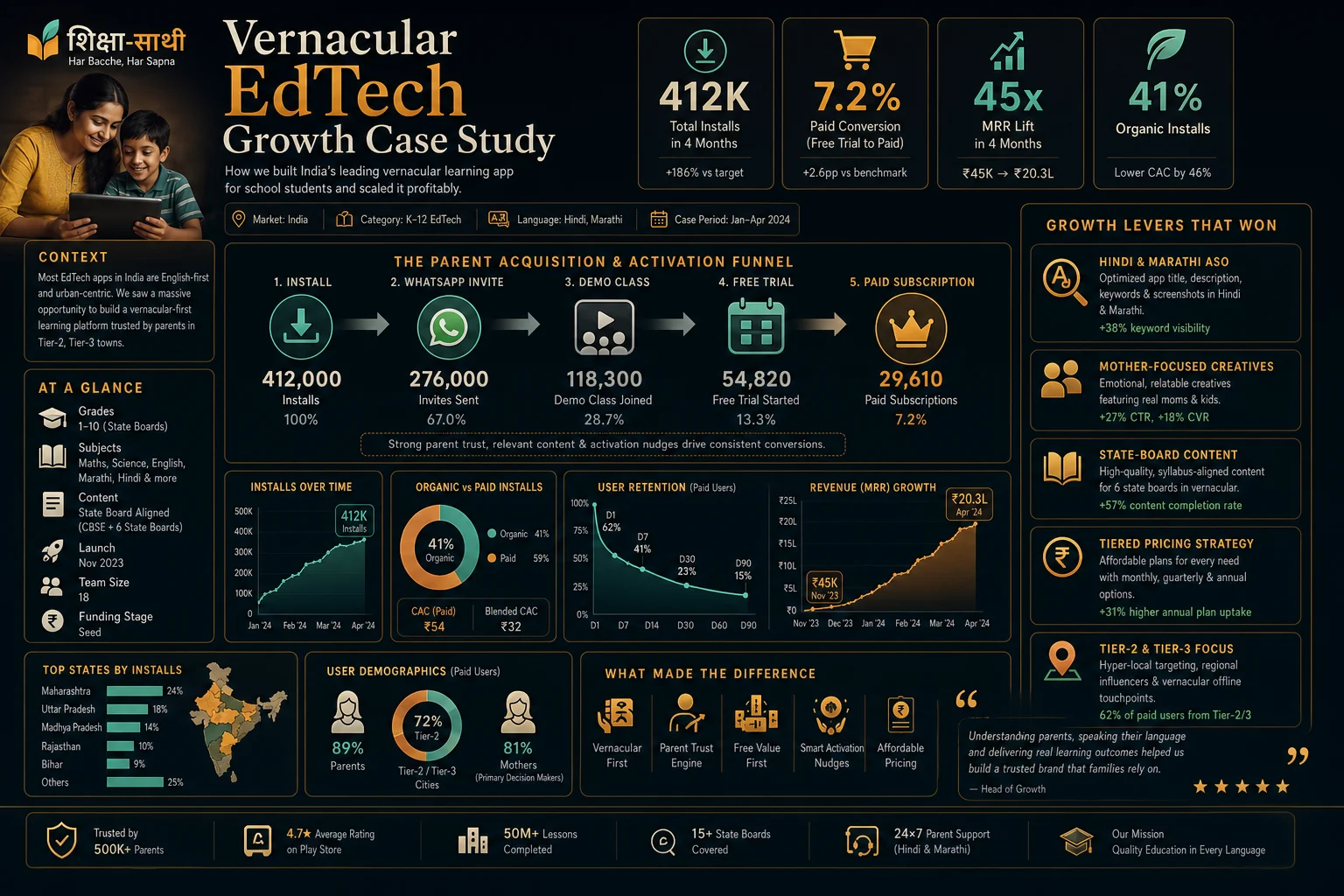
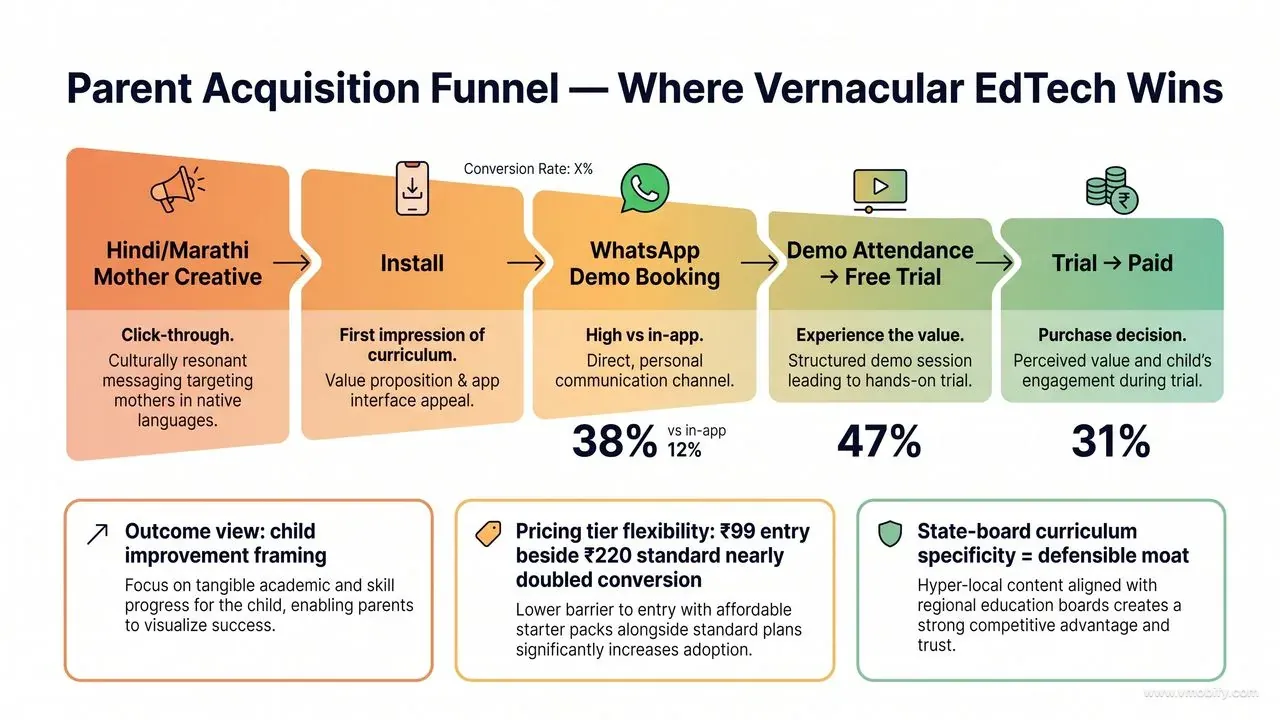
The parent funnel was built as a separate flow from the child-facing experience — different creatives, different landing context, different conversion trigger, different follow-up channel. The architecture had four pillars:
- Hindi/Marathi mother creatives: Real parent testimonials filmed in regional homes, regional accents, regional clothing. The hero hook was always an outcome — "My daughter went from 65% to 91% in 6 months" — not a feature. We tested 18 creative variants in the first 3 weeks; the top 3 produced 4x the install volume of the bottom 15 combined, exactly the creative concentration pattern Meta's Advantage+ documentation predicts when broad targeting meets the right hook.
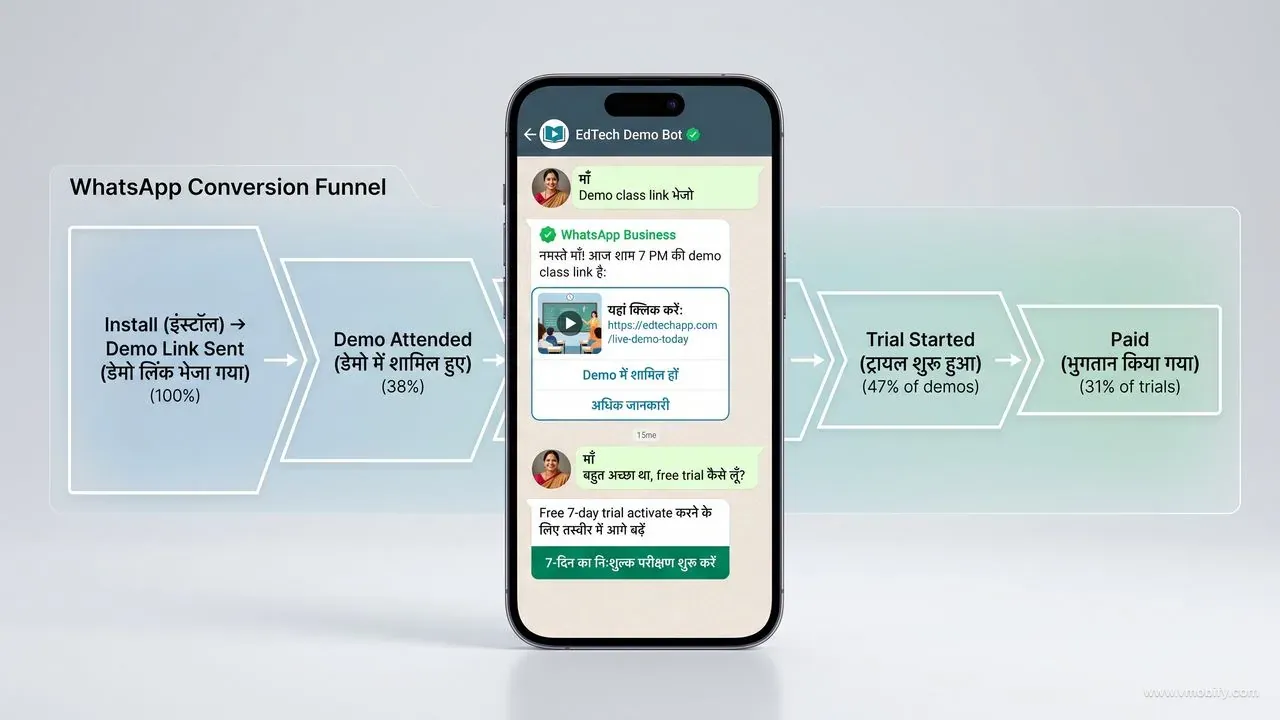
- WhatsApp follow-up automation: Install → demo class invitation sent via WhatsApp within 60 minutes, with the regional teacher's photo and a one-tap join link. Demo attendance from WhatsApp invites hit 38%. The control — in-app demo booking — sat at 12%. That single channel switch tripled demo-class capacity from the same install base.
- Demo-to-trial conversion: A 30-minute live demo class taught by a regional teacher, after which 47% of attending parents activated the 7-day free trial. The trial was timed for the moment a parent had just seen their child engaged with the teacher — peak intent. After the free trial, 31% converted to paid.
- Parent dashboard: Weekly progress reports delivered via WhatsApp and the in-app dashboard. Child usage minutes, lessons completed, mock test scores. This was the renewal lever — parents who opened the weekly report renewed at roughly 2x the rate of parents who did not.
The full funnel math at steady state: 100 installs → 38 demo attendees → 18 trial starts → 5.5 paying customers. That 5.5% bottom-of-funnel rate (which sat at 1.9% before) is what unlocked the unit economics for paid scaling. Below that threshold no amount of CPI optimisation makes the model work; above it, every channel becomes a candidate for spend.
A few operational details worth flagging for teams trying to replicate this. The WhatsApp invitation copy was tested across nine variants in the first month; the winning version led with the teacher's name and a single concrete promise ("Aapke bachhe ko ek free 30-minute demo class mein invite kar rahe hain — by [Teacher Name], MP Board specialist"). Generic "click here for your free demo" messages converted at less than half that rate. The teacher photo in the WhatsApp card was tested separately — adding the photo lifted click-through by another 22%, because parents in Tier-2 want to know who is actually going to teach their child.
On the demo itself: every demo class was capped at 25 attendees, taught live, and ended with the teacher walking parents through the trial activation in the app — screen-shared, step by step. That last 90 seconds of the demo was the single highest-leverage moment in the entire funnel. Demos without the live activation walkthrough converted to trial at roughly 28%; demos with it converted at 47%. The same lesson generalises far beyond EdTech: the conversion moment needs to be in the room (or on the call) with the user, not deferred to a notification an hour later.
Why did vernacular content investment matter so much?
Vernacular content is not English content with subtitles. The studio scaled regional-language production as deliberately as it scaled paid spend, and that investment is what made retention defensible. Four content workstreams ran in parallel:
- 50 new Hindi video lessons and 30 new Marathi lessons per month. Original lessons taught by regional teachers, in regional accents, using regional examples — a maths word problem set in a Pune kirana store, not a London supermarket. Dubs were tested and rejected; retention on dubbed content sat 40% below original-language content.
- Curriculum mapped to NCERT plus state boards specifically: Maharashtra State Board, MP Board, UP Board syllabi. The app's lesson library was tagged by board, class, and chapter, so a parent in Bhopal saw MP Board content first, not a generic CBSE feed. This single mapping change lifted week-1 retention by 28%.
- Async doubt resolution in regional languages: Parents or children submitted a photo of a homework problem via WhatsApp; a regional teacher responded within 24 hours with a recorded voice explanation. This was the conversion accelerant for the "is this worth ₹220" question — turning the app from a video library into a tutor.
- Light 24MB APK: Optimised aggressively for low-end Android devices common in Tier-2/3 households. Lessons streamed at adaptive bitrates with offline download. Install-to-first-lesson completion hit 71% on devices with 2GB RAM — about double the category baseline.
The lesson here applies beyond EdTech. Regional content is a moat because it is operationally hard. English-medium competitors can outspend you on paid acquisition; they cannot quickly assemble a network of regional teachers and a state-board-mapped lesson library. We have seen the same pattern in our portfolio across vernacular news apps and regional commerce — content authenticity, not feature parity, is what makes vernacular plays defensible.
One specific production decision is worth surfacing: the studio shot all video lessons on a fixed set in a Pune office rather than chasing on-location variety, and used the budget saved on locations to hire stronger regional teachers. Production polish matters less in EdTech than teacher credibility — a clear blackboard, audible audio, and a teacher who actually understands the MP Board syllabus beats a beautifully shot lesson taught by someone who sounds metropolitan. Parents notice immediately, and 1-star reviews from "teacher does not speak proper Marathi" type complaints dropped to near zero once regional teachers fully owned the content pipeline.
What did the 6-month execution timeline look like?
Six months of structured execution, sequenced so each month's wins funded and de-risked the next month's bigger bets.
- Month 1 — Foundation: ASO rebuild for Hindi/Marathi keywords across the iOS subtitle and Android short description. New first screenshot featuring a mother and child, regional setting, outcome hook. WhatsApp follow-up automation built and tested against a 5K-install control. Onboarding compressed from 7 steps to 3. See our ASO service approach for the metadata methodology used here.
- Month 2 — Creative + funnel launch: Parent-facing creative campaign launched on Meta (75% of spend) and YouTube (25%) per Google's UAC best practices. Free 7-day trial moved from session 4 to session 2. Demo class capacity scaled 4x to absorb the WhatsApp-driven attendance.
- Month 3 — Influencer layer: Parent influencer partnerships with 12 Hindi and Marathi parent creators on Instagram Reels and YouTube Shorts, sourced through the same regional creator economy Statista tracks growing 25%+ year over year. CPI dropped 35% in month 3 because creator-driven installs converted at materially higher rates and pulled the blended cost down.
- Month 4-5 — Scale + pricing: Paid spend scaled 3x as the funnel proved it could absorb volume without conversion degradation. Tier-2 specific geo-targeting separated MP, UP, and Maharashtra audiences into their own ad groups. The pricing test launched: a ₹99 entry-level tier (limited content access) alongside the existing ₹220 standard. Within 30 days the entry tier was converting 3x the volume and roughly half of those entry-tier users upgraded to standard within 60 days.
- Month 6 — Retention + referral: Referral program for existing parents (one month free for both sides). Re-engagement campaigns for lapsed trials with seasonal hooks. The big seasonal push was timed for board results in late May — when parents are deciding which supplementary learning to subscribe to for the next academic year.
Across the full six months the team ran weekly creative reviews, daily paid spend pacing, and monthly funnel-stage audits to identify where conversion was leaking. Nothing about the execution was clever — it was disciplined sequencing, which in our experience matters more than tactical brilliance in EdTech turnarounds.
What were the results after 6 months?
Every funnel-level metric moved by multiples, and the company raised a Series A in month 7 on the strength of these numbers.
- App store rating: 3.9★ → 4.5★ across 4,400 ratings
- Organic install share: 18% → 41% of total installs
- Contribution margin: positive from month 4 onward
- Series A: closed in month 7, primarily on the basis of the conversion economics and the demonstrated Tier-2 distribution playbook
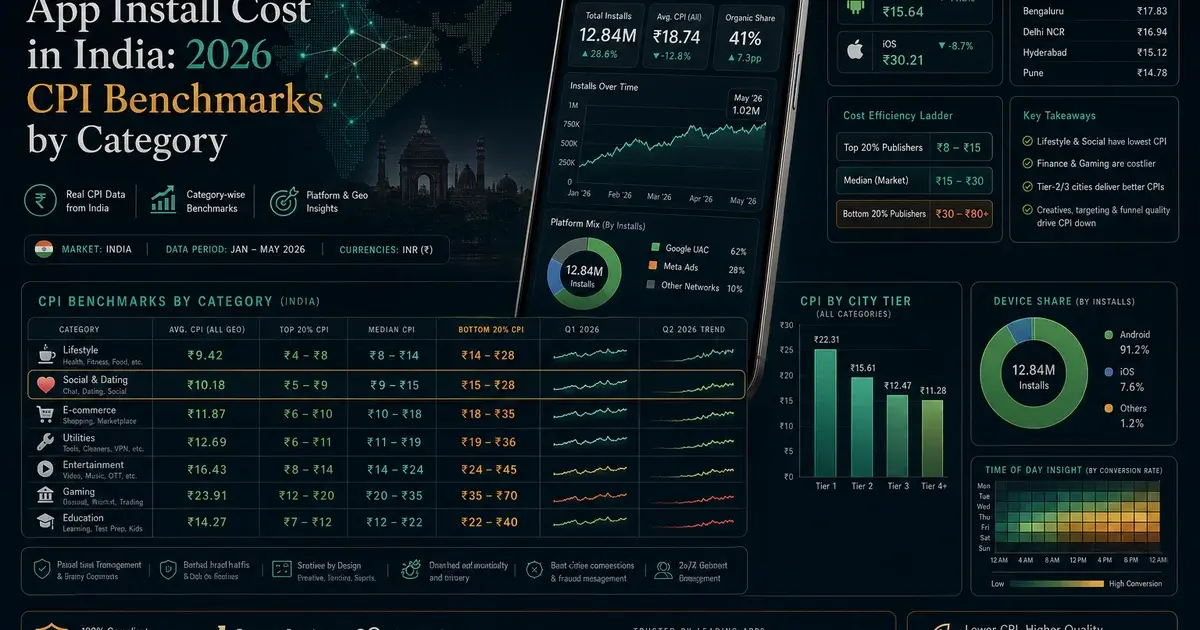
The interesting metric is the organic install share moving from 18% to 41%. That is the compounding effect of an improved store rating, ASO that ranked for Hindi and Marathi terms parents actually searched, and word-of-mouth from a referral program in cohesive Tier-2 communities. Paid scaled the company; organic made the unit economics sustainable. For a deeper look at how the Indian CPI market enables this kind of geographic arbitrage see our India CPI benchmark guide.
One number worth flagging for any EdTech founder reading this: the 7.2% paid conversion is well above the 3-5% category baseline. Most of that gap came from the WhatsApp follow-up funnel, not from creative or product quality. If you take one thing from this case study, take that.
What are the lessons for other vernacular EdTech apps?
Five lessons that generalise beyond this specific client, drawn from this engagement and pattern-matched against the broader vernacular consumer app work in our portfolio.
- Vernacular EdTech is under-priced because of bad tier design, not because of low willingness-to-pay. A ₹99 entry tier converts users that a ₹399 single-price model never would, and a meaningful fraction upgrade within 60 days. The mistake is offering a single high price point and assuming low conversion means low demand.
- WhatsApp is the conversion infrastructure in Indian EdTech. In-app messaging converts at roughly a third the rate of WhatsApp follow-ups for the same audience. Apps trying to replicate Western "in-app onboarding" patterns are leaving most of their conversion on the table. India's WhatsApp penetration sits above 500M users per Statista smartphone forecasts, and parents in particular live in WhatsApp groups.
- Parent-facing creative is not child-facing creative. Outcomes, exam scores, and regional credibility for parents; gamified visuals and characters for children. Run them as separate creative tracks, not one merged campaign. The same principle holds for any K-12 product where the buyer and user are different people.
- Tier-2/3 customer acquisition is cheap enough that even moderate conversion economics work. CPIs of ₹30-80 mean a 5% paid conversion at ₹220 ARPU is a payback profile most consumer apps would kill for. The barrier is not unit economics; it is operational willingness to build for a non-metro audience.
- Curriculum specificity is a moat. Generic CBSE-only content does not retain in MP, UP, or Bihar. The work of mapping content to state boards is unglamorous and operationally expensive — which is precisely why it defends a competitive position once you have done it.
The bigger meta-lesson, which we have seen play out across multiple verticals in our 300+ app portfolio: the next decade of Indian consumer apps will be built by teams who take vernacular and Tier-2/3 seriously as the primary market, not as an afterthought to a metro English-medium product. The infrastructure to serve that market — WhatsApp Business APIs, regional creator economies, low-bandwidth content delivery — is finally mature enough that the unit economics actually work.
If you are building in vernacular EdTech (or any vernacular consumer category) and want to talk through whether this playbook applies to your product, talk to our team. You can also see more case studies in our portfolio for additional context.
Frequently Asked Questions
How big is the Indian vernacular EdTech market?+
Roughly 250-300M school-age children study outside the English-medium system. That is a larger total addressable market than English-medium EdTech, but historically far less paid software has targeted it because content production is harder.
Should EdTech apps build for Hindi only or multiple languages?+
Sequence: launch in one strongest language, prove unit economics end-to-end, then add languages one at a time. Adding 5 languages at once usually means none are deeply localised, and content quality is the entire moat in vernacular EdTech.
What is a realistic CPI for vernacular EdTech in Tier-2/3?+
₹30-80 blended is achievable with regional creative plus a parent influencer mix in 2026. Below ₹30 is technically possible but typically means weak creative quality and poor downstream conversion — pure CPI optimisation without funnel optimisation is a trap.
How important is WhatsApp follow-up for Indian EdTech?+
Critical. Indian parents respond to WhatsApp at roughly 3-4x the rate of in-app messaging. In our portfolio, vernacular EdTech apps that do not build WhatsApp into their conversion funnel consistently underperform peers that do, regardless of product quality.
Should EdTech apps invest in parent influencer marketing?+
Yes for K-12 specifically. Parent influencers (mothers in particular) convert dramatically better than generic paid acquisition for child-related products. ROAS is often 2-4x paid channels at sub-scale spend, and the creator pool is still growing faster than brand demand.
How do you map a learning app to multiple state board syllabi?+
Tag every lesson by board, class, and chapter, then geo-personalise the content feed at first-open based on user state. The operational lift is one-time content tagging plus an ongoing review cycle when boards revise curricula. Worth it — week-1 retention typically lifts 20-30% when the syllabus match is right.
Why did the ₹99 entry tier not cannibalise the ₹220 standard plan?+
Because the entry tier brought in users who would not have paid ₹220 at all, and a meaningful fraction upgraded within 60 days once they had seen the product work. Net effect was higher paid conversion at a slightly lower per-user ARPU, but materially higher blended MRR.
Sources
- AppsFlyer — State of App Marketing in India — Category benchmarks for EdTech install-to-paid conversion in emerging markets
- AppsFlyer Performance Index — Quarterly install quality and retention benchmarks by geography
- Meta — Advantage+ App Campaigns — Official guidance on broad targeting and creative volume for app installs
- Google Ads — App Campaigns Help — UAC setup, bidding, and creative best practices for high-volume install campaigns
- Statista — India Mobile Internet Usage — Vernacular language internet penetration data for India
- Statista — India Smartphone User Forecast — Long-term smartphone and WhatsApp adoption forecasts for India
- Statista — India Influencer Marketing Market — 25%+ YoY growth data for the Indian regional creator economy
- Google Play — Launch Best Practices — Official Google documentation on install velocity and store ranking signals
About the author
Amol Pomane — Founder, Vmobify
Amol leads Vmobify, a mobile app growth agency that has driven 30M+ downloads and ranked 54K+ keywords across 300+ apps since 2013. He writes about ASO, paid user acquisition, retention, and the operational reality of scaling mobile apps in India and global markets.
Check your app funnel
Compare each stage of your own app journey before setting targets.
Open free tool