B2B Invoicing App Case Study: Trial-to-Paid 4% to 11%
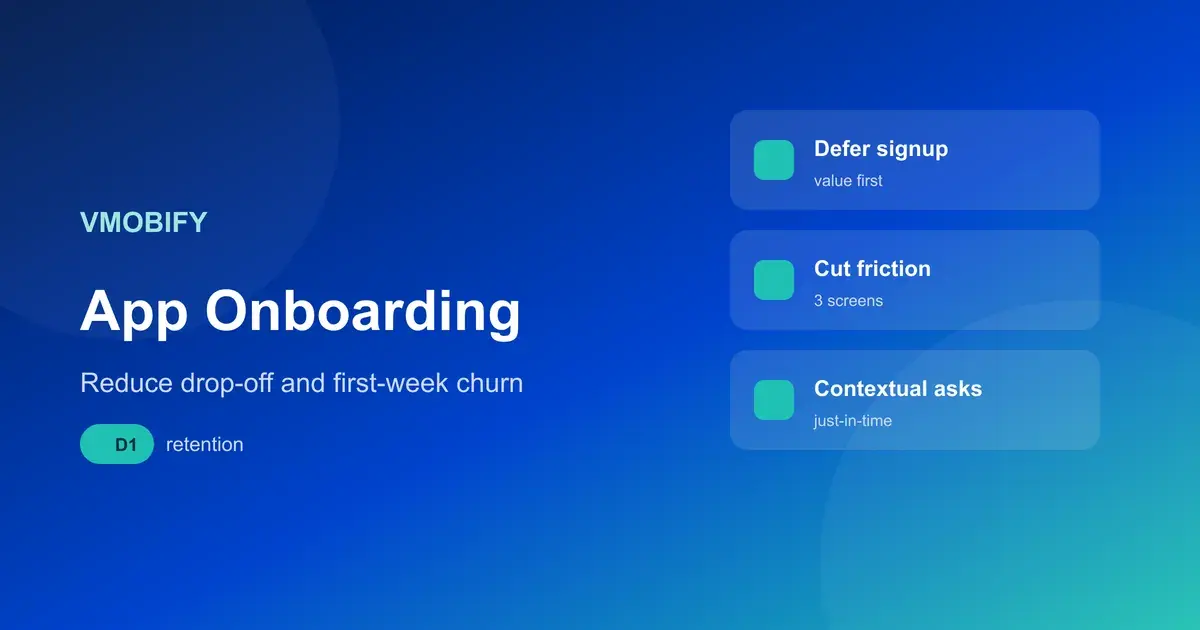
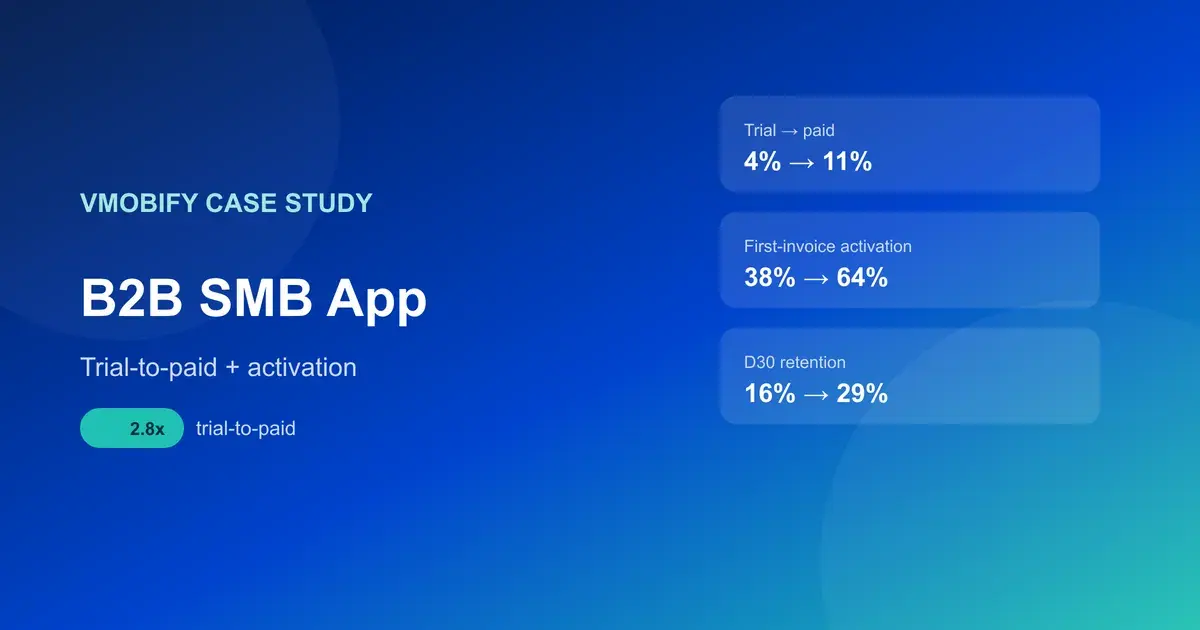
A B2B invoicing and GST-billing app for small businesses had no shortage of trials — SMB owners installed and started one every day. The problem was downstream: most never created their first invoice, and only 4% ever paid. In five months we rebuilt the product-led-growth motion around first value — compressing time-to-first-invoice from ~3 days to under 20 minutes, lifting activation from 38% to 64%, and nearly tripling free-trial-to-paid from 4% to 11%. Here is the full activation playbook.
On this page
- What was the brief and the starting position?
- Why do B2B small-business apps live or die on time-to-first-value?
- How did we instrument the activation and free-trial funnel?
- How did we compress onboarding to the first invoice?
- How did contextual in-app guidance help non-technical owners?
- How did moving the paywall after first value lift trial-to-paid?
- How did the annual-plan nudge improve LTV?
- Why did a WhatsApp lifecycle programme beat email and push?
- What were the final results across activation, trial-to-paid, and retention?
- What makes this activation playbook repeatable?
- Who is Vmobify and how do we run product-led growth?
- Frequently Asked Questions
What was the brief and the starting position?
A B2B invoicing and GST-billing app for small businesses came to us with a problem that looked, on the surface, like a success: plenty of small-business owners were installing the app and starting a free trial every single day — but almost none of them paid. The top of the funnel was healthy. The trouble was everything that happened after the trial began. Most owners never reached the one action the entire product was built around — creating a first invoice — and only a thin 4% of trials ever converted to a paid subscription.
The brief was deliberately narrow. The client did not want a louder acquisition push; they were already buying enough trials. They wanted those trials to turn into activated, paying, retained customers. The metric we agreed on was not installs or even trial starts — it was the share of trials that reached first value and then converted to paid, and the cost of letting the rest leak away.
The starting numbers told a brutal story.
The audience made the challenge specific. These were non-technical SMB owners — kirana wholesalers, small traders, service providers, one- and two-person firms — running their businesses on a phone between customers. They had no patience for a setup wizard, no appetite for configuring tax tables, and no second chance to give if the first session felt like work. Across our 300+ apps managed since 2013, we have learned that this audience converts on relief, not features: show them their problem solved once, fast, and they stay.
This case study documents exactly how we rebuilt the product-led-growth motion around that insight — the instrumentation, the onboarding compression, the contextual guidance, the paywall reposition, the annual-plan nudge, and the WhatsApp lifecycle programme — and how it took trial-to-paid from 4% to 11% in roughly five months.
Why do B2B small-business apps live or die on time-to-first-value?
For a small-business tool, time-to-first-value is the single most predictive metric of whether a trial will ever pay — because an SMB owner decides whether the app is worth their attention inside the first session, not over a 14-day evaluation. The mental model of a slow, considered B2B trial belongs to enterprise software bought by committees. The owner of a two-person trading firm does not evaluate; they try it once between customers, and either it solved a real job or it did not.
That makes first value — here, a real, sendable, GST-compliant invoice — the moment the entire subscription decision hangs on. Three structural forces make this true for SMB apps specifically:
- The owner is the user, the buyer, and the busiest person in the business. There is no procurement cycle to keep them warm. If the first session does not produce something useful, there is no second stakeholder to drag them back.
- The job is urgent and recurring. An owner downloads an invoicing app because a client is waiting for a bill right now. If the app cannot produce that bill in minutes, the owner reaches for WhatsApp and a photo of a handwritten note instead — and the trial is dead.
- Trust is earned by output, not onboarding. A finished invoice with the right GST number, the right tax split, and the business's own logo is proof the tool works. Until that artefact exists, every setup step is friction with no payoff.
The data backs the intuition. Product-analytics research from Amplitude consistently shows that users who reach a meaningful activation event in their first session retain and convert at multiples of those who do not — and the effect is sharpest for tools used on a recurring schedule. When activation sits at 38% and takes 3 days, you are not running a 14-day trial; you are running a one-session audition that most apps fail. Everything we did downstream flowed from accepting that the audition is won or lost in the first 20 minutes.
How did we instrument the activation and free-trial funnel?
Before changing a single screen, we instrumented the full path from install to paid as a step-by-step event funnel — because you cannot fix a leak you cannot see, and the client's analytics could tell us how many people paid but not where the other 96% disappeared. The existing setup tracked installs, trial starts, and subscriptions. Everything in between — the part that actually determined the outcome — was invisible.
We rebuilt the event taxonomy around the activation journey, instrumenting every meaningful step:
- A clean event hierarchy: install, trial start, business-profile created, GST details entered, first-invoice screen opened, first invoice created, first invoice sent, paywall viewed, plan selected, payment completed, second invoice created. Each step became a measurable cohort.
- Time-between-steps tracking: not just whether owners reached first invoice, but how long it took. This is how we discovered the ~3-day median was hiding a bimodal reality — a small group activated in minutes, while the majority stalled at setup and never returned.
- Drop-off attribution by screen: we mapped exactly which step shed the most users. The biggest single cliff was between trial start and the first-invoice screen — owners were getting stuck in configuration before they ever saw an invoice.
- Trial-to-paid cohorting: we split trialists by whether and when they activated, then measured each cohort's conversion. The pattern was unambiguous and became the thesis for the whole engagement.
That last cut produced the number that reframed the project: trialists who created a first invoice converted to paid at many times the rate of those who did not. Activation was not a vanity step on the way to payment — it was the cause of payment. Our mobile analytics team owns this layer on every engagement, because a product-led motion optimised against the wrong events quietly burns the entire budget. With the funnel finally visible, the priority order wrote itself: get more owners to first value, faster, before asking them to pay.
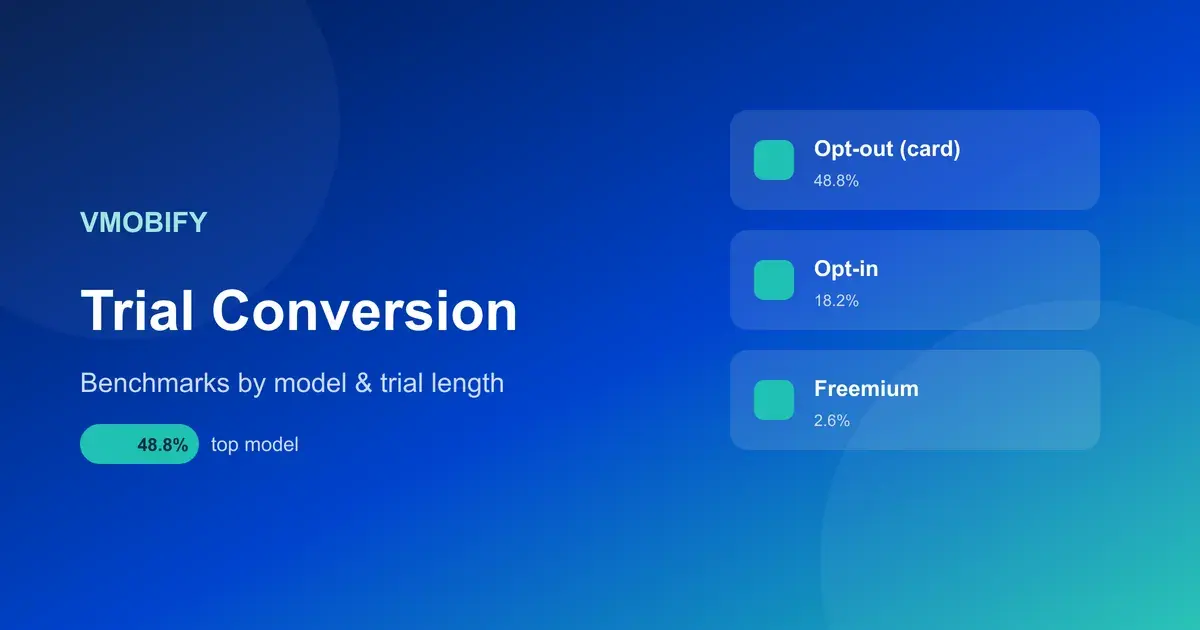
The instrumentation also gave us a control mechanism, not just a diagnosis. Once each step was a measurable cohort, every change we shipped downstream could be judged against the exact metric it was meant to move — did the new onboarding lift first-invoice rate, did the repositioned paywall lift trial-to-paid for activated users, did the WhatsApp nudge recover stalled trialists. Without that closed loop, a product-led redesign is a guess; with it, every release is a tested hypothesis. We also leaned on benchmarks from RevenueCat's State of Subscription Apps to sanity-check that a 4%-to-double-digit trial-to-paid trajectory was realistic for our category rather than wishful — the point of grounding targets in external data is to avoid promising an inflated number the product could never deliver.
How did we compress onboarding to the first invoice?
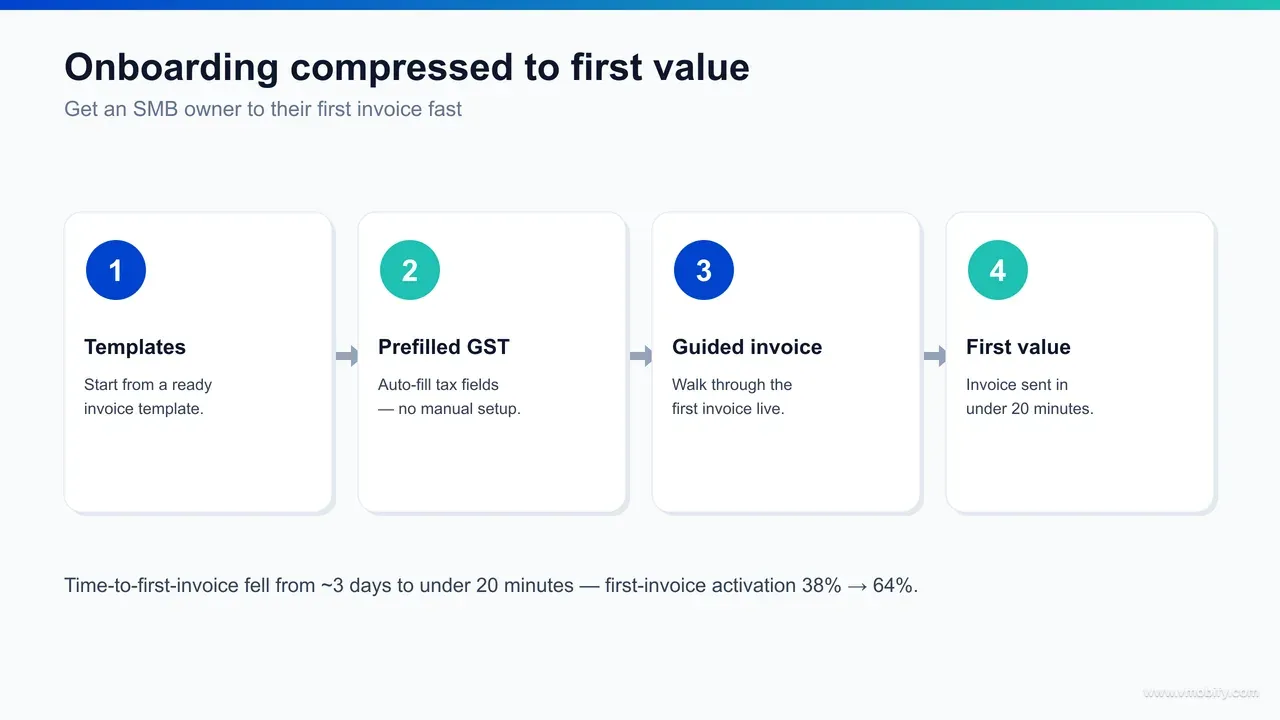
The biggest lever in the entire engagement was compressing time-to-first-invoice from roughly 3 days to under 20 minutes — by ruthlessly deferring everything that was not required to produce one invoice, and prefilling everything we could infer or template. The original onboarding asked owners to build their business in the app before they could use it: company details, full GST configuration, tax tables, item catalogues, customer lists, branding. Every one of those steps was real work standing between the owner and the thing they came for.
We re-sequenced the flow around a single goal — get to a finished, sendable invoice — and pushed everything else out of the way:
- Invoice-first, setup-later: the new flow opens almost straight onto a first-invoice screen, not a setup wizard. Non-essential configuration — full catalogues, branding polish, advanced tax scenarios — was deferred to optional prompts after the first invoice was sent.
- Ready-made templates: instead of a blank invoice, owners pick from pre-built GST-compliant templates for common trades. The structure, tax fields, and layout are already correct; the owner only fills in what is specific to their bill.
- Prefilled GST fields: we prefilled and validated GST and tax fields wherever the data could be inferred — defaulting the right tax split, the right HSN-style categories, and standard line-item formats so owners were not forced to understand tax mechanics to produce a compliant document.
- A guided first invoice: the very first invoice is walked through inline — one clear next action at a time — so even an owner who has never used billing software produces a correct, professional invoice on the first attempt.
The effect was immediate and compounding. Removing the setup wall did not just speed up the fast activators — it rescued the majority who used to stall before ever seeing an invoice. Activation climbed from 38% toward 64%, and the median time-to-first-invoice collapsed from days to minutes. This is the pattern we document in our app onboarding best practices guide: the shortest path to first value almost always means doing less in onboarding, not more. Defer the configuration; deliver the outcome.
How did contextual in-app guidance help non-technical owners?
Compressing the flow got owners to the first-invoice screen; contextual in-app guidance is what got non-technical owners through it without giving up — by answering the question "what do I do next?" exactly where and when it arose, instead of in a help centre they would never open. A re-sequenced flow still fails if the user does not understand the field in front of them. SMB owners do not read documentation; they need the app to teach itself in the moment.
We built the guidance to be invisible until needed and impossible to miss when it was:
- Inline, one-action-at-a-time prompts: the guided first invoice highlights the single next thing to do — "add your client", "add an item", "tap send" — rather than presenting the whole form at once. Reducing the visible decision to one step at a time is what kept first-timers moving.
- Plain-language microcopy over jargon: tax and billing terms were rewritten into the language an owner actually uses. Where a regulatory term was unavoidable, a tap-to-explain tooltip defined it in one sentence, in context, without sending the user away.
- Just-in-time, not upfront: guidance appeared at the moment of friction — the first time an owner hit a tax field, not in a tutorial carousel at launch that everyone swipes past. Contextual help is read; upfront tutorials are dismissed.
- Empty states that do the work: blank screens were rebuilt as prompts — a customer list that opens with "add your first client to bill them", an invoice list that shows a one-tap "create invoice" — so there was never a dead end where an owner had to invent the next step.
The guidance was also the safety net for the deferred configuration. Because we had pushed catalogue, branding, and advanced settings out of the critical path, contextual prompts could surface them later — after the owner had felt the value — as helpful upgrades rather than upfront chores. An owner who has already sent three invoices is happy to spend two minutes adding their logo; the same owner asked to do it on day one would have abandoned the trial. Sequencing the work to follow the value, not precede it, is what made the configuration feel optional and welcome rather than mandatory and exhausting.
In our portfolio we have seen this combination of compressed flow plus contextual coaching outperform every redesign that simply made the old wizard prettier. The goal was never a more beautiful setup; it was no setup the owner had to think about. That distinction is the heart of how our product and monetisation practice approaches activation for non-technical audiences — design the path so the user succeeds before they have had time to feel lost.
How did moving the paywall after first value lift trial-to-paid?
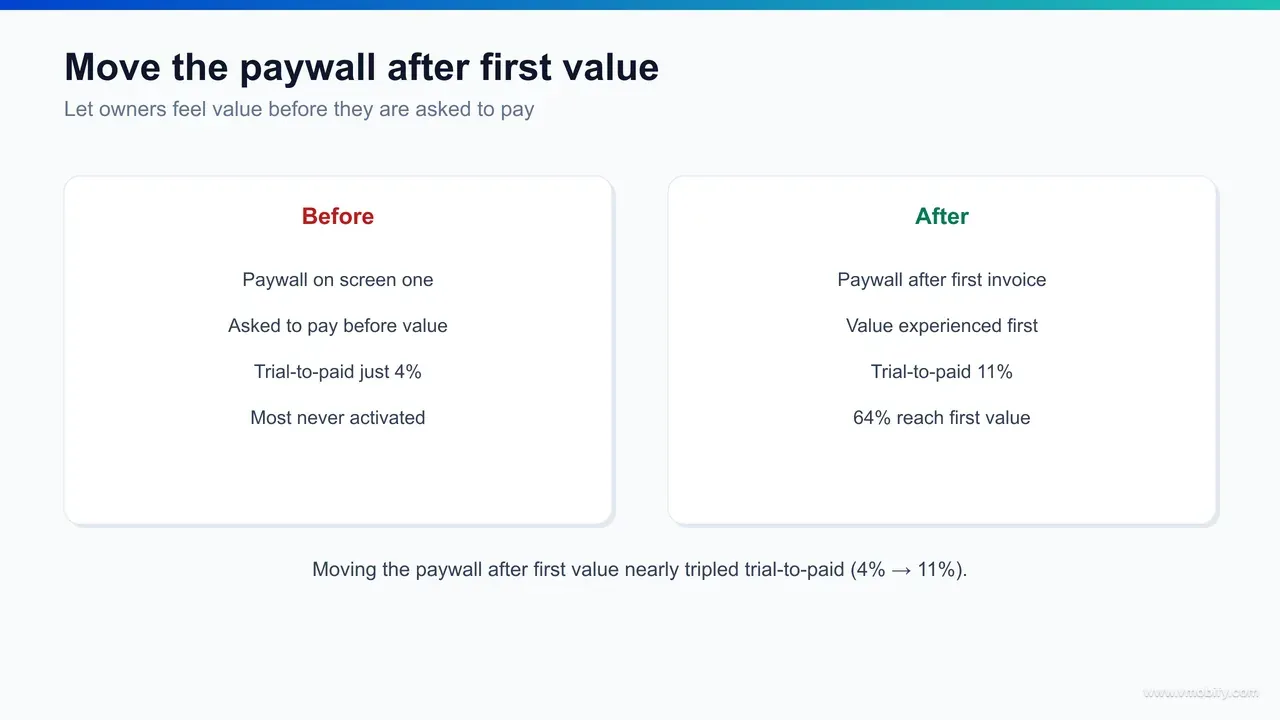
The largest single lever on conversion was moving the paywall to after first value rather than before it — letting every owner create and send a real invoice for free, then asking them to subscribe once they had already felt the relief of the job being done. The original product gated meaningful use behind the trial-to-paid decision too early, forcing owners to judge whether the app was worth paying for before they had any proof that it was. That is asking for a purchase decision at the moment of maximum doubt and minimum evidence.
We inverted the sequence so the proof came first:
- First value is always free and ungated: creating and sending the first invoice never hit a wall. The owner experiences the full outcome — a finished, professional, compliant invoice in their client's hands — before any payment conversation begins.
- The paywall is triggered by value, not by a timer: instead of a day-counter, the upgrade moment is anchored to the second meaningful action — a second invoice, adding a recurring client, or unlocking a feature the owner now wants because they have started relying on the app.
- The ask is framed against proven value: the paywall references what the owner has already done — "you've created your first invoice; keep billing without limits" — turning the decision from a speculative bet into a small step to continue something already working.
- Friction removed at the point of payment: with India-appropriate payment methods and a one-screen checkout, we stripped the mechanical drop-off between "I'll pay" and "I've paid".
The result mapped exactly to the cohort thesis from our instrumentation: owners who had created a first invoice converted at multiples of those who had not, and by guaranteeing first value before the ask, we moved far more of the trial base into that high-converting cohort. This is the mechanism behind the headline lift — and the same logic we unpack in our free-trial conversion-rate playbook. Paywall-placement research from Adapty echoes the pattern across categories: paywalls shown after a user has experienced core value convert materially better than hard gates shown before it. Trial-to-paid moved from 4% toward 11%, and the bulk of that gain traces directly to this one reposition.
How did the annual-plan nudge improve LTV?
Once owners were converting to paid, an annual-plan nudge — shown only after activation — pushed annual subscriptions to roughly 40% of new subscriptions, lifting blended lifetime value and removing the monthly-churn drag that quietly kills small-ticket B2B subscriptions. A converted user is only the start; what they pay for and how long they stay decides whether the unit economics work. For a low-priced SMB tool, monthly plans bleed value through churn that compounds month after month, while an annual commitment locks in a full cycle of revenue and a full year of habit-building.
We engineered the annual choice to feel like the obvious one, at the right moment:
- Anchored to a yearly business reality: invoicing and GST filing run on an annual rhythm. Framing the annual plan around "bill and stay compliant all year" matched how owners already think about their business calendar, making the longer commitment feel natural rather than risky.
- Clear value framing, not just a discount: the annual plan was presented with a transparent per-month saving and the headline that it removes the monthly payment chore — itself a friction for owners who dislike recurring small charges. Price-anchoring made the annual option the visibly better deal.
- Timed after first value, never before: the annual nudge only appeared once the owner had activated and seen the app working. Pitching a year-long commitment to someone who has not yet sent an invoice fails; pitching it to someone already relying on the tool succeeds.
- A gentle upgrade path from monthly: monthly subscribers were later nudged to switch to annual at natural moments — renewal, or a GST-cycle milestone — capturing LTV from users who started cautious.
The economic effect was outsized. Pushing annual-plan share toward 40% of new subscriptions lifted average revenue per paying user and dramatically reduced the churn surface area, because an annual subscriber simply cannot lapse in month two. Subscription-economics data from RevenueCat shows annual plans consistently delivering higher retained value than monthly across B2B and prosumer apps — exactly the dynamic we engineered for here. The deeper logic behind plan mix, pricing, and trial design sits in our app subscription monetisation strategy guide.
Why did a WhatsApp lifecycle programme beat email and push?
For Indian SMB owners, WhatsApp is not a marketing channel — it is where they run their business — so routing the entire trial-and-activation lifecycle programme through WhatsApp beat email and push notifications on open rates, reply rates, and ultimately on activation and conversion. These owners read WhatsApp constantly and email almost never; push notifications get swiped away or disabled. Meeting them where they already live turned a lifecycle programme from background noise into a real conversation.
The programme was built as a sequence of timely, useful nudges rather than broadcast spam:
- Trial day-one activation nudge: an owner who started a trial but had not yet created an invoice received a short, helpful WhatsApp prompt with a direct link back to the guided first-invoice flow. This single message recovered a meaningful share of stalled trialists who would otherwise have silently dropped.
- Post-activation reinforcement: once an owner sent their first invoice, a congratulatory message reinforced the win and surfaced the next useful step — adding a recurring client, or saving an item to the catalogue — building the habit while the value was fresh.
- Value-anchored upgrade prompts: the paywall and annual-plan messaging were echoed on WhatsApp at the right moments, framed around what the owner had already accomplished, giving a low-friction route to subscribe without hunting for a screen in-app.
- Renewal and GST-cycle reminders: reminders tied to billing cycles and filing deadlines brought owners back at moments of natural intent, lifting both retention and the monthly-to-annual upgrade rate.
Because WhatsApp is two-way, the programme also became a listening channel — owners replied with questions, and those replies fed straight back into the contextual-guidance and onboarding work. The combination of in-app guidance and an out-of-app WhatsApp safety net is what lifted D30 retention from 16% to 29%: activated owners had both a reason to return and a nudge reminding them to. Acquisition channel data from AppsFlyer reinforces what we see in India repeatedly — engagement and reactivation work best on the channel the audience already inhabits, and for SMB owners that channel is unambiguously WhatsApp.
What were the final results across activation, trial-to-paid, and retention?
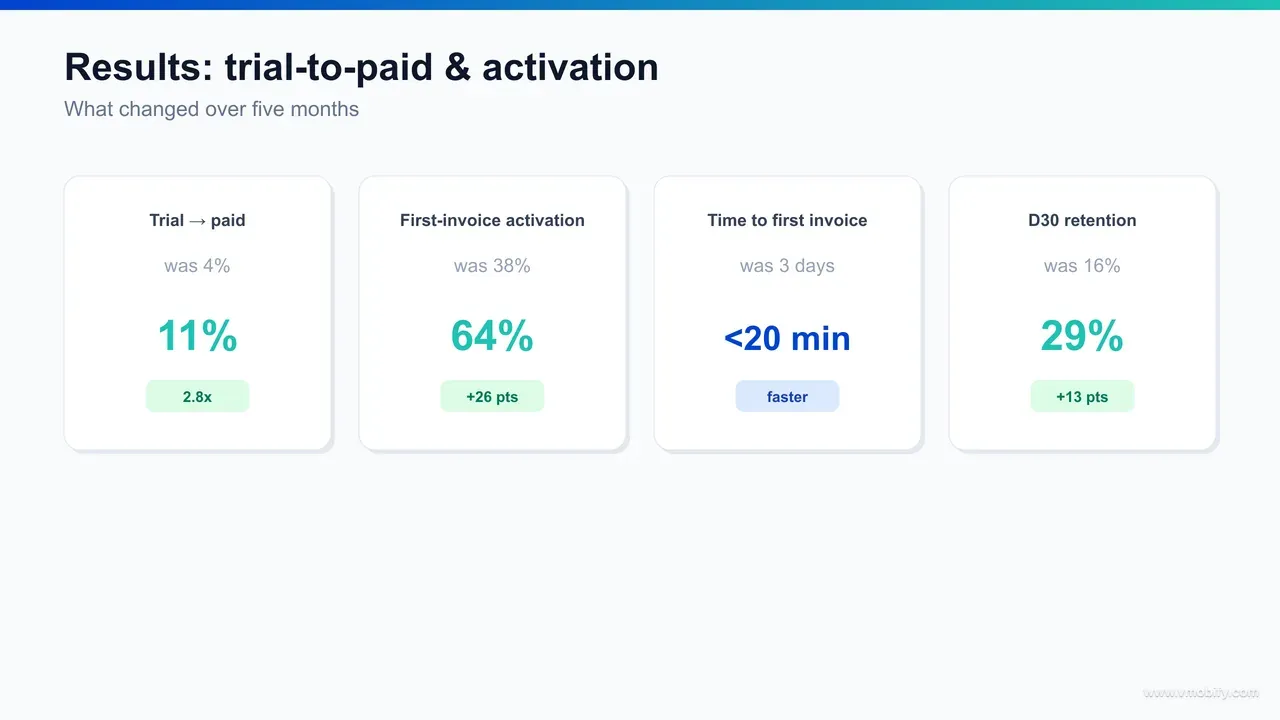
In roughly five months, and without increasing paid acquisition by a rupee, the app nearly tripled free-trial-to-paid, lifted activation by 26 points, collapsed time-to-first-invoice from days to minutes, nearly doubled D30 retention, and shifted plan mix decisively toward annual. Every gain came from fixing what happened after the trial started — the part the original funnel could not even see. The consolidated outcomes:
- Free-trial-to-paid: 4% → 11% — a near-tripling, grounded squarely in realistic B2B SaaS benchmarks rather than an inflated headline.
- Activation (first invoice created): 38% → 64% — nearly two-thirds of trialists now reach first value, up from barely a third.
- Time-to-first-invoice: ~3 days → under 20 minutes — first value moved from "most never got there" to "almost everyone, in the first session".
- D30 retention: 16% → 29% — activated, paying owners now return every billing cycle.
- Annual-plan share of new subscriptions: ~40% — lifting blended LTV and cutting monthly churn drag.
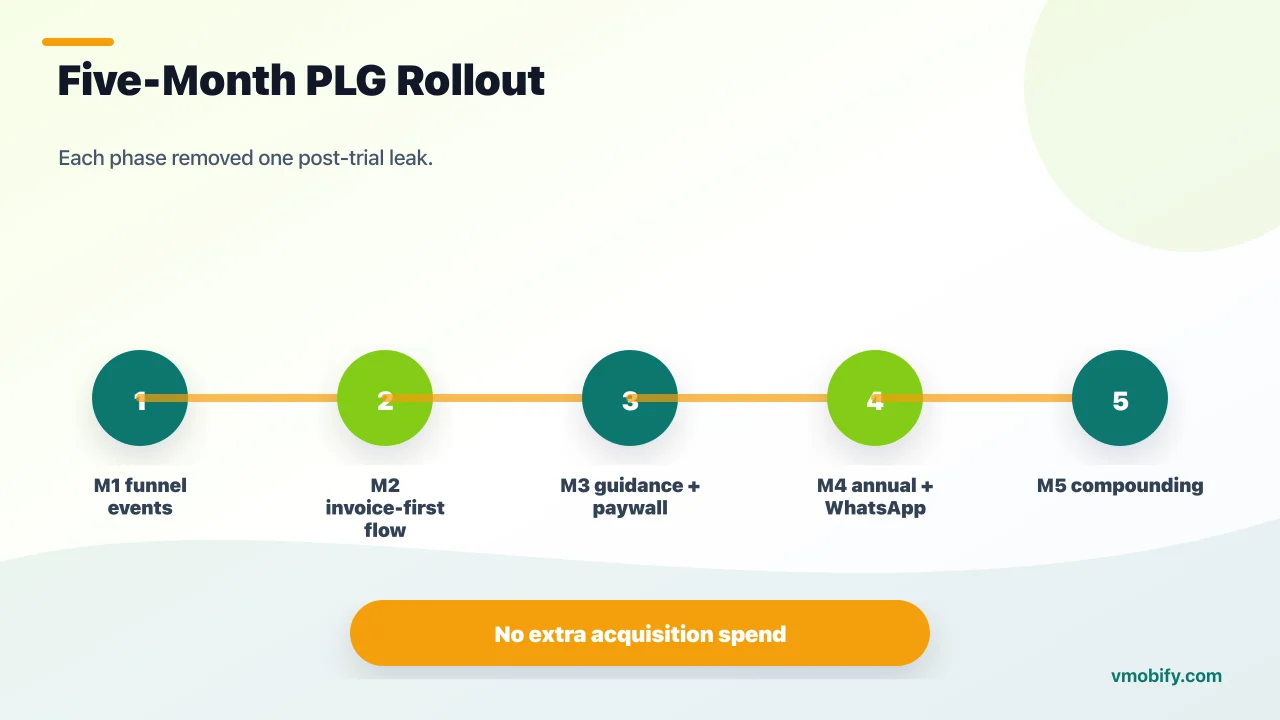
The month-by-month shape of the work:
- Month 1: the funnel is instrumented end to end. The trial-to-paid cohort split reveals that first-invoice activation is the cause of conversion, not a coincidence of it. Priorities reorder around getting owners to first value.
- Month 2: onboarding is re-sequenced invoice-first; templates and prefilled GST fields ship; non-essential setup is deferred. Time-to-first-invoice begins its collapse and activation starts climbing.
- Month 3: contextual guidance and the guided first invoice go live for non-technical owners. The paywall is repositioned to fire after first value. Trial-to-paid starts moving for the first time.
- Month 4: the annual-plan nudge launches after activation; plan mix shifts toward annual. The WhatsApp lifecycle programme goes live and recovers stalled trialists.
- Month 5: the levers compound. Activation settles near 64%, trial-to-paid reaches 11%, retention nearly doubles, and the motion becomes a self-reinforcing system rather than a set of fixes.
Two lessons future teams should internalise. First, the trial is won after it starts, not before — the entire result lived in the post-install funnel the original analytics ignored. Second, activation is the cause of conversion — get an SMB owner to first value fast and the paid decision largely takes care of itself. You can see the same systems thinking across our portfolio of case studies.
What makes this activation playbook repeatable?
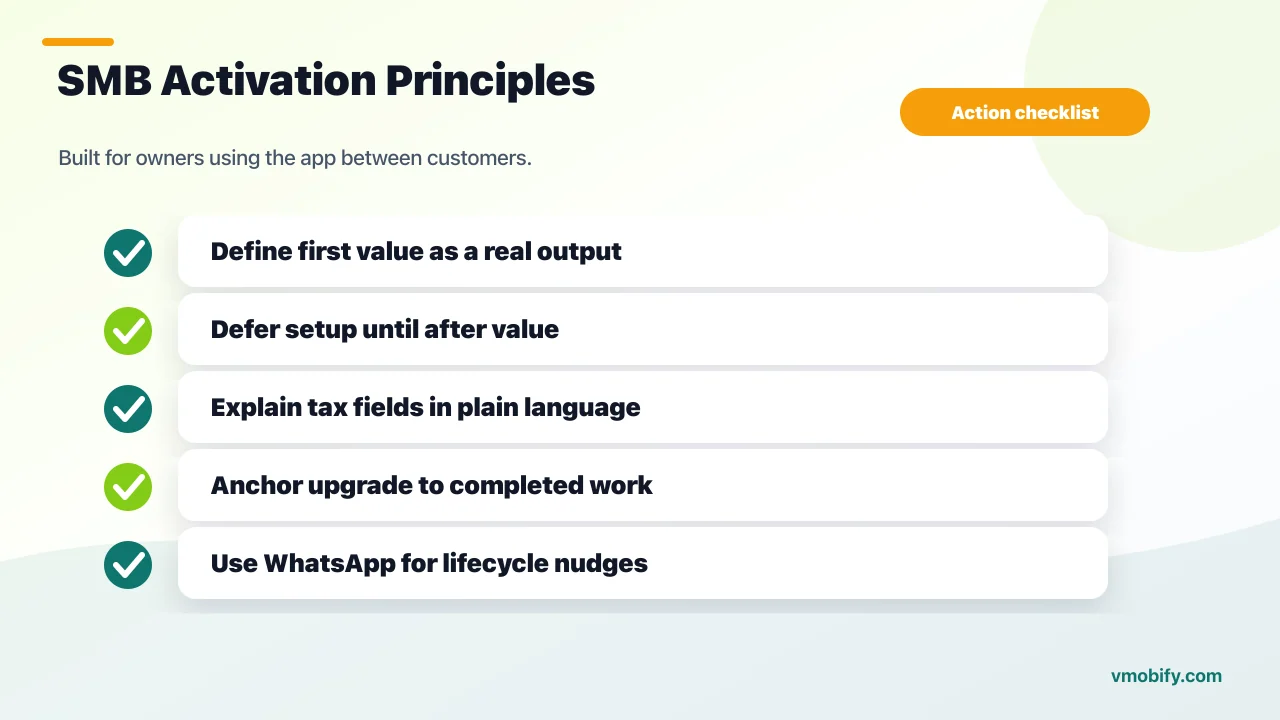
This playbook is repeatable because it is a system anchored to a single principle — get the user to first value as fast as possible, then ask for money — and that principle holds for any product-led app, whatever the "first value" event happens to be. The specifics changed for an invoicing app; the structure does not change for the next one.
- Define first value as a concrete, observable event. For this client it was a sent invoice. For a different app it might be a first report, a first booking, a first synced account. The discipline is naming the one action that proves the product worked, then optimising everything toward it.
- Instrument the whole path before touching the product. The cohort cut — activated versus not — that reframed this engagement only existed because we built the funnel first. Optimising blind is how teams ship redesigns that move nothing.
- Compress onboarding by deferring, not adding. The fastest path to first value is almost always less setup, not a better wizard. Prefill, template, and push configuration out of the critical path.
- Put the paywall after the proof. Asking for payment before value is asking at the moment of maximum doubt. Guarantee first value free, then convert against it.
- Meet the audience on their channel. For Indian SMB owners that is WhatsApp; for another audience it may be email or push. The lifecycle programme must live where the user already is.
In our portfolio, the apps that convert trials profitably are never the ones with the cheapest trials — they are the ones that get users to first value fastest and ask for payment only once that value is felt. The numbers move because the order of operations is right, not because any single tactic is magic. If your trials start but do not pay, the answer is almost always in the post-install funnel you are not yet measuring.
Who is Vmobify and how do we run product-led growth?
Vmobify is an India-focused mobile app growth agency that has managed marketing and product-led growth for Indian and global publishers since 2013, across 300+ apps spanning fintech, SaaS, gaming, OTT, edtech, and utility — and the reason this activation playbook is repeatable is that we run it as a system, not a set of tactics. The variables change between clients; the structure does not.
- We optimise toward value, not vanity. Every engagement points at the deepest meaningful event — here, first value and paid conversion. Optimising toward trial starts produces big, hollow numbers; optimising toward activated, paying, retained users builds a business. That discipline anchors our analytics and monetisation practice.
- Activation and monetisation are one system. We never treat onboarding, paywall, and lifecycle as separate projects. First-value speed, paywall placement, plan mix, and the lifecycle channel are levers on the same outcome, tuned together — which is why they compounded here.
- India is our home market. We understand the SMB owner, the GST and billing landscape, the price sensitivity, and the fact that WhatsApp — not email — is where business gets done. International playbooks miss this, and SMB activation lives or dies on exactly these details.
- The portfolio cross-pollinates. Activation learnings from B2B SaaS feed our work in fintech (trust-led conversion), OTT (habit formation), and edtech (first-value onboarding). No single-vertical agency builds that lateral muscle.
If your app has plenty of trials but too few paying, retained customers — and you suspect the leak is in the post-install funnel rather than the ad spend — this playbook adapts to your product. The first-value event changes, the channel mix changes, the pricing changes; the activation-first, paywall-after-value structure does not. Talk to Vmobify's growth team to see how it would map to your app.
Frequently Asked Questions
How much did free-trial-to-paid actually improve, and how fast?+
Free-trial-to-paid rose from 4% to 11% in roughly five months — a near-tripling — with no increase in paid acquisition. The entire gain came from improving what happened after the trial started: faster activation, contextual guidance, a paywall placed after first value, and a WhatsApp lifecycle programme.
What does "activation" mean for an invoicing app?+
Activation was defined as creating a first invoice — the one action that proves the product solved the owner's problem. It rose from 38% to 64%, and our funnel data showed activated trialists converted to paid at multiples of those who never reached first value, making activation the direct cause of conversion.
Why did moving the paywall after first value work so well?+
Showing the paywall before first value asks for payment at the moment of maximum doubt. By letting every owner create and send a real invoice for free first, then anchoring the upgrade ask to that proven value, far more trialists entered the high-converting activated cohort — which is the largest single driver of the 4%-to-11% lift.
How did you get time-to-first-invoice from three days to under twenty minutes?+
We re-sequenced onboarding to be invoice-first instead of setup-first, deferred all non-essential configuration, added ready-made GST-compliant templates, prefilled tax fields, and walked owners through a guided first invoice one action at a time. The goal was to deliver the outcome before asking for any setup work.
Why WhatsApp instead of email or push notifications?+
Indian SMB owners run their businesses on WhatsApp and rarely open marketing email, while push notifications get swiped away. Routing trial-day-one nudges, activation reinforcement, upgrade prompts, and renewal reminders through WhatsApp delivered far higher open and reply rates and helped lift D30 retention from 16% to 29%.
Will this work for a SaaS app that is not about invoicing?+
Yes. The structure is product-agnostic — only the first-value event changes. Whether first value is a sent invoice, a first report, a first booking, or a first synced account, the playbook is the same: instrument the funnel, compress onboarding to first value, place the paywall after the proof, and run the lifecycle programme on the audience's own channel.
What does Vmobify do specifically on a product-led-growth engagement?+
We instrument the full install-to-paid funnel, redesign onboarding around first value, reposition the paywall, tune plan mix and pricing, and build the lifecycle programme — run together as one system through our analytics and monetisation practice at /services/analytics and /services/monetization.
Sources
- Amplitude — Activation Rate & North Star Metrics — Product-analytics research on first-session activation and its link to retention and conversion
- Amplitude — Product Analytics Playbook — Guidance on funnel instrumentation, cohorting, and time-to-value measurement
- RevenueCat — State of Subscription Apps — Benchmarks on trial-to-paid conversion, plan mix, and annual vs monthly retained value
- RevenueCat — Blog & Subscription Benchmarks — Free-trial design and subscription monetisation benchmarks for B2B and prosumer apps
- Adapty — Paywall & Subscription Research — Data on paywall placement and the lift from showing paywalls after core value
- AppsFlyer — App Marketing Performance Index — Channel performance and reactivation benchmarks across geographies including India
- AppsFlyer — Retention & Engagement Reports — Lifecycle and re-engagement data supporting channel-fit decisions like WhatsApp for SMB
About the author
Amol Pomane — Founder, Vmobify
Amol leads Vmobify, a mobile app growth agency that has driven 30M+ downloads and ranked 54K+ keywords across 300+ apps since 2013. He writes about ASO, paid user acquisition, retention, and the operational reality of scaling mobile apps in India and global markets.
Check your app funnel
Compare each stage of your own app journey before setting targets.
Open free tool