Hybrid Monetisation: Combine Ads + IAP Without Cannibalising Purchases
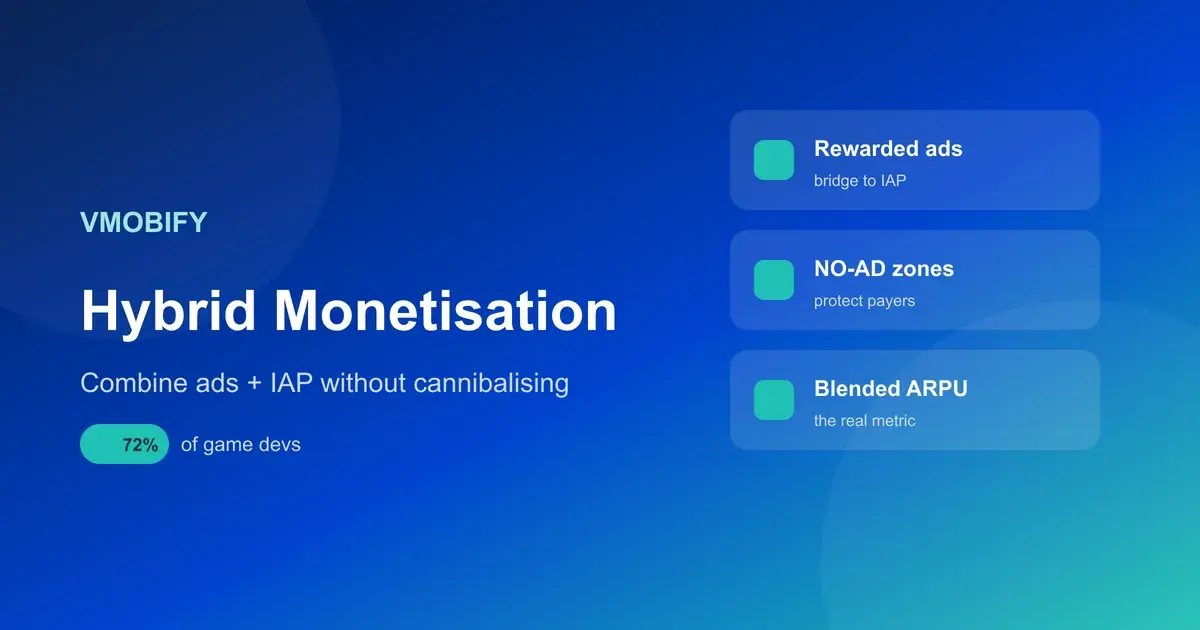
Hybrid monetisation — running in-app ads alongside in-app purchases and subscriptions — is now the default for roughly 72% of mobile game developers. Here is how to combine ad and purchase revenue so they compound instead of cannibalising each other, with an India low-ARPU playbook built in.
On this page
- What is hybrid monetisation, and why is it now the default?
- What are the layers of a hybrid monetisation model?
- Do in-app ads cannibalise in-app purchases?
- Which ad formats work, and where should you place them?
- How do you segment payers from non-payers?
- How do rewarded ads bridge users to their first purchase?
- How do you balance ad eCPM against IAP ARPU?
- What does the India low-ARPU hybrid playbook look like?
- How do you measure a hybrid model with blended ARPU?
- Which hybrid monetisation pitfalls hurt retention most?
- Frequently Asked Questions
What is hybrid monetisation, and why is it now the default?
Hybrid monetisation is running more than one revenue model in the same app at the same time — in-app advertising (IAA) alongside in-app purchases (IAP) and, increasingly, subscriptions — so that you earn from users who pay and users who never will. It has stopped being an advanced tactic and become the baseline: per Adjust's analysis of hybrid monetisation, around 72% of mobile game developers now run a hybrid model rather than relying on a single stream.
The reason is simple arithmetic about who actually pays. In almost every app, the share of users who ever make an in-app purchase sits in the low single digits — frequently 2-5%. A pure-IAP app therefore earns nothing from 95% or more of the people who install it, no matter how engaged they are. A pure-ads app, on the other hand, leaves money on the table from the small minority who would happily spend on a subscription or a one-off purchase. Hybrid exists to close both gaps at once: ads monetise the non-paying majority, IAP and subscriptions capture the high-intent minority, and the two audiences barely overlap.
This is not limited to games, although games led the shift. The same logic now runs through content apps, utilities, and casual productivity tools — anywhere a large free base coexists with a thin tier of willing payers. The collapse of single-model thinking has been accelerated by post-IDFA measurement pressure, which — as AppsFlyer's Performance Index documents across categories — made every install more expensive to acquire and therefore made squeezing revenue from every user, not just payers, a survival requirement rather than an optimisation.
Across our 300+ apps managed since 2013, the pattern is consistent: the teams that treat ads and purchases as rival revenue streams underperform the teams that treat them as one funnel. The question is never "ads or IAP" — it is "which user, which surface, which moment." Get that allocation right and the two models compound. Get it wrong and they fight each other, which is the cannibalisation fear this entire guide is built to defuse.
What are the layers of a hybrid monetisation model?
A well-built hybrid model has three stacked layers — an ad layer that monetises everyone, an IAP layer that monetises engaged non-subscribers, and a subscription layer that captures your highest-intent users — each aimed at a different slice of the base. The art is matching the layer to the user, so no single user is hit with all three at full intensity.
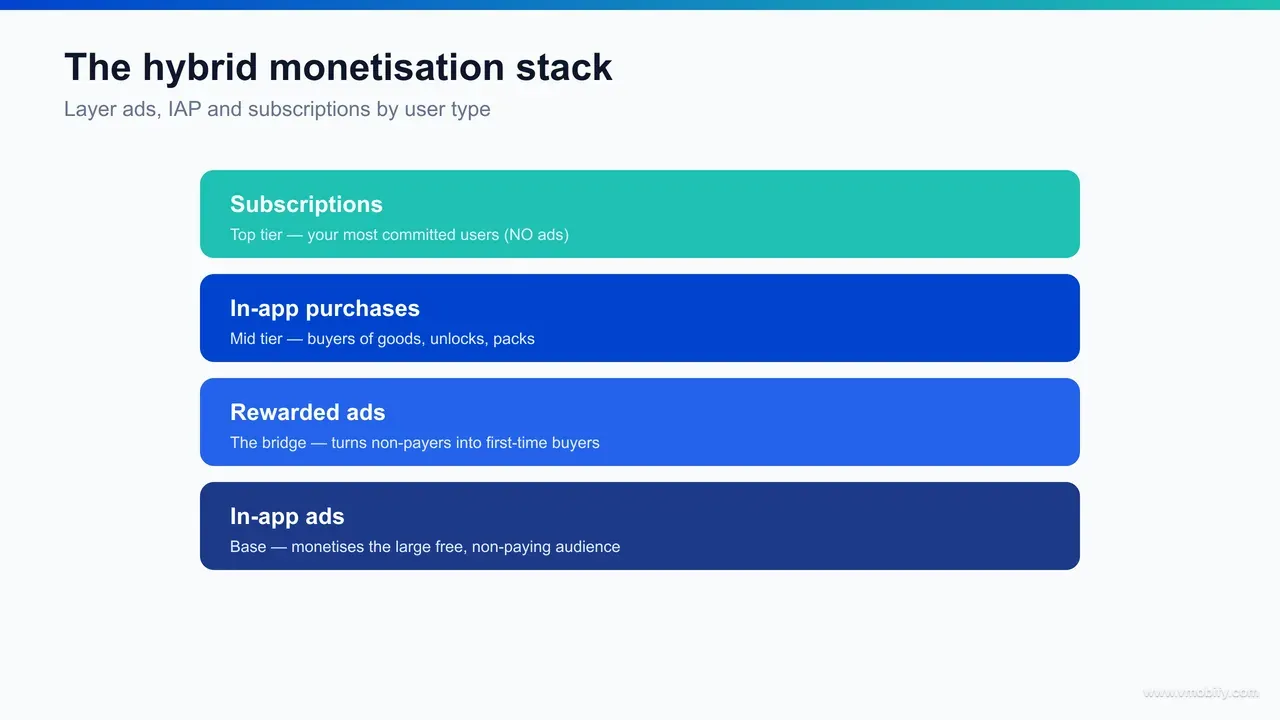
- The ad layer (IAA): the floor under your entire user base. Rewarded video, interstitials at natural breaks, and occasionally banners. This is the only layer that earns from the 95%+ who will never pay, so it carries the base-wide ARPU for free users.
- The IAP layer: consumables, durable unlocks, and one-off purchases for users who are engaged enough to spend but not ready for a recurring commitment. This is where most discretionary spend lives, and where pricing experiments move the needle most — our guide to in-app purchase pricing experiments covers how to test it without guessing.
- The subscription layer: the top tier — recurring revenue from your most committed users, often bundled with an ad-free experience as a benefit. This is the layer with the highest lifetime value per user and the one most worth protecting from ad clutter.
The layers are not mutually exclusive per user, but they should be sequenced. A new install starts in the ad layer by default; as engagement signals accumulate, you surface IAP offers; as a user demonstrates repeat spend or deep usage, you present the subscription. Forcing the subscription paywall on a cold install — before the ad layer has even shown the product's value — is the most common way teams suppress conversion and then blame the price.
The mistake we see most often is treating these as three separate teams shipping three separate roadmaps. A monetisation team that optimises ad eCPM in isolation from the IAP team will, sooner or later, place an interstitial that interrupts the exact moment a user was about to buy. The layers have to be designed as one system, with one owner of blended revenue — which is exactly how our app monetisation engagements are structured.
Do in-app ads cannibalise in-app purchases?
No — when the ad strategy is built around rewarded, opt-in formats and respects payer segments, ads do not cannibalise purchases; they enlarge them. The evidence is direct: rewarded-ad users are roughly 4.5-5x more likely to go on to make an in-app purchase than users who never engage with a rewarded ad. The ad is acting as a discovery and value-demonstration mechanism, not as a cheaper substitute for spending.
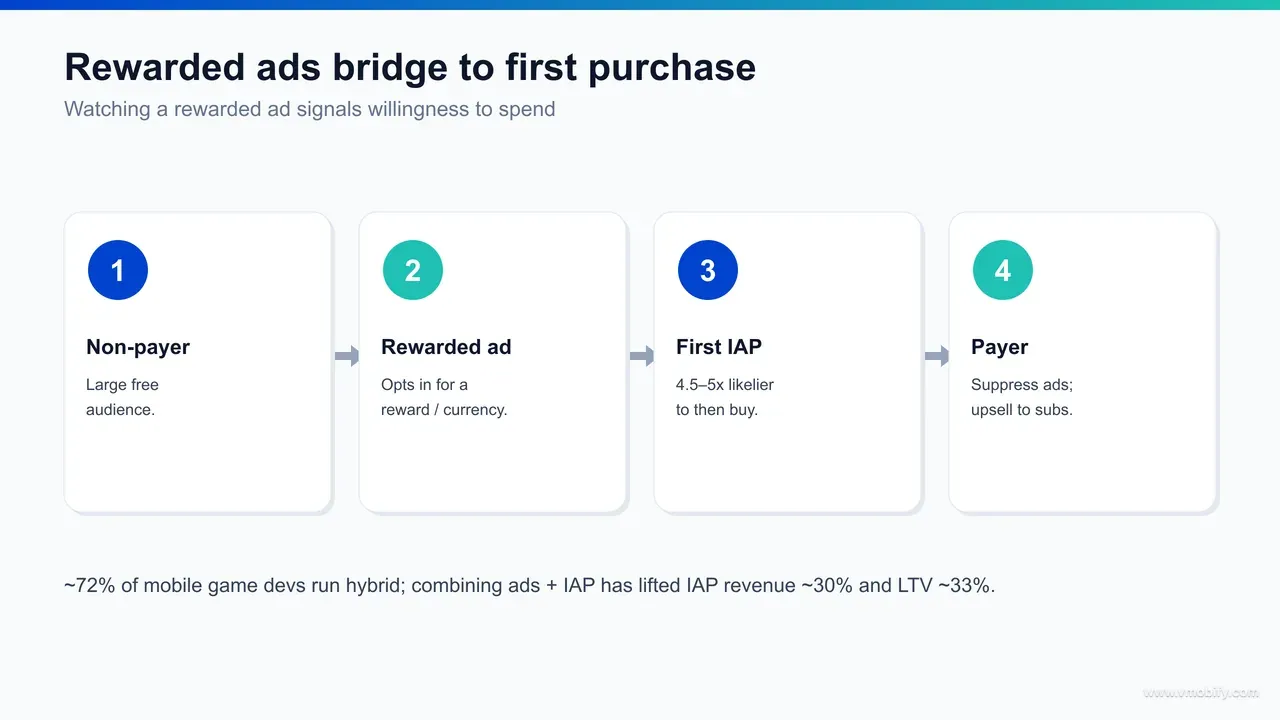
This counterintuitive result is the single most important fact in hybrid monetisation, so it is worth being precise about the mechanism. A rewarded ad lets a user sample the thing they might otherwise buy — extra lives, a temporary boost, a premium feature for one session. That sample does two things: it teaches the user the value of the premium good, and it creates a habit of "spending" attention that lowers the psychological barrier to later spending money. Far from replacing the purchase, the rewarded ad is the trailer for it.
The revenue numbers reflect this. Adjust's analysis documents reported hybrid implementations lifting IAP revenue by around 30% and lifetime value by around 33% after layering in-app ads onto an existing purchase model — gains that would be impossible if ads were stealing purchases. The uplift comes from two sources stacking: incremental ad revenue from non-payers, plus a higher conversion rate among the engaged users that rewarded ads warm up toward their first purchase.
A worked example makes the stacking concrete. Take an app with 100,000 monthly active users where 3% — 3,000 users — make a purchase, and the other 97,000 generate nothing. Add a rewarded-ad layer and two things happen at once. First, those 97,000 non-payers now produce ad revenue they never did before. Second, the engaged slice of them who watch rewarded ads start converting at the elevated 4.5-5x rate, so your payer count climbs from 3,000 toward 4,000 without a single change to price or packaging. The ad layer did not redistribute existing revenue; it manufactured new revenue from a population that was previously worth zero.
The cannibalisation fear is real, but it applies to the wrong implementation, not to hybrid itself. Forced interstitials slammed onto paying users, ad placements that interrupt a checkout flow, or an ad-laden experience that drives engaged users to churn before they ever convert — those cannibalise. The fix is not to abandon ads; it is to segment, which the rest of this guide details. As RevenueCat's work on ad monetisation for subscription apps argues, the question is never whether to show ads but to whom, where, and how often.
Which ad formats work, and where should you place them?
Rewarded video is the workhorse of hybrid monetisation because it is opt-in and value-positive; interstitials work at genuine content breaks; banners are low-yield filler; and the most important placement rule is the NO-AD zone — surfaces where you never show an ad to anyone, payer or not. Format choice and placement discipline matter more than ad network selection.
- Rewarded video — the default: the user chooses to watch in exchange for a clearly stated reward. Because it is opt-in, it does not feel like an interruption, it carries the highest user acceptance, and it is the format that produces the 4.5-5x purchase-propensity lift. Make rewarded ads the centre of gravity of your ad layer.
- Interstitials — at natural breaks only: full-screen ads between levels, after a session goal, or at a clean content boundary. They earn well but punish hard if placed mid-action. Never show one in the first session, never two in quick succession, and never during a flow the user is trying to complete.
- Banners — low priority: persistent banners earn little and tax screen real estate and attention. Use sparingly, if at all, and never on a high-conversion or premium surface.
The placement decision that protects revenue most is defining your NO-AD zones up front. These are surfaces where an ad would either interrupt a purchase or degrade the experience for users who have earned the right to a clean one: the IAP store and checkout flow, the onboarding sequence before a user has seen value, and the entire experience for active subscribers and recent spenders. An ad shown on any of these is almost always net-negative, even if it books a few rupees of eCPM in the moment.
Frequency capping is the lever that turns these formats from a retention risk into a revenue engine. An interstitial with no cap is a churn machine; the same interstitial capped to once every few minutes, never in the first session, and skippable for spenders is a clean revenue line. Set a global cap on full-screen ads per session, a separate cap on rewarded grants per day, and a hard rule that no ad fires within a configurable cooldown after the previous one. These caps are not revenue you are leaving on the table — they are the guardrails that keep the high-frequency, low-value impressions from cannibalising the high-value ones.
In our portfolio, the highest-yielding hybrid configurations are also among the least cluttered — they concentrate ad load into a small number of well-chosen rewarded placements and keep everything else clean. Volume of ads is a vanity metric; revenue per retained user is the real one, and the two pull in opposite directions past a surprisingly low ad-frequency threshold.
How do you segment payers from non-payers?
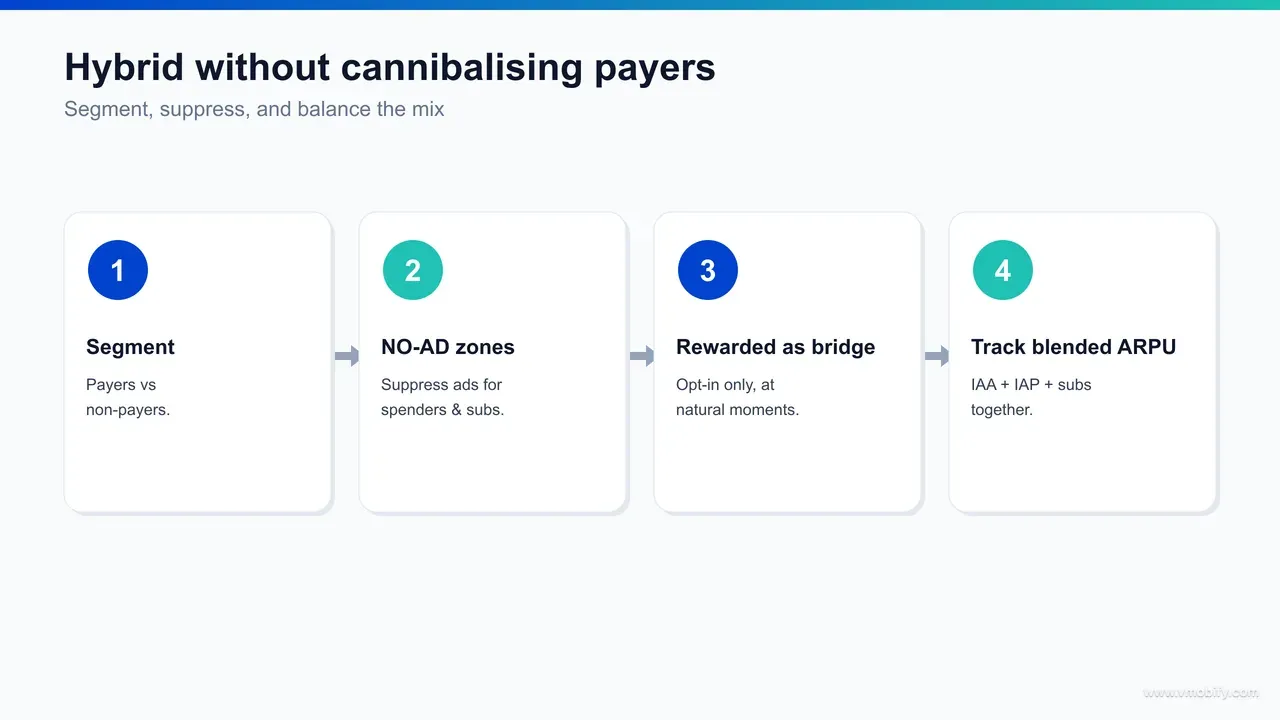
The core discipline of hybrid monetisation is segmentation: suppress or eliminate ads for active spenders, keep premium and subscription surfaces ad-free, and concentrate ad monetisation on the non-paying majority who generate no purchase revenue. Showing the same ad load to a whale and a never-paying user is the fastest way to manufacture the cannibalisation you were trying to avoid.
The logic is a simple opportunity-cost calculation. A user who spends ₹500 a month on IAP is worth vastly more as a payer than as an ad impression — interrupting them with an interstitial that earns a fraction of a rupee, at the cost of even a small churn risk, is an obviously bad trade. A user who has installed three months ago and never spent a paisa is the opposite case: ad revenue is the only revenue they will ever generate, so monetising them through ads is pure upside.
Concretely, segment along these lines and adjust ad exposure accordingly:
- Active subscribers and recent spenders: remove ads entirely, or cut them to opt-in rewarded only. Treat an ad-free experience as a paid benefit you have promised them.
- Engaged non-payers showing purchase intent: lighter ad load, heavy on rewarded formats that warm them toward a first purchase. This is the bridge cohort.
- Low-intent and dormant non-payers: the core ad-monetised segment. Standard rewarded and interstitial cadence — they are unlikely to convert, so ad revenue is the realistic ceiling on their value.
This requires a real-time signal of payer status feeding your ad-serving logic, which is an engineering investment many teams skip — and then wonder why their best users are churning. Across our work, building that payer/non-payer flag and wiring it into the ad SDK is one of the highest-ROI pieces of monetisation plumbing a team can ship. It is also the precondition for everything else here: you cannot run a humane hybrid model if you cannot tell a whale from a free rider at the moment an ad is about to load.
How do rewarded ads bridge users to their first purchase?
Rewarded ads are the bridge between your ad-monetised audience and your paying audience because they let a non-payer experience the value of a premium good for free, which is the single strongest predictor of a future purchase — the reason rewarded-ad users convert to IAP at roughly 4.5-5x the rate of non-watchers. The rewarded ad is, functionally, a free trial of spending.
Think about what a rewarded ad actually does in the user's head. They want a premium item — a continue, a hint, a power-up, a temporary ad-free session. They cannot or will not pay yet. The rewarded ad gives it to them in exchange for thirty seconds of attention. Now they have used the premium good, felt its benefit, and — critically — established that this good is worth acquiring. The next time they want it and no ad is available, or the reward is capped, the paid version is a small, obvious step rather than a cold first purchase.
To engineer this bridge deliberately rather than leaving it to chance:
- Reward the exact good you sell: if you sell extra lives, let rewarded ads grant extra lives. The closer the ad reward maps to a real IAP, the more the ad warms the purchase. Rewarding an unrelated currency dilutes the bridge.
- Cap the free supply: generous but limited. A daily or per-session cap on rewarded grants means a heavy user eventually hits the ceiling — and that ceiling is precisely where the IAP offer should appear, in context, at the moment of demonstrated demand.
- Surface the paid upgrade at the cap: when a user finishes their last available rewarded ad, that is the highest-converting moment to show "buy more, skip the wait." You are presenting the purchase to someone who has just proven they want the good.
This is also why pure-IAP apps quietly leave growth on the table: they never give the 95% a low-commitment way to taste the premium experience, so those users never warm up. In our portfolio, adding a well-mapped rewarded layer to a previously ads-light app is one of the most reliable ways to lift first-purchase conversion — it is covered in depth in our mobile app monetisation playbook, and it is the mechanic that makes hybrid more than the sum of its parts.
How do you balance ad eCPM against IAP ARPU?
You balance ads against purchases by optimising blended revenue per user, not ad eCPM or IAP ARPU in isolation — because the highest-eCPM ad strategy and the highest-IAP-ARPU strategy almost never coexist, and chasing either one alone destroys the other. The right objective function is total revenue per retained user over the lifetime, with retention treated as a hard constraint.
The tension is structural. Pushing ad frequency up raises eCPM-driven ad revenue in the short term but increases interruption, which suppresses both retention and the engaged-user conversion that feeds IAP. Pushing IAP aggressively — frequent paywalls, hard gates — can lift purchase ARPU but drives away the non-payers whose ad impressions were funding the base. Every increment in one model has a marginal cost in the other, and the optimum is rarely at either extreme.
A practical way to navigate this, drawing on the benchmark discipline in Tenjin's ad-monetisation benchmarks:
- Track ARPDAU as your headline number: average revenue per daily active user, blended across ads and IAP, is the single figure that exposes whether a change helped or just shuffled revenue between models. If ad revenue rises and ARPDAU does not, you cannibalised.
- Hold retention as a guardrail: any ad-frequency increase that moves Day-7 or Day-30 retention down is disqualified, regardless of the eCPM gain — because retention is the multiplier on lifetime value, as our ARPU, ARPPU and LTV benchmarks spell out in detail.
- Test ad frequency as an experiment, not a setting: A/B test interstitial cadence and rewarded caps against blended ARPDAU and retention together, never against ad revenue alone.
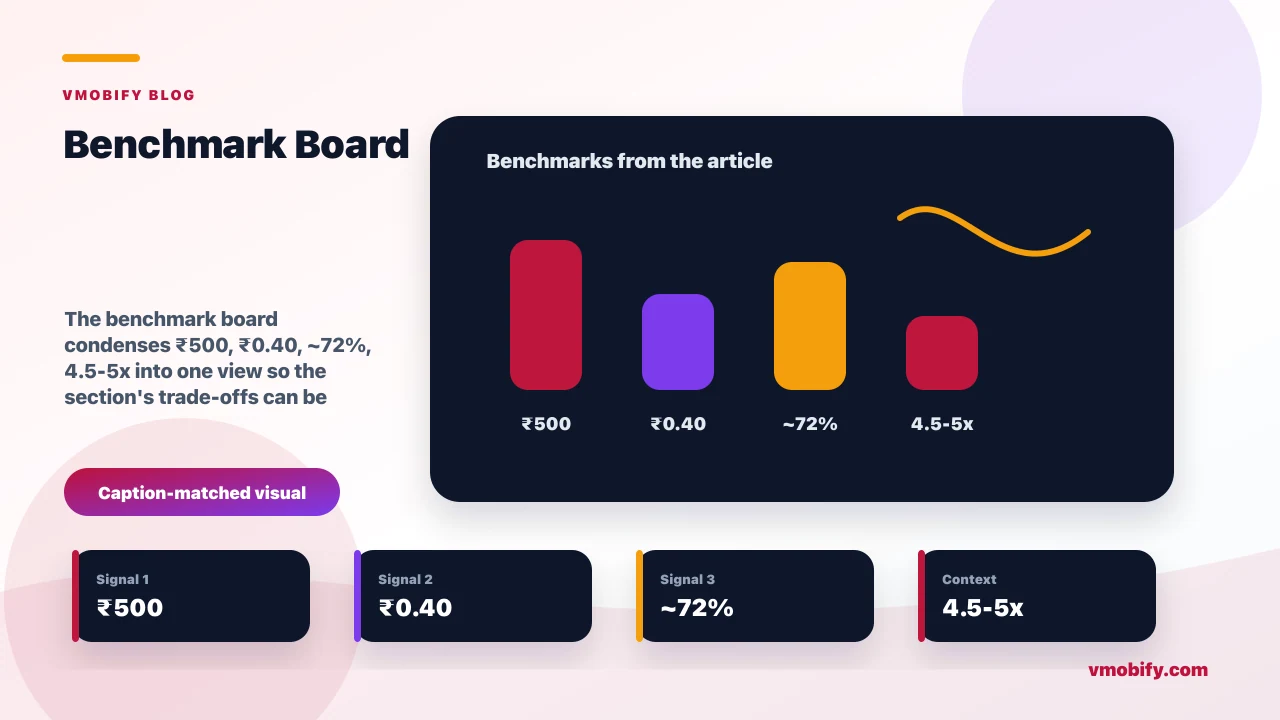
It helps to put rough numbers on the trade. If raising interstitial frequency lifts ad ARPDAU by ₹0.40 but shaves two points off Day-7 retention and suppresses the rewarded-to-IAP conversion that was feeding purchases, the blended ARPDAU can easily fall even as the ad dashboard turns greener. The only way to see that is to instrument both effects on the same chart and judge the change on the net. A frequency increase that wins on ad revenue and loses on blended ARPDAU is a loss, full stop.
The teams that get this right run ad load like a thermostat, not a throttle — finding the frequency that maximises blended ARPDAU and then holding it, rather than ratcheting ads upward every quarter to hit an ad-revenue target. We have seen apps add 15-25% to ad revenue by raising frequency, then lose more than that in suppressed IAP and churn within two months. The eCPM line went up; the business went down.
What does the India low-ARPU hybrid playbook look like?
In India and other low-ARPU markets, hybrid is not a choice but the default, because the base monetises overwhelmingly through ads with only a thin top tier ever paying — so the strategy is to maximise ad yield from the many while using rewarded ads as the on-ramp to a first-ever purchase for the few who can convert. The iOS-style premium-subscription playbook simply does not transfer to an Android-dominant, price-sensitive market.
The structural facts that shape the India model are well known: the install base is overwhelmingly Android, card penetration is low, willingness to pay for digital subscriptions is thin outside metros, and per-user revenue runs far below Western benchmarks. A monetisation model anchored on everyone subscribing will starve. A model that earns a little from everyone through ads, and a lot from a small premium tier, matches the actual economics — and that is hybrid by definition.
The India-specific moves we run for clients:
- Lead with rewarded ads, not paywalls: a cold paywall converts almost no one in a low-ARPU base. Rewarded ads earn from day one and warm the small convertible minority toward their first purchase over weeks, not minutes.
- Price the IAP tier for local purchasing power: the premium tier exists, but it has to be priced and packaged for the market — small-denomination consumables and affordable, locally relevant payment rails like UPI, not a flat global price that prices out the entire base.
- Treat a first purchase as a milestone, not a default: in a market where most users will never pay, converting a non-payer to their first-ever transaction is a genuine event — and rewarded ads that demonstrate premium value are the most reliable mechanism to produce it.
There is also a measurement nuance specific to low-ARPU markets. Because each user is worth so little individually, the model only works at scale — which means cheap, efficient acquisition and strong retention matter even more than in high-ARPU geographies. A few rupees of ARPDAU multiplied across millions of retained users is a real business; the same ARPDAU across a base that churns in a week is nothing. This is why India hybrid strategy is inseparable from retention work: the ad layer only pays if users stay long enough to see enough ads, and the IAP layer only pays if the rewarded bridge has weeks to warm the convertible minority. Frequency discipline matters more here, not less, because there is no premium tier thick enough to absorb the churn that ad overload causes.
This is the same logic that governs gaming app marketing in India, where the hybrid model is most mature: huge ad-monetised player bases with a small spending elite, and rewarded video doing the heavy lifting of converting the convertible. Across our India work, the apps that try to force a Western subscription-first model underperform, while the ones that embrace ad-led hybrid with a thin, well-priced IAP tier capture the revenue that is actually there to capture.
How do you measure a hybrid model with blended ARPU?
You measure a hybrid model on blended metrics — blended ARPU and ARPDAU that combine ad and purchase revenue per user — never on ad revenue and IAP revenue reported in separate silos, because siloed reporting is exactly what pushes teams to over-serve ads and quietly kill the purchase revenue and retention that do not show up on the ad dashboard. The unit of truth is total revenue per user, segmented by cohort and platform.
The failure mode is organisational as much as analytical. When an ad-ops team is measured on ad revenue and an IAP team on purchase revenue, each rationally optimises its own number — and the interaction effects, where more ads suppress purchases or more paywalls suppress the engaged base that watches ads, fall into the gap between the two dashboards. Blended reporting closes that gap by forcing every decision to be judged on the same number both teams move.
The metrics that matter for a hybrid model:
- Blended ARPDAU: total ad + IAP revenue divided by daily active users. Your single headline figure — if a change does not lift this, it did not help, no matter what it did to ad revenue alone.
- Blended ARPU by cohort: per-user revenue across the full lifetime, segmented by payer status, platform, and acquisition source, so you can see whether ads are warming non-payers toward purchases or simply churning them.
- Ad-to-IAP conversion rate: the share of rewarded-ad watchers who later make a purchase — the direct measure of whether your bridge is working.
- Retention by ad exposure: Day-7 and Day-30 retention split by ad-frequency band, the early-warning system for over-serving.
Getting this measurement right is the difference between a hybrid model that compounds and one that slowly eats itself. In our portfolio, building the blended-revenue view — and giving one owner accountability for it — is consistently the change that turns a stalled monetisation effort around, because it is the only lens under which the right trade-offs become visible. If you want help standing up that view and the segmentation behind it, that is core to our monetisation work, and you can talk to our team about pressure-testing your own blended ARPU.
Which hybrid monetisation pitfalls hurt retention most?
The pitfalls that wreck hybrid models all share one cause — prioritising short-term ad revenue over the retention and purchase revenue that ads are supposed to support — and they show up as ad overload, payer interruption, broken bridges, and siloed measurement. Each one is avoidable, and each one is something we have seen quietly bleed apps that looked healthy on the ad dashboard.
- Ad overload: ratcheting ad frequency up to hit an ad-revenue target until interruption drives engaged users to churn. The eCPM line rises while retention and IAP fall faster. This is the number-one killer — treat ad frequency as a thermostat set to maximise blended ARPDAU, not a dial you keep turning up.
- Interrupting payers: showing the same ad load to spenders and subscribers as to free riders. It manufactures the exact cannibalisation hybrid is meant to avoid. Segment payer status into your ad logic and keep premium surfaces ad-free, always.
- Breaking the bridge: rewarding an unrelated currency, giving away premium goods with no cap, or hiding the IAP upgrade when a user hits the rewarded ceiling. Each of these severs the rewarded-ad-to-purchase link that delivers the 4.5-5x conversion lift.
- Cold paywalls: forcing a subscription or purchase decision before the ad layer and free experience have demonstrated value. In low-ARPU markets especially, this converts almost no one and burns the install.
- Siloed reporting: measuring ad revenue and IAP revenue separately, which hides every interaction effect and lets the two models cannibalise each other unobserved. Blended ARPDAU with one owner is the antidote.
The through-line is that ads in a hybrid model are not a revenue stream to be maximised in isolation — they are infrastructure for a larger system whose real output is blended lifetime value. We have watched apps in our portfolio post a strong ad-revenue quarter and a weak retention one, then realise the two were the same story. The discipline that prevents it is unglamorous: segment your users, map rewarded ads to real purchases, protect your payers, and judge every change on blended ARPDAU and retention together. Do that, and ads and purchases stop competing and start compounding — which is the entire promise of hybrid monetisation. If you want it built and measured properly for your app, that is exactly what our monetisation team does, and you can see the outcomes across our case studies.
Frequently Asked Questions
What is hybrid monetisation in mobile apps?+
Hybrid monetisation runs more than one revenue model in the same app at once — typically in-app advertising alongside in-app purchases and subscriptions — so you earn from the non-paying majority through ads and from the high-intent minority through purchases. Roughly 72% of mobile game developers now use a hybrid model.
Do in-app ads reduce in-app purchase revenue?+
Not when done correctly. Rewarded-ad users are roughly 4.5-5x more likely to make an in-app purchase, because the ad lets them sample premium value and warms them toward buying. Cannibalisation only happens when ads are forced on payers or interrupt purchase flows.
How much can hybrid monetisation lift revenue?+
Reported implementations have lifted IAP revenue by around 30% and lifetime value by around 33% after adding in-app ads to a purchase model, because the gains stack: incremental ad revenue from non-payers plus higher conversion among engaged users that rewarded ads warm up.
Why are rewarded ads central to hybrid monetisation?+
Rewarded ads are opt-in and value-positive — the user chooses to watch in exchange for a premium good. That lets non-payers experience what they might buy, acts as a free trial of spending, and is the bridge that converts ad-monetised users into paying users.
Should subscribers and spenders still see ads?+
Generally no. Active subscribers and recent spenders should see ads removed or cut to opt-in rewarded only, and premium surfaces should stay ad-free. Interrupting payers with low-value ad impressions is the fastest way to manufacture churn and cannibalisation.
How should you measure a hybrid monetisation model?+
Measure on blended ARPU and ARPDAU that combine ad and purchase revenue per user, never on ad and IAP revenue in separate silos. Siloed reporting hides the interaction effects and pushes teams to over-serve ads at the expense of retention and purchases.
Why is hybrid monetisation the default in India?+
In low-ARPU markets like India the base monetises overwhelmingly through ads, with only a thin top tier ever paying. Hybrid matches that reality — maximise ad yield from the many, use rewarded ads as the on-ramp to a first purchase, and price a small IAP tier for local purchasing power.
Sources
- Adjust — Hybrid monetisation — ~72% of mobile game developers run hybrid; ~30% IAP-revenue and ~33% LTV uplifts; rewarded-ad purchase propensity
- Tenjin — Ad-monetisation benchmarks — eCPM, ARPDAU and ad-frequency benchmarking discipline for balancing ads against IAP
- RevenueCat — Ad monetisation for subscription apps — When ads complement rather than cannibalise subscription and purchase revenue
- RevenueCat — State of Subscription Apps 2025 — ARPU, LTV and retention context underpinning blended-revenue measurement
- AppsFlyer — App Marketing Performance Index — Benchmark context for per-user revenue and acquisition cost by category and geography
- Adjust — Mobile app trends and resources — Supporting data on ad formats, rewarded video and mobile monetisation trends
- Sensor Tower — State of Mobile — Cross-market context on mobile spend, ad monetisation and India growth
About the author
Amol Pomane — Founder, Vmobify
Amol leads Vmobify, a mobile app growth agency that has driven 30M+ downloads and ranked 54K+ keywords across 300+ apps since 2013. He writes about ASO, paid user acquisition, retention, and the operational reality of scaling mobile apps in India and global markets.