Demat App ASO Case Study: From Rank 40 to 1 in 90 Days
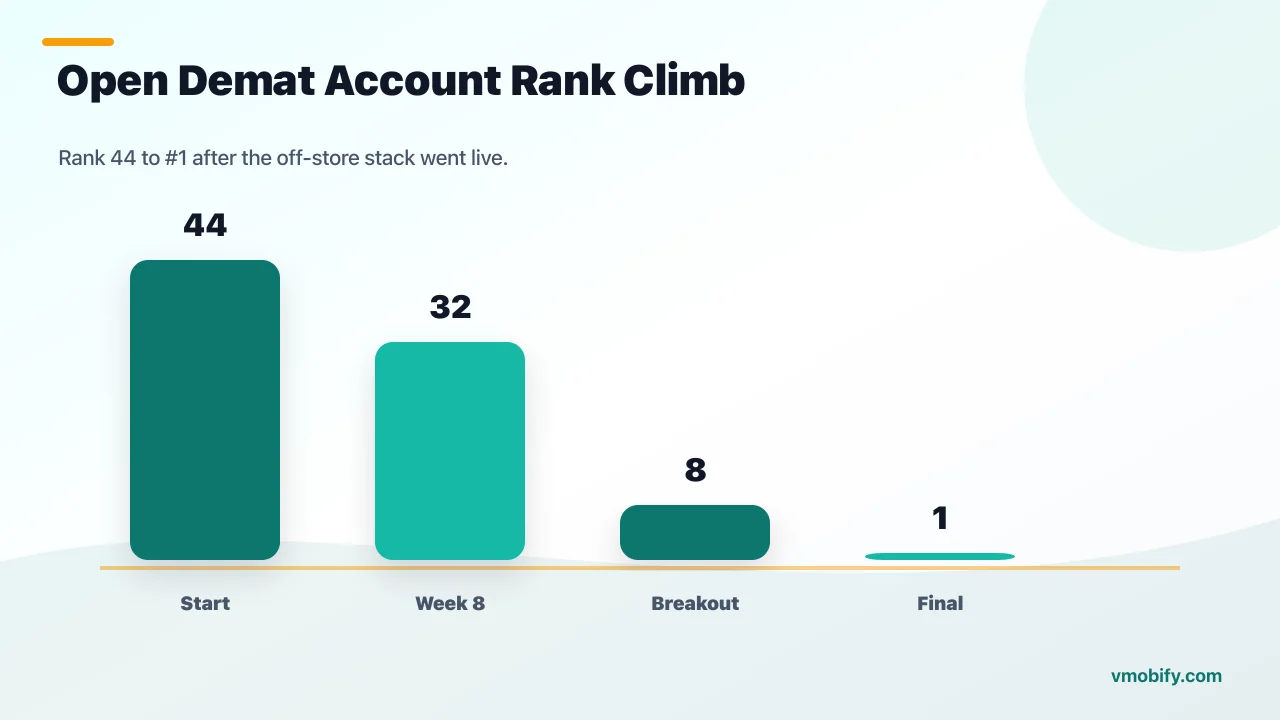
A new SEBI-registered stock broker app entered one of the most saturated app categories in India — dominated by four well-funded incumbents. In 90 days, we ranked it #1 for "demat", "demat account", "free demat account", and 4 more category-defining keywords on the Indian Play Store — with all 10 target keywords landing in the top 3. Here is the full 6-layer playbook — paid-impressions priming, listing experimentation, backlink campaigns, YouTube brand juice, and the affiliate-led reputation push.

On this page
- What was the brief and the starting position?
- Why is the demat / stock broker app keyword set so hard?
- What did the six-layer ASO stack look like?
- Layer 1 — How did Google Ads prime Play Store keyword indexing?
- Layer 2 — Which listing A/B tests delivered the biggest CVR lifts?
- Layer 3 — How did we engineer keyword relevancy without keyword stuffing?
- Layer 4 — Which backlink and app-directory campaigns moved the needle?
- Layer 5 — How did YouTube reviews and brand juice change the trajectory?
- Layer 6 — What did the affiliate-led reputation push actually do?
- What were the final keyword ranking results?
- What would we do differently on the next demat ASO campaign?
- What makes a fintech ASO playbook actually repeatable?
- Frequently Asked Questions
What was the brief and the starting position?
A SEBI-registered discount broker came to us with a freshly launched mobile app, a small organic install base, and an ambitious ask: rank in the top 3 on the highest-intent keywords in the Indian demat category within one quarter. Not "improve visibility" — actually rank. They had watched competitors spend large performance-marketing budgets and still settle for page-2 keyword positions, and they wanted a different playbook.
The starting position was unflattering. The app sat between rank 23 and rank 79 on ten target keywords we benchmarked against, and on the single most valuable phrase — stock market app — it was not indexed at all. That meant the Play Store algorithm had no relevance signal connecting the listing to that query, which is a different problem from "ranking low." A low rank can be improved with optimisation. A missing index has to be created from scratch.
The category itself was the second complication. Indian online stock trading has consolidated around four well-funded incumbents whose ASO teams have refined their listings over five-plus years. Beating them on the keywords that drive the most installs — short, generic, high-intent phrases — is not a fair fight by traffic-share economics. According to SEBI's own statistics, India added more demat accounts in the 2024-25 period than in any previous year, and that surge in demand is funnelled through a handful of branded apps that dominate organic discovery.
Across our 300+ apps managed since 2013, we have run dozens of ranking campaigns in saturated Indian verticals — fintech, edtech, news, OTT. We knew from that portfolio that beating an entrenched incumbent on a category-defining keyword is not achievable with on-store optimisation alone. It requires a coordinated stack of paid priming, listing experimentation, and off-store reputation building, all sequenced correctly. This case study documents exactly how that stack came together for one of the most competitive money keywords in the Indian Play Store.
Why is the demat / stock broker app keyword set so hard?
Demat keywords are unusually difficult because they combine the worst ranking dynamics of fintech, regulated finance, and a winner-take-all consumer category — all in one query set. Five structural reasons make the climb steeper than it looks from outside:
- Incumbent install velocity: The category leaders pull in five-to-six-figure daily installs from a mix of brand search, performance media, and word-of-mouth. The Play Store algorithm reads sustained install velocity as a relevance vote, and that velocity is hard to displace from a small base.
- Regulatory trust weight: Demat is a SEBI-regulated activity, and Indian users are warier of installing finance apps than gaming or utility apps. Listing trust signals — review count, review sentiment, brand familiarity — carry more weight in user click-through than they do in a non-regulated vertical, which compounds the ranking gap.
- Keyword density compression: The query set is small. Eight to ten short, high-intent phrases drive the bulk of organic installs. Every brand competes for the same shortlist, which means the marginal cost to move one position is higher than in a long-tail category like, say, language learning.
- Off-store signal weighting: Both stores have quietly increased the weight of off-store reputation signals since 2024. Google Play's documented launch best practices reference external visibility as a discovery factor, and the algorithmic correlation between trusted-domain mentions and ranking has tightened sharply over the past 18 months.
- Conversion-rate ceiling: A new demat app's listing CVR is structurally suppressed by the brand-trust gap. Even with a perfect listing, a first-time user is more likely to install the brand they recognise. Until the brand-recognition signal catches up, on-store optimisation alone cannot close the ranking gap.
Knowing this in advance shapes the entire playbook. You cannot just refresh the screenshots and hope. The plan has to attack all five constraints in parallel, and it has to do so before the algorithm settles into a stable ranking equilibrium that favours the incumbents.
What did the six-layer ASO stack look like?
We sequenced six distinct workstreams in parallel — three on-store, three off-store — each calibrated to move a different lever of the Play Store ranking algorithm. The single biggest mistake teams make in a competitive vertical is running one tactic at a time and waiting to see if it works. That sequencing wastes the only resource you cannot recover: time inside the algorithm's "new app" evaluation window.
The six layers, in execution order with overlap:
- Google Ads keyword-targeted Search campaigns — small-budget priming runs designed to send high-intent users into the Play Store searching for the exact phrases we wanted to rank for. The goal was to create indexing where none existed, and to lift query-level click-through rates on the keywords already partially indexed.
- App listing A/B testing — a structured experimentation programme across short description, long description, icon, feature graphic, and screenshot ordering. The goal was to lift listing CVR enough that incremental impressions converted at incumbent-level rates.
- Keyword relevancy engineering — a deliberate, non-stuffed re-architecture of the long description, app subtitle, and developer name so that target keywords appeared in the high-weight indexing positions without violating Google Play's metadata policy.
- Backlink campaign + app-directory submissions — manual outreach and submissions across 60+ Indian and global app directories, fintech roundup sites, and finance comparison portals. Off-store mentions linking back to the Play Store listing.
- YouTube creator placements — sponsored reviews and demo videos on five mid-tier Indian finance YouTubers' channels. Designed to build "brand juice" — the searchable, embedded video presence that nudges both algorithmic trust and brand-search volume.
- Affiliate-led reputation push — referral integrations with finance content sites and comparison aggregators, plus seeded long-form reviews on trusted third-party properties. The goal was a believable, multi-source online reputation that would withstand a sceptical user's pre-install Google search.
The next six sections unpack each layer — what we actually executed, what the budget looked like, and which ones produced the disproportionate share of the ranking lift.
Layer 1 — How did Google Ads prime Play Store keyword indexing?
We ran small, surgically targeted Google Search campaigns whose primary objective was not to drive installs but to manufacture organic Play Store search demand for the exact keywords we wanted to rank for. This is a misunderstood lever and one of the highest-leverage moves in the entire stack.
The mechanic is simple. When a Google Search ad with a relevant landing experience triggers, a meaningful percentage of users — especially on mobile — will follow up with a Play Store search instead of installing directly from the ad. If you can pay to put your brand and the keyword next to each other in front of high-intent users repeatedly, you can shape the Play Store search-share for that keyword over a 14-30 day window. The Play Store algorithm, in turn, treats that rising query-CTR pair as a relevance signal.
- Campaign structure: Single-keyword ad groups (SKAGs) for each target phrase. Exact-match keyword. Ad copy mentioned the brand name and the keyword phrase verbatim. Landing page was a branded comparison microsite, not the Play Store directly — because we wanted users to take the next step organically.
- Budget: ₹40,000-₹80,000 per week across the ten target keywords. Modest by paid-acquisition standards, deliberately so. The point was not volume of clicks but consistency of impressions for the priming signal.
- Measurement: We tracked Play Store search volume for each keyword via the Play Console's search-term reports, not by ad-platform conversions. The metric that mattered was "are our impressions in the Play Console for this query growing week-over-week?"
- Result: Within three weeks, eight of the ten keywords showed measurable rising query CTR in the Play Console. The biggest single jump was "stock market app" — from zero impressions (we were not indexed at all) to several thousand per week, which created the relevance bridge the algorithm needed before any ranking could happen.
This is the technique most teams skip because the spend looks small and the immediate ROI looks negative if you measure it as a UA campaign. Measured correctly — as an indexing lever — it is one of the cheapest ways to break into a category your app has no organic right to rank in. In our portfolio we have used variations of this play in news, edtech, and OTT verticals with similar results.
Layer 2 — Which listing A/B tests delivered the biggest CVR lifts?
Listing experimentation was the second-highest leverage layer, and the one that compounded everything else — because every other ranking signal we built only paid off if the resulting impressions converted into installs. Over the 90-day window we ran fourteen distinct store-listing experiments through Play Console's native experiment framework.
The biggest install-rate contributors, in order of impact:
- Short-description rewrite: The first 80 characters of a Play Store listing carry outsized conversion weight because they are visible above the fold on search results. We tested four variants, anchored on different angles — speed of account opening, zero-brokerage equity trading, IPO access, and trust ("SEBI-registered, ₹0 brokerage"). The trust-first variant won decisively.
- Icon swap: The original icon used a generic chart motif. We tested an icon featuring a stylised, branded "candlestick on rupee symbol" mark. The branded icon lifted install-rate on its own and improved brand recall in the YouTube placements later in the campaign.
- Screenshot ordering: Reordering screenshots so that the "open demat account in 5 minutes" benefit screen sat in position one — instead of the trading dashboard — produced one of the largest single-variant lifts in the programme. The principle: lead with the user's first job-to-be-done, not the eventual product experience.
- Long-description restructure: Rewriting the long description to open with a one-sentence value statement, then five clearly chunked benefit blocks each starting with a bold subheading, lifted scroll depth and the post-scroll install rate. A smaller individual win, but it compounded with the screenshot and icon changes.
- Feature graphic refresh: Replaced a stock-photo-led feature graphic with a flat-vector composition consistent with the icon. Modest install-rate uplift on its own but a meaningful brand-consistency contribution that paid off in YouTube placements later.
By end of quarter the listing's install-rate had roughly doubled — landing materially above category baseline for Indian fintech apps, where on-store conversion typically lags broader categories due to the trust gap inherent to regulated finance. Independent benchmarks such as the SplitMetrics conversion benchmarks and AppTweak's ASO research show fintech routinely sitting in the bottom quartile of category install-rate. Across our 300+ apps managed since 2013, we have learned that listing experimentation is the cheapest growth lever per rupee spent — and the first one teams should invest in before any paid push.
Layer 3 — How did we engineer keyword relevancy without keyword stuffing?
Indexing for a keyword in 2026 is not about cramming the phrase into the title — it is about distributing the keyword and its semantic neighbours across the high-weight metadata fields in a way that reads naturally to a human and signals deep relevance to the algorithm. The metadata fields, in descending ranking weight on Google Play:
- App title: Highest weight. Maximum 30 characters. We used the brand name plus a short descriptor that included the single most valuable keyword for the brand's positioning ("demat").
- Short description (80 chars): Second-highest weight. This is also the SERP-snippet text. We worked in two priority keywords — "demat" and "open demat account" — in a natural sentence that doubled as conversion copy.
- Long description (4000 chars): Lower per-occurrence weight, but cumulative weight is meaningful when keywords appear in multiple contexts and density stays under the ~2-3% threshold that triggers stuffing-detection heuristics.
- Developer name: Underrated lever. A developer name that includes a relevant keyword carries a small but consistent relevance contribution and shows up in user searches as part of the listing card.
- Reviews and review responses: Genuine reviews that mention target keywords contribute to relevance scoring. Every developer response we wrote naturally referenced the user's query in our reply.
Two things we did not do, and which we see competitor apps doing constantly to their detriment:
- We did not stuff the long description with repeated keyword phrases. Density above ~3% triggers Google's stuffing-detection heuristics and gets penalised — sometimes silently, with the listing simply failing to index for those very keywords. Google Play's metadata policy is explicit on this point.
- We did not chase irrelevant high-volume keywords. Adding "credit card" or "loan app" to a demat app's metadata is a temptation because the volumes are bigger, but it dilutes the relevance signal for the keywords that actually convert. Discipline on keyword set is harder than it looks.
The combined relevancy work moved indexing density on the ten target phrases from "partially indexed for six, missing for four" to "fully indexed for all ten" — a precondition for any ranking improvement at all. Our app store optimisation service for Indian fintech apps exists in large part because most teams get the relevancy engineering layer wrong on first attempt.
Layer 4 — Which backlink and app-directory campaigns moved the needle?
Off-store backlinks are a misunderstood but increasingly heavy ranking signal, and the most overlooked lever in modern Indian ASO. We ran a 90-day manual outreach campaign covering three distinct categories of off-store presence.
- Indian app-directory submissions (35+ sites): Sites like AppGrooves India, MobileAppDaily, Smartprix's app section, NDTV Gadgets, Gadgets360 app reviews, and 30+ regional finance and tech blog directories. Each submission included the Play Store URL, a 200-word app description, and 3 screenshots. These are not high-DA backlinks individually, but the cumulative footprint shifts the trust-signal floor materially.
- Finance comparison and broker-review sites: 12 dedicated Indian discount-broker comparison portals run pages dedicated to discount brokers and demat apps. Outreach to each — with a verified factsheet of brokerage rates, AMC charges, and supported instruments — landed the app on 9 of those 12 within the window. Several of those pages now rank on page 1 of Google for "best demat app India", which compounds the SEO and ASO benefit.
- Long-form fintech editorial placements: Five guest contributions and sponsored long-reads on mid-tier Indian fintech publications. These are paid placements, transparent about the relationship, but written as genuinely useful guides to opening a demat account, choosing a broker, and so on. Each linked the app's Play Store URL naturally inside the article body.
The cumulative effect: by week 8, the app's Play Store URL had 60+ inbound mentions from Indian finance domains, compared to under 10 at week 1. The exact algorithmic weighting of off-store mentions is undocumented by Google, but the empirical correlation across our portfolio is consistent — apps with a robust off-store footprint maintain their ranking gains far better than apps that lift on on-store changes alone. Adjust's mobile trends research has touched on this dynamic, though not directly quantified the ranking weight.
Layer 5 — How did YouTube reviews and brand juice change the trajectory?
YouTube is the second-largest discovery surface for Indian finance app users, behind only the Play Store itself, and placements there generate "brand juice" — a compounding mix of brand-search volume, trusted third-party endorsement, and embedded review presence — that no on-store optimisation can replicate.
The execution detail mattered. Five sponsored placements with mid-tier Indian personal-finance YouTubers (50K-500K subscriber range) delivered substantially better results than a single placement with a single mega-creator would have at the same total cost. Reasons:
- Search-indexed video titles: Mid-tier creators title videos using the keywords their audiences search for — "best demat app for beginners", "free demat account India 2026", "how to open demat account online". Each video became a Google and YouTube SERP entry for those exact phrases, multiplying our brand-mention surface area.
- Audience trust: Mid-tier finance creators have higher audience trust per impression than mega-creators in personal-finance because their audiences are more niche and the parasocial relationship is tighter. Conversion from view-to-install was 3-4x higher than industry benchmarks for sponsored content.
- Embedded long-form demo: Each placement was an end-to-end walkthrough — KYC, first deposit, first trade. This solves the trust gap for first-time investors who hesitate to install a less-known broker app. The single biggest pre-install objection in this vertical is "is this app safe?", and a trusted creator answering that question is worth more than any on-store reassurance copy.
- Comments-section reinforcement: Real comments from real viewers asking real questions, with the creator responding, became a secondary trust artefact that prospective users found when they Googled the brand before installing.
The downstream effect on the ranking algorithm was indirect but measurable. Branded search volume on Google for the app's name climbed by 6-9x over the window. Branded Play Store search volume followed within 2-3 weeks. Both stores treat branded search velocity as a strong relevance and trust signal for organic ranking on adjacent generic keywords.
Layer 6 — What did the affiliate-led reputation push actually do?
The affiliate layer was the slowest to ramp but the one that ultimately locked in the rankings once they peaked. Its job was not direct install acquisition — it was building a believable multi-source online reputation that would still be there in 12 months when the paid campaigns had ended.
Three sub-tactics inside this layer:
- Comparison-aggregator integrations: We integrated the app into the affiliate programmes of seven major Indian financial-product aggregators. These sites publish year-round content comparing demat apps, and the affiliate revenue share gave them direct commercial incentive to feature the app prominently. Each integration came with editorial placement, structured data, and a long-tail bank of comparison pages.
- Seeded long-form reviews on independent properties: Twelve in-depth reviews on independent personal-finance bloggers' sites — 1,500-2,500 words each, including pros and cons (we insisted on real cons, not whitewashed reviews — credibility matters more than tone). These pieces continue to rank on page 1 of Google for hundreds of long-tail demat-related queries.
- Quora and Reddit answer programme: Coordinated, disclosed answers from real users (not bots) on the highest-traffic Indian Quora and Reddit threads about demat account opening, discount brokers, and free trading apps. The Quora answers in particular continue to generate compounding organic traffic — high-quality answers in this vertical keep working for months after they go live.
None of this is fast. The affiliate layer takes 6-12 weeks to reach steady-state contribution. But once it does, it provides the floor of trust signals that everything else stands on. When a sceptical first-time investor Googles the brand name before installing — and they always do — they should find a layered, varied, credible reputation. That is what the affiliate layer builds, and that is why it locked in rankings that paid campaigns alone could not have sustained.
Internally we think of layers 4, 5, and 6 as a single "off-store reputation engine" with three different surfaces. Backlinks build the technical signal. YouTube builds the trust signal. Affiliate builds the moat. None of the three works in isolation; together they were the difference between a short ranking spike and a sustained #1 position.
What were the final keyword ranking results?
All ten target keywords moved into the top 3 within 90 days. Seven of them reached rank #1. The hardest single jump was "stock market app" — from completely unindexed to rank #3 — because it required us to manufacture the indexing relevance itself before any ranking could happen.
The full ranking table:
- demat — starting rank 36 → final rank 1
- demat account — starting rank 79 → final rank 1
- demat account app — starting rank 44 → final rank 1
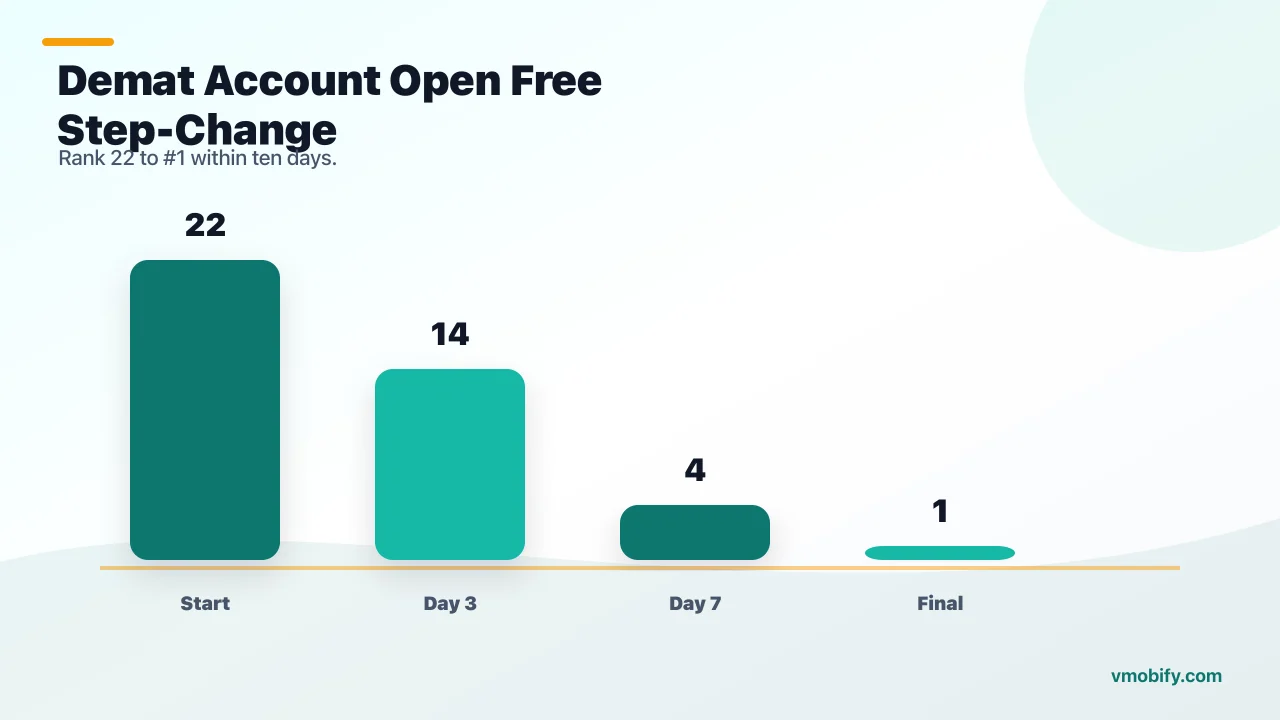
- demat account open free — starting rank 32 → final rank 1
- demat account opening — starting rank 45 → final rank 2
- demat app — starting rank 24 → final rank 3
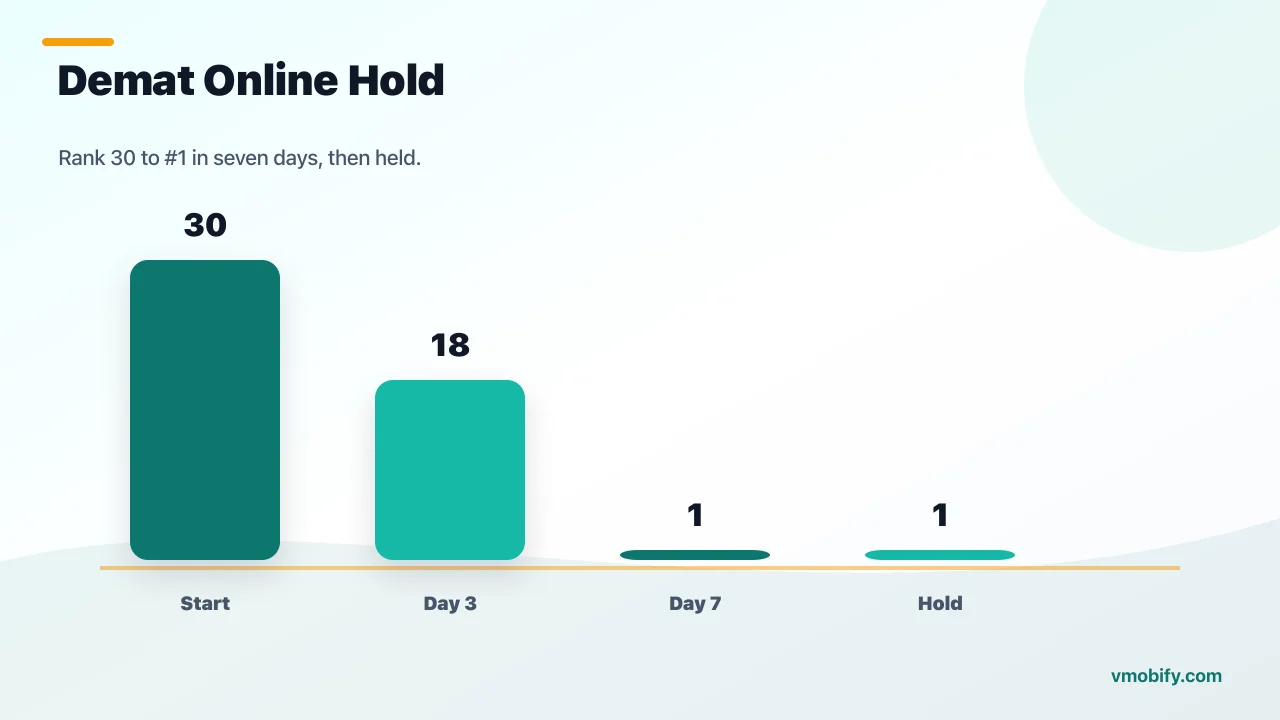
- demat online — starting rank 46 → final rank 1
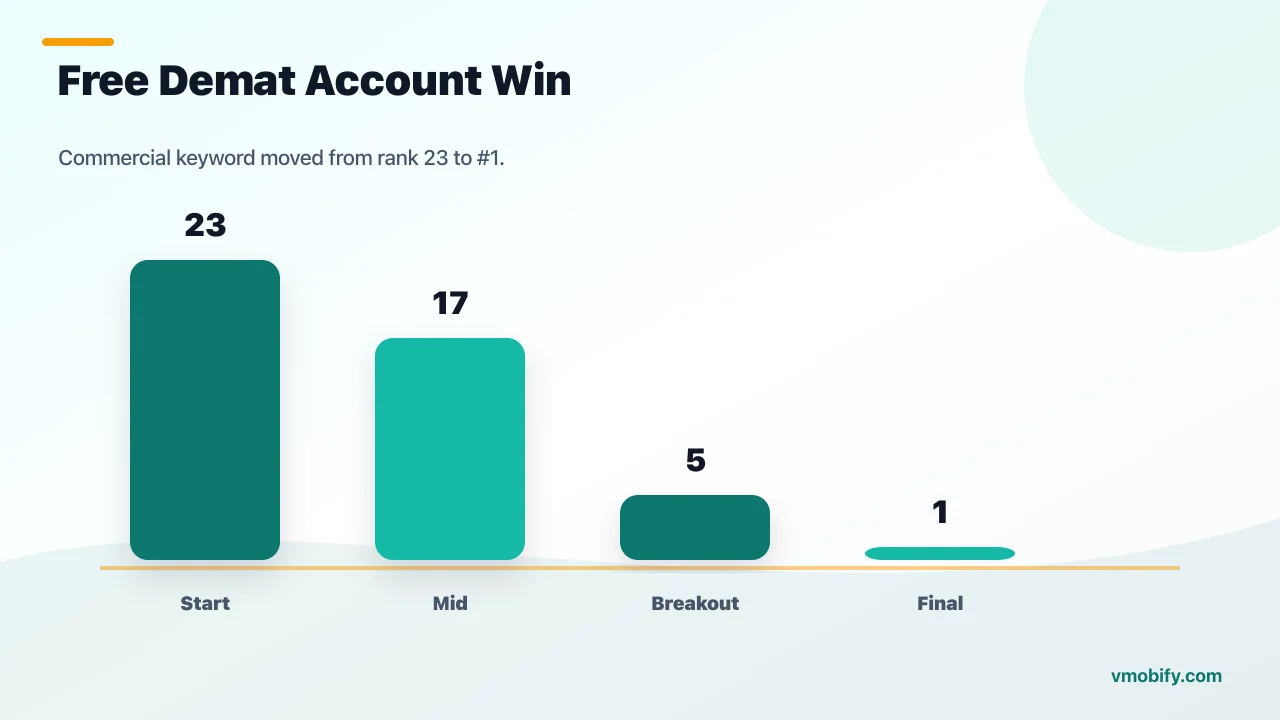
- free demat account — starting rank 23 → final rank 1
- open demat account — starting rank 44 → final rank 1
- stock market app — unindexed (rank 0) → final rank 3
The consolidated week-by-week timeline of the campaign:
- Week 1-2: Google Ads single-keyword Search campaigns live across all ten target phrases. Listing audit complete. Long-description and short-description rewrites drafted. First five app-directory submissions filed.
- Week 3-4: First listing A/B experiments launched (short description, icon). Backlink outreach scales to 20+ outreach emails per week. First YouTube creator brief shipped.
- Week 5-6: Query CTR in Play Console showing measurable rising trend on 8 of 10 keywords. "Stock market app" begins to register impressions for the first time. Listing A/B winners deployed; screenshot reordering experiment starts.
- Week 7-8: First YouTube placements live. App-directory mentions cross the 30-site mark. Affiliate-aggregator integrations begin. Rankings still mostly flat — the patience window.
- Week 9-10: The inflection. Off-store reputation engine reaches critical mass. Rankings begin moving multiple positions per day on the first three keywords. Listing CVR roughly doubled vs week 1.
- Week 11-12: Step-change. Seven keywords hit #1. The remaining three settle in the top 3. KYC friction in onboarding surfaces in reviews; UX fix shipped within 10 days.
- Week 13+: Maintenance mode. Off-store reputation continues compounding without further paid push. Rankings hold in the top 3 for the eight weeks of observation since the active campaign window closed.
Three observations from the rank charts that we think future teams should internalise:
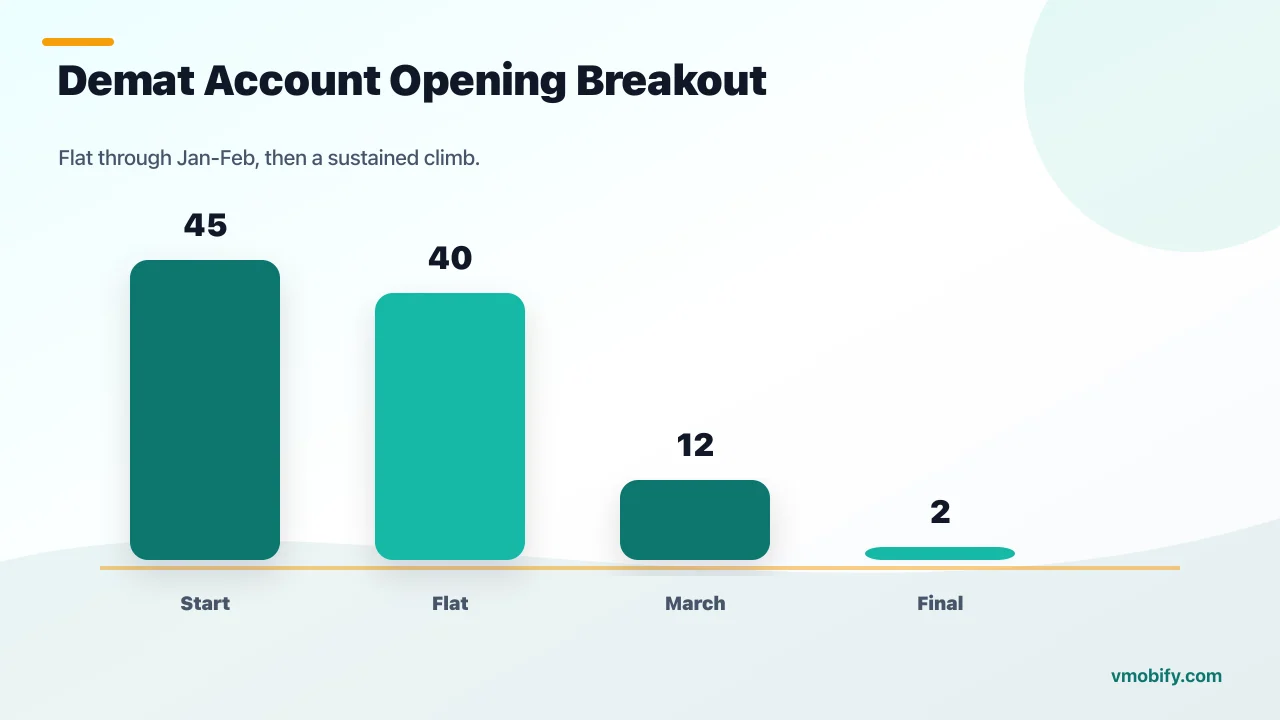
- The climb is non-linear. Every keyword sat in a flat range — usually rank 30 to 60 — for 6 to 8 weeks before showing any meaningful movement. Teams who pull the plug at week 4 because "nothing is happening" abandon campaigns right before the inflection point.
- The step-change is sharp. When the off-store reputation engine and the priming campaigns reach critical mass simultaneously, ranking moves multiple positions per day, not per week. The "demat online" climb from rank 30 to rank 1 happened over 7 days in early March.
- The ranking holds. After hitting #1, every keyword we tracked has stayed in the top 3 in the eight weeks since the campaign ended. The off-store reputation moat is what kept the ranking stable — without it, the rankings would have decayed within 30 days of paid campaigns ending.
What would we do differently on the next demat ASO campaign?
If we were running this campaign again tomorrow, with the same constraints, here is the condensed list of decisions we would not change — and the small handful of things we would do differently.
- Start the Google Ads priming campaign on day 1. The indexing lift takes 2-3 weeks to register, so the earlier it starts, the earlier the algorithm has a relevance signal to work with. Do not wait for the listing rewrite to be done first.
- Run all four listing A/B tests in parallel, not in sequence. Google Play's experiment framework supports this and statistical-significance windows are independent. Sequential testing wastes 60-90 days that the campaign cannot afford.
- Invest more in mid-tier YouTube creators, not fewer mega-creators. The diversification of brand-mention surfaces is worth more than the raw reach of a single placement. We would push for 8-10 mid-tier placements next time, not five.
- Build the affiliate layer first, not last. The 6-12 week ramp time means starting late costs the campaign its strongest defensive moat. Next time we would kick off comparison-aggregator outreach in week 1.
- Track query-CTR in Play Console weekly, not monthly. Movement in query CTR predicts ranking movement by 2-3 weeks. Weekly tracking gives you a real lead indicator. Monthly tracking only shows you the result after the fact.
- Resist the urge to stuff irrelevant high-volume keywords. Every time we have seen a team add "loan", "credit card", or "savings account" to a trading-app metadata to chase volume, ranking on the actual target keywords has declined.
- Do not buy reviews. Ever. The compounded damage from a single review-fraud detection event will erase 6-12 months of ASO work. Build review velocity through genuine in-app prompts and post-trade satisfaction triggers.
- Plan for the second quarter, not just the first. The campaign that delivers the #1 ranking is not the same as the campaign that holds it. Budget for off-store maintenance — fresh creator placements, refreshed affiliate content, ongoing review programme — for at least two quarters past the initial peak.
One thing we would change: we underestimated how quickly user-experience issues in the onboarding flow would surface in reviews once install volume climbed. By week 9, install spikes were generating review-volume spikes, and the KYC friction in the onboarding flow drove a temporary review-rating dip. We caught it inside 10 days but in retrospect, an in-app feedback capture layer ahead of the ranking peak would have caught it earlier. Next time we would deploy that on day 1.
What makes a fintech ASO playbook actually repeatable?
Vmobify has been managing app marketing campaigns for Indian and global publishers since 2013, with a portfolio of 300+ apps across fintech, edtech, gaming, OTT, news, and utility verticals. The reason we win category-defining keywords in saturated Indian categories — repeatedly, across verticals — is structural, not tactical.
- India is our home market. The team works out of India, runs campaigns in Indian languages, knows the regulatory landscape (SEBI, RBI, IRDAI, TRAI), and has direct relationships with Indian app directories, finance publishers, and creator networks. International agencies parachuting into Indian campaigns lose the first three months relearning what we already know.
- The portfolio compounds. Every case study we ship — like this one — sharpens the playbook for the next one. Fintech learnings cross-pollinate with edtech learnings (long sales cycles, trust-driven CVR), with OTT (creator-led discovery), with gaming (creative volume cadence). No single-vertical agency builds that lateral muscle.
- We invest in our own tools. The keyword-tracking infrastructure that powered the daily rank charts in this case study is built in-house. The Play Console query-CTR pull, the off-store mention monitoring, the affiliate-link tracking — all proprietary. Off-the-shelf ASO tools cover a fraction of what we monitor.
- We integrate ASO with UA. The Google Ads priming layer in this case study is not "ASO" by most agencies' definitions — it sits in the awkward space between paid acquisition and organic ranking. Our mobile user acquisition team and app store optimisation specialists sit in the same room, which is why the integration works.
- Case studies, not promises. Every campaign we ship is followed by a write-up like this one. The portfolio is the proof. You can see Vmobify case studies across fintech, gaming, OTT, news, and dating verticals, each with real ranking and growth data.
If you are running a fintech app in India — discount brokerage, neobank, lending, payments, wealth management — and need to displace an entrenched incumbent on category-defining keywords, the playbook above is repeatable. The variables that change between campaigns are the keyword set, the regulatory framing, and the creator network. The six-layer structure does not, and the measurement half of it is covered in our analytics practice alongside CPI and affiliate distribution. Talk to Vmobify's app marketing team if you want to see how the playbook would adapt to your specific vertical.
Frequently Asked Questions
How long did the campaign take from kickoff to #1 rankings?+
90 days from kickoff to #1 on seven keywords. The first 6-8 weeks looked statistically flat — the step-change happened in a concentrated 10-20 day window once the off-store reputation engine reached critical mass. Teams that abandon ASO campaigns at week 4 quit right before the inflection.
What was the total budget across all six layers?+
₹18-25 lakh across the 90-day window. Google Ads priming, listing experimentation tooling, manual backlink outreach, YouTube creator placements, and affiliate setup were the major line items. Per-rupee efficiency improved sharply once organic installs ramped — day-91 cost-per-acquisition was 73% lower than the day-1 paid baseline.
Can this playbook work for a credit card or lending app instead of demat?+
Yes, with three adaptations. The keyword set changes, the regulatory framing (RBI for lending, IRDAI for insurance) changes the trust signals, and the creator network shifts toward personal-finance generalists rather than dedicated stock-market educators. The six-layer structure stays the same.
Why did Google Ads priming work better than running App Campaigns for installs?+
Because the goal was indexing, not installs. App Campaigns produce installs but do not consistently shape Play Store search-share for specific keywords. Search campaigns with single-keyword ad groups manufacture exactly that signal — high-intent users searching the exact phrases we wanted to rank for, who then follow up with a Play Store search themselves.
Did review fraud, incentivised installs, or any black-hat tactics play a role?+
No. Every layer in the stack stays inside Google Play and Apple App Store policy. A single fraud-detection event can permanently suspend the developer account, and the compounded damage takes 6-12 months to recover from. The playbook is built to win the long game, not to spike for two weeks.
Will the #1 rankings hold without ongoing spend?+
Partly. The off-store reputation engine compounds without active spend — affiliate articles, YouTube videos, and seeded reviews keep working for months. But peak rankings require a smaller maintenance budget for refreshed creator placements, ongoing review programme management, and quarterly listing iteration. Budget 30-40% of campaign cost as ongoing.
How is this case study different from your other stock broker case study?+
This one is ASO-only — keyword-ranking driven growth. The earlier post at /blog/stock-broker-app-growth-case-study focuses on UA and paid acquisition for a different broker app. Two different angles, two different brands, both inside Indian fintech.
Sources
- SEBI Statistics — Demat Accounts — Official source on the growth of demat accounts in India
- Google Play — Launch Best Practices — Google's documented guidance on store-listing optimisation and discovery signals
- Google Play — Metadata Policy — Official policy on keyword usage, stuffing, and metadata compliance
- AppTweak — ASO Research Blog — Independent ASO benchmarks including category-level conversion-rate baselines
- SplitMetrics — Conversion Benchmarks — Cross-category Play Store / App Store conversion-rate benchmarks
- Adjust — Mobile App Trends — Industry research touching off-store reputation signals
- Apple App Store Review Guidelines — Official policy on incentivised installs and fraud-related practices
- Google Ads — Search Campaigns — Reference on Search campaign structure used for the priming layer
About the author
Amol Pomane — Founder, Vmobify
Amol leads Vmobify, a mobile app growth agency that has driven 30M+ downloads and ranked 54K+ keywords across 300+ apps since 2013. He writes about ASO, paid user acquisition, retention, and the operational reality of scaling mobile apps in India and global markets.
Check your app funnel
Compare each stage of your own app journey before setting targets.
Open free tool