App Store vs Google Play: How the Two Algorithms Differ
Apple and Google rank apps on fundamentally different signals — Apple indexes a hidden 100-character keyword field and ignores your description, while Google full-text-indexes a 4,000-character long description. Here is exactly how the two algorithms differ, with the primary-sourced data, and why one ASO playbook cannot serve both stores.
On this page
- Why do the App Store and Google Play rank apps so differently?
- Which metadata fields does the Apple App Store actually index?
- How does Google Play's full-text indexing change your keyword strategy?
- Does retention and engagement affect ranking on each store?
- How do featuring and editorial differ between the two stores?
- How do app review and rejection rates compare?
- What changed in the store algorithms in 2025-2026?
- Can you reuse one ASO strategy across both stores?
- Frequently Asked Questions
Why do the App Store and Google Play rank apps so differently?
The two stores rank apps differently because they index your listing in opposite ways and weight post-install behaviour differently — Apple runs a tight, keyword-field-driven model, while Google runs a search-engine-style model that reads your whole listing and watches what users do afterwards. Understanding that split is the single most useful thing you can know before writing a word of store metadata.
Apple's algorithm treats ranking like a controlled keyword auction against a fixed set of indexed inputs. Google's behaves far more like its own web search engine: it crawls your long description as text, factors in engagement and technical health, and continually re-weights signals. That is not a stylistic difference — it changes which words you put where, and which levers actually move your rank.
The practical consequence is that the same listing copied across both stores will underperform on at least one of them. The fields that carry your keywords on Apple are largely wasted on Google, and the long-form keyword density that Google rewards is invisible to Apple. Our deep dives on the App Store algorithm in 2026 and the Google Play algorithm in 2026 cover each store in isolation; this guide is the side-by-side that shows where they diverge and what that means for your workflow.
Across our 300+ apps managed since 2013, the most common ASO mistake we inherit from new clients is a single metadata set reused verbatim on both stores. It is the fastest way to leave rankings on the table, and it is entirely avoidable once you see how the two indexing models actually work.
Which metadata fields does the Apple App Store actually index?
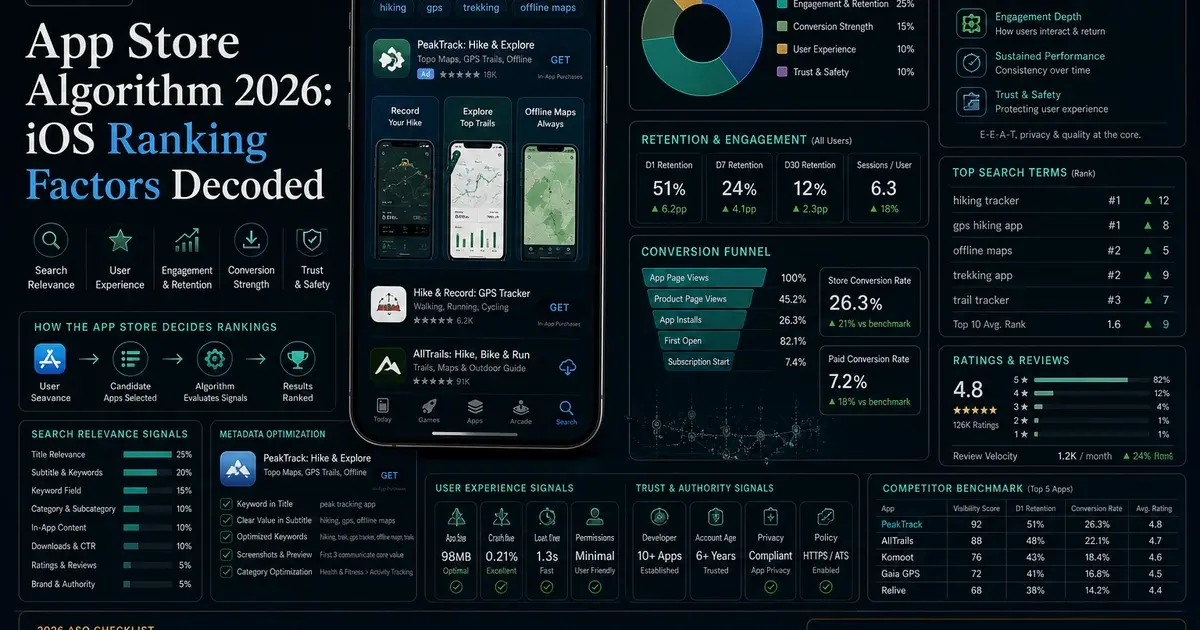
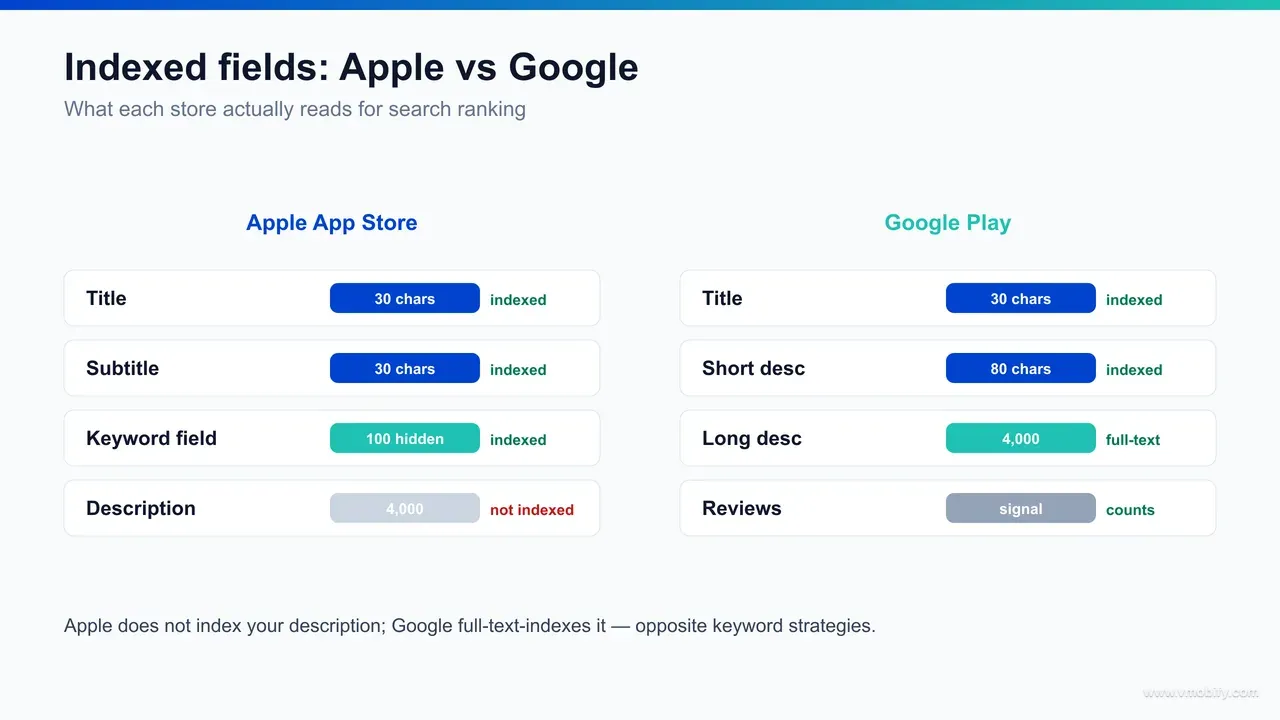
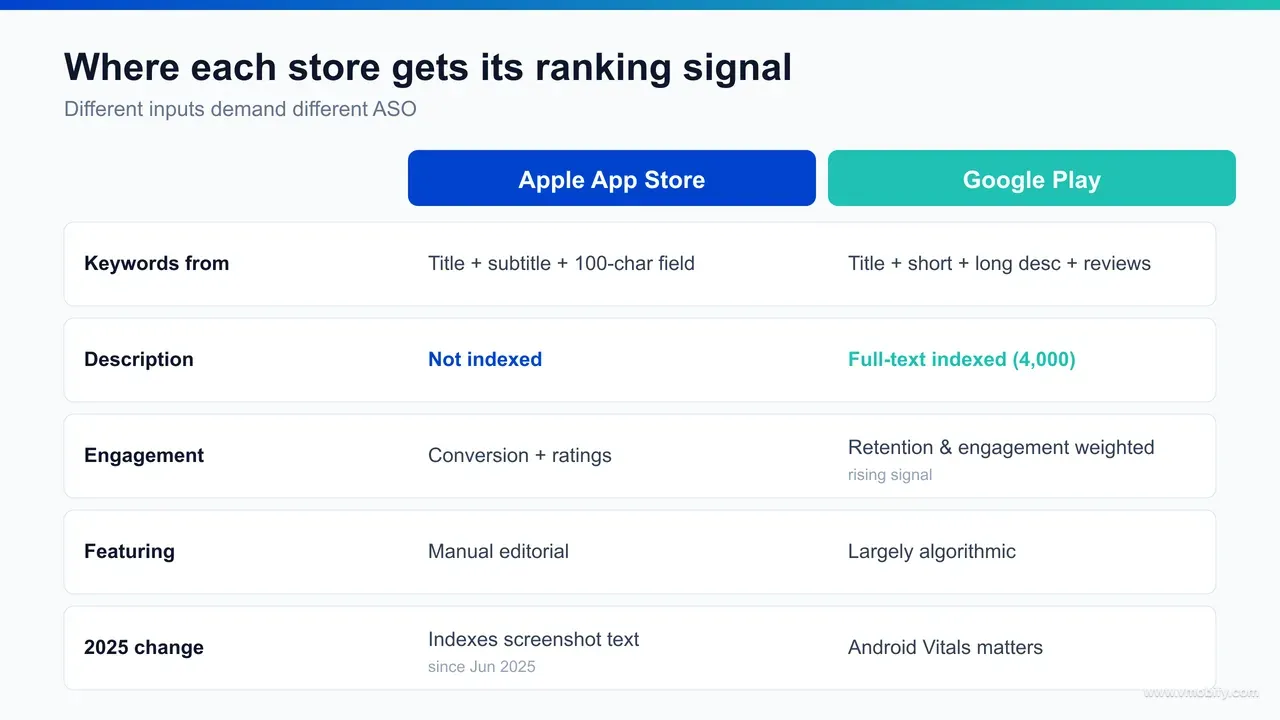
Apple indexes your app Title (30 characters), Subtitle (30 characters) and a hidden 100-character keyword field — and, since mid-2025, the text inside your screenshots — but it does not index your description, your promotional text, or your developer name for keyword ranking. The description on the App Store is a conversion asset that the user reads, not a ranking asset the algorithm crawls.
That hidden keyword field is the part most teams coming from a web-SEO background miss. It is a comma-separated, 100-character field, visible only to you in App Store Connect, where you list the terms you want to rank for. Per AppTweak's field-by-field comparison, the indexed Apple surfaces are Title, Subtitle and that keyword field — and crucially, the description is not among them. SplitMetrics' App Store keyword guidance confirms the same structure and stresses using every one of those 100 characters without repeating words across fields.
Because the indexable space is so small — 30 + 30 + 100 characters — Apple ASO is an exercise in ruthless prioritisation. You cannot afford to spend a Title slot on a word already covered by the keyword field, and you should never waste characters on spaces or duplicate terms inside the keyword field. Every character is real estate.
The 2025 addition of screenshot-text indexing widened that space slightly. Apple now reads the caption text rendered on your screenshots, which means the headline overlays you used purely for conversion are now also a discovery surface — a change we cover in detail below. In our portfolio, the listings that benefit most from Apple's model are the ones where the keyword field is treated as a research output, not an afterthought: built from real search-volume data, deduplicated against the Title and Subtitle, and refreshed as ranking data accumulates.
How does Google Play's full-text indexing change your keyword strategy?
Google Play full-text-indexes your long description — up to 4,000 characters — alongside your Title (30 characters) and short description (80 characters), which means keyword placement, repetition and natural phrasing across the whole listing genuinely affect where you rank. This is the mirror image of Apple, and it demands a completely different writing approach.
On Google, there is no hidden keyword field. Per the same AppTweak field comparison cited above, the indexed surfaces are the Title, the short description and the long description — and the long description is treated as crawlable text the way a web page body is. That is why mentioning your most important keyword two to five times across a well-written long description, in natural sentences, is a legitimate ranking tactic on Play and a pointless one on Apple.
The 4,000-character ceiling changes the economics of keyword targeting entirely. Where Apple forces you to choose perhaps a dozen high-value terms within 100 characters, Google gives you room to cover a long tail — your primary keyword, its close variants, the problems your app solves, and the phrases real users type, all in one readable body. The constraint flips from scarcity of space to discipline of prose: write too sparsely and you under-index; write too densely and you trip Google's spam and quality filters and read like a robot to the human who actually has to be convinced. The winning long description threads that needle — it reads naturally to a person while carrying the terms the crawler needs.
The short description deserves a careful, caveated note. A yellowHEAD study of 15 apps across 9 keywords found that short-description keywords ranked 87% of the time. That sounds like a strong ranking signal — but the study itself is explicit that the short description's primary job is conversion, not ranking, and that you should write it for the human reading it rather than stuffing it for the algorithm. So: yes, the short description is indexed and contributes, but treat it first as the 80-character pitch that earns the tap, and only secondarily as a keyword slot.
The strategic takeaway is that Google rewards a different craft. You write a genuinely readable, keyword-aware long description; you front-load your strongest term in the Title and short description for both relevance and conversion; and you avoid keyword stuffing, which Google's quality systems penalise. The skill is closer to on-page SEO than to the constrained keyword-field game Apple makes you play — which is exactly why our full ASO optimisation guide treats Play and Apple metadata as two separate writing disciplines.
Does retention and engagement affect ranking on each store?
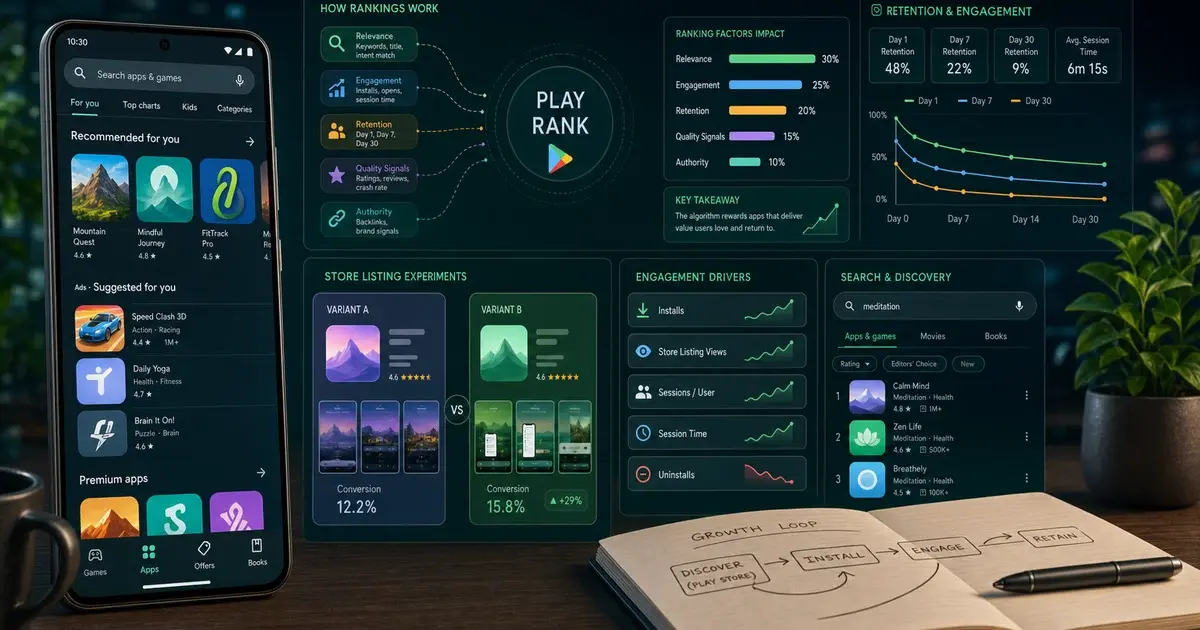
Yes on both, but more visibly and more heavily on Google Play — which weights retention, engagement and technical quality (Android Vitals) as direct ranking inputs, while Apple folds engagement signals in more opaquely behind its keyword-relevance core. The industry-wide direction of travel is unmistakable: ranking has shifted from rewarding raw installs toward rewarding what happens after the install.
Google is the clearer case. Per AppTweak's Google Play ranking-factors analysis, retention, engagement and app quality — including crash rates and ANRs surfaced through Android Vitals — feed into how Play ranks and surfaces apps. A technically healthy app that keeps users coming back is rewarded; a crashy one that bleeds users is suppressed, regardless of how many installs it bought.
The broader shift from an installs-first to a retention-first ranking model is one that ASO analysts at firms like AppTweak and MobileAction have documented across both stores. The reasoning is sound: install velocity is gameable, but sustained retention and engagement are far harder to fake, so the stores increasingly lean on signals that correlate with genuine user value. The honest caveat is that neither store publishes its exact weightings — these are informed reads from ranking-correlation studies, not algorithm source code, and you should treat them as directional rather than precise.
Apple is the murkier case. It clearly weights keyword relevance most heavily, but engagement and retention signals appear to feed in behind the scenes rather than as the named, surfaced metrics Google exposes through Android Vitals. The safe working assumption is that on Apple, strong metadata gets you found and strong post-install behaviour helps you hold the position you earn — but you cannot point to a published Vitals-style dashboard to prove it the way you can on Play.
What this means in practice is that your ASO and your product cannot live in separate silos. We have seen this repeatedly across our portfolio: listings that win the install but lose the user plateau on rank, because the post-install signals quietly drag them back down. The teams that compound their rankings are the ones treating Day-1 and Day-7 retention as ASO metrics, not just product metrics — because on Google especially, they now are. The corollary is that a burst of bought installs with no retention behind them is, at best, a temporary rank spike that decays as soon as the engagement data catches up to the acquisition.
How do featuring and editorial differ between the two stores?
Apple runs a heavily curated, human-led editorial operation — the Today tab and themed stories are hand-picked by Apple's editorial team — while Google Play blends editorial curation with far more algorithmic, personalised merchandising surfaces. Both can drive meaningful install spikes, but you court them in different ways.
- Apple's editorial model: Apple's editors select apps for the Today tab, "App of the Day", and themed collections based on quality, design, timeliness and platform-feature adoption. You influence it by building a genuinely polished app, adopting new iOS capabilities early, and pitching the editorial team through App Store Connect ahead of a launch or major update.
- Google's blended model: Google Play does run editorial selections, but a larger share of what a user sees is personalised and algorithmically merchandised — recommendations driven by the user's history, the app's performance signals, and category context. That makes consistent quality and engagement metrics your route to more surface area, not just an editorial pitch.
- What both reward: technical excellence and active maintenance. A crash-prone or stale app gets neither editorial love nor algorithmic lift on either store.
The tactical difference is where you spend effort. For Apple, an editorial pitch with strong visuals and a clear story can produce an outsized, if temporary, install surge — so it is worth a deliberate outreach motion around launches. For Google, the durable play is feeding the personalisation and quality signals continuously, so the algorithm keeps surfacing you across more of those automated recommendation slots. In our portfolio we plan these as two separate motions, because optimising for an Apple editor and optimising for Google's recommendation engine are genuinely different jobs.
How do app review and rejection rates compare?
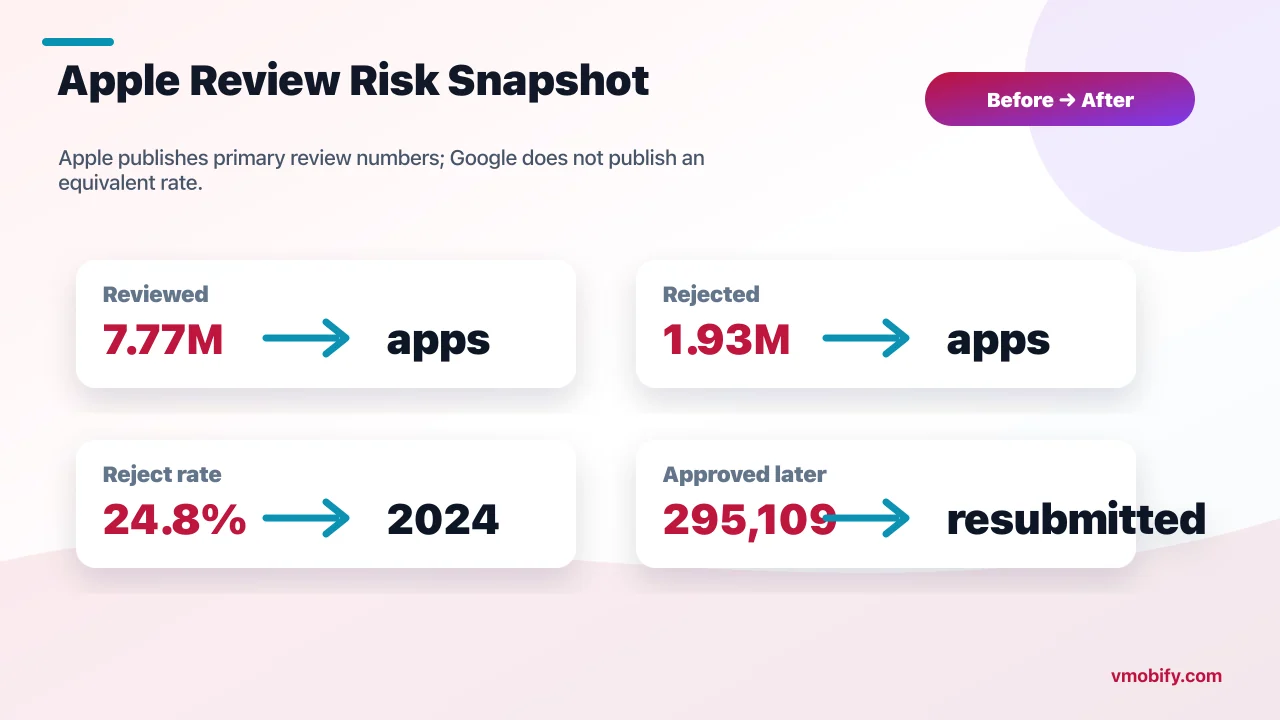
Apple runs a stricter, more consistently enforced review with a primary-sourced 2024 rejection rate of roughly 24.8%, while Google's review is generally faster and lighter — though Google's specific rejection numbers circulate mostly as vendor estimates and should be treated with caution. The gap matters because a rejection is lost launch momentum, and momentum is itself a ranking input.
The Apple figure is unusually well documented. Apple's own 2024 App Store Transparency Report states that of 7.77 million app submissions reviewed, 1.93 million were rejected — about a 24.8% rejection rate — with 295,109 of those later approved on resubmission. This is the number to plan against; you will see vendor blogs quote "~40%", but that is an estimate and not what Apple's own data shows.
Google's review is widely regarded as faster and less likely to bounce a submission on subjective grounds, but here we have to be honest about the evidence: Google does not publish an equivalent transparency report with a clean rejection rate, so any specific Google rejection percentage you encounter is a third-party estimate rather than a primary figure. State it as such, plan for Google to be the lighter-touch review, and do not anchor decisions on a number Google itself has not confirmed.
The operational lesson is the same one we give every client: budget for an Apple rejection. With roughly a quarter of submissions bounced, a first-pass rejection on iOS is a normal event, not a crisis — but only if your release calendar has the slack to fix and resubmit without missing the launch window you have been building install velocity toward. The common triggers are metadata and privacy mismatches, incomplete information, and design or guideline edge cases — most of which a careful pre-submission review catches before Apple does, turning a multi-day rejection loop into a clean first pass.
What changed in the store algorithms in 2025-2026?
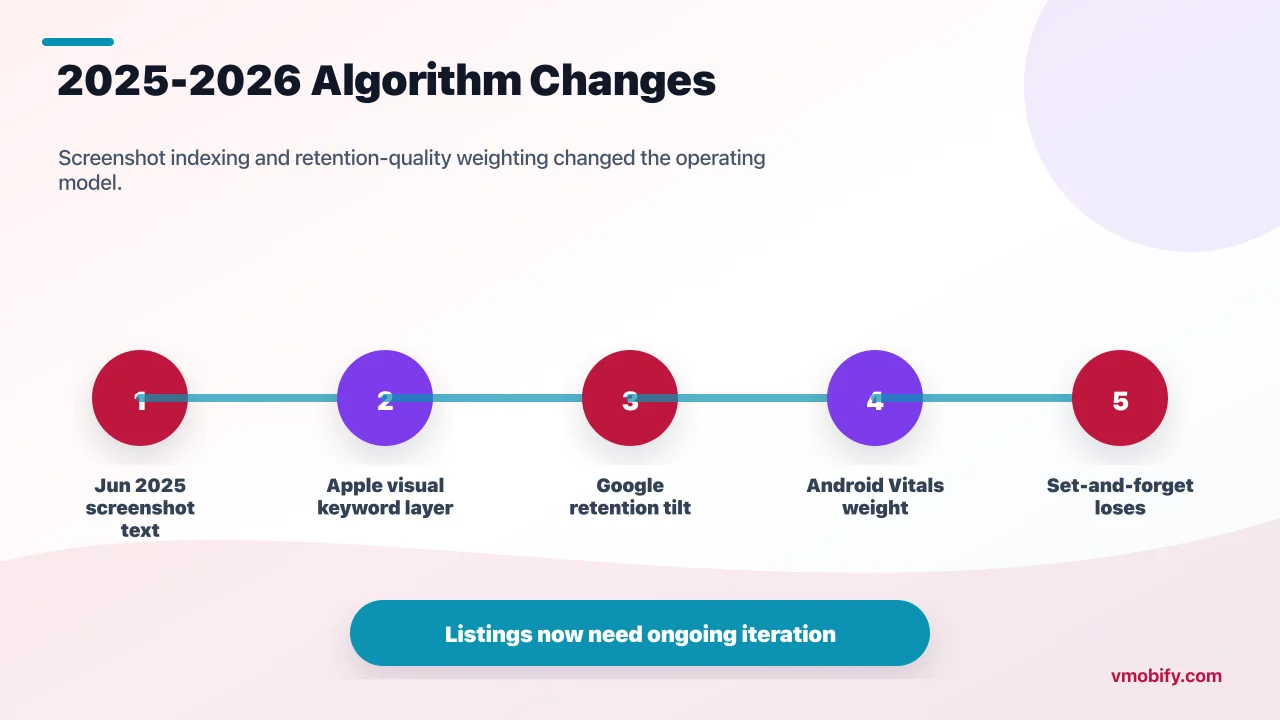
The most consequential recent change is that Apple began indexing the text inside your screenshots around mid-June 2025 — turning screenshot captions into a genuine keyword surface — while Google continued to lean further into retention, engagement and quality signals over raw install volume. Both shifts reward teams that keep their ASO current rather than set-and-forget.
On the Apple side, Appfigures documented the 2025 algorithm update in which the App Store started reading and indexing the caption text rendered on screenshots — a change observed from roughly 16 June 2025. The practical effect is meaningful: the punchy headlines you write across your screenshot set, which previously did only conversion work, now also contribute to what you can rank for. That makes screenshot caption copy a place to deliberately place secondary keywords you could not fit into the 30/30/100 character budget elsewhere.
This does not mean stuffing your screenshots with keywords — they still have to convert a human scanning your product page in two seconds. But it does mean the words on your screenshots are no longer purely creative; they are now part of your indexed footprint, and they should be chosen with both jobs in mind.
On Google's side, the trajectory is continuity rather than a single dramatic event: a steady tilt toward retention, engagement and Android Vitals as ranking inputs, reinforcing the installs-to-retention shift that ASO analysts have tracked across the industry. The combined message for 2026 is that both algorithms are rewarding quality and active optimisation more than ever — the listings that drift untouched for a year are the ones that quietly lose ground.
Can you reuse one ASO strategy across both stores?
No — and trying to is one of the most expensive mistakes in ASO, because the two stores index opposite fields and reward opposite writing styles, so a single shared metadata set will always underperform on at least one of them. You need one shared keyword research foundation and two distinct execution playbooks.
Here is the split that actually works in practice:
- Shared: your keyword research, your competitive set, your conversion creative principles and your retention work. These translate across both stores — do them once, well.
- Apple-specific: a tightly prioritised Title and Subtitle, a fully used 100-character keyword field with zero duplication, no keywords wasted in the description (it is not indexed), and screenshot captions now chosen partly for the terms they let you rank for.
- Google-specific: a keyword-aware long description written as readable prose with natural repetition, a short description optimised first for conversion and second for its indexed keywords, and a sustained focus on engagement and Android Vitals because Google ranks on them.
The error we see most often — and inherit most often — is the team that researches keywords once and then pastes the identical Title, subtitle/short description and description into both stores. It feels efficient. It quietly costs rankings on both: the keywords meant for Apple's hidden field end up buried in a Google long description where they help only Google, and the long-form keyword density Google rewards never gets written because the team optimised for Apple's character ceiling.
The bottom line: build one keyword foundation, then split into two store-native executions. If you want that done properly — research once, optimise twice, and measure each store on its own signals — that is exactly the work our ASO team runs every day. You can talk to us about your specific listing, and we will show you which store you are currently leaving rankings on.
Frequently Asked Questions
Does Apple index the app description for ranking?+
No. The Apple App Store does not index your description, promotional text or developer name for keyword ranking. The description is a conversion asset the user reads; Apple ranks on the Title, Subtitle and the hidden 100-character keyword field, plus screenshot caption text since mid-2025.
How many characters is Apple's keyword field?+
Apple's hidden keyword field is 100 characters. It is comma-separated, visible only in App Store Connect, and you should use every character without repeating words that already appear in your Title or Subtitle.
Does Google Play index the full long description?+
Yes. Google Play full-text-indexes the long description, up to 4,000 characters, alongside the Title (30 characters) and short description (80 characters). Natural keyword placement and modest repetition across the long description genuinely affect ranking.
Should I put keywords in the Google Play short description?+
Yes, but write it for conversion first. A yellowHEAD study of 15 apps found short-description keywords ranked 87% of the time, yet the study stresses the short description mainly drives conversion, not rankings — so treat it as your 80-character pitch first and a keyword slot second.
Does the Apple App Store read text inside my screenshots now?+
Yes. Apple began indexing screenshot caption text around 16 June 2025, so the headlines on your screenshots are now a keyword surface as well as a conversion one. Choose them for both jobs without compromising readability.
What are Apple's and Google's app rejection rates?+
Apple's 2024 Transparency Report shows 7.77 million submissions reviewed and 1.93 million rejected — roughly 24.8%. Google does not publish an equivalent figure, so any specific Google rejection rate you see is a vendor estimate rather than a primary number.
Can I use the same ASO strategy on both stores?+
No. Share your keyword research and conversion principles, but execute separately: Apple needs a tight Title, Subtitle and 100-character keyword field, while Google needs a keyword-aware 4,000-character long description plus strong retention and Android Vitals signals.
Sources
- AppTweak — Apple App Store vs Google Play differences — Field-by-field indexed-metadata comparison for both stores
- SplitMetrics — App Store keyword optimisation — Structure and best practice for Apple's 100-character keyword field
- yellowHEAD — Google Play short description study — 15-app study; short-description keywords ranked 87%, with the conversion-not-ranking caveat
- Apple — 2024 App Store Transparency Report (PDF) — Primary data: 7.77M reviewed, 1.93M rejected (~24.8%)
- MacRumors — App Store 2024 Transparency Report — Breakdown of the primary review and rejection figures
- Appfigures — App Store algorithm update 2025 — Apple began indexing screenshot caption text from ~16 June 2025
- AppTweak — Google Play ranking factors — Retention, engagement and Android Vitals as Google ranking inputs
About the author
Amol Pomane — Founder, Vmobify
Amol leads Vmobify, a mobile app growth agency that has driven 30M+ downloads and ranked 54K+ keywords across 300+ apps since 2013. He writes about ASO, paid user acquisition, retention, and the operational reality of scaling mobile apps in India and global markets.
Check your store metadata
Run your current App Store or Play metadata through the free checker.
Open free tool